
WeChat did not win because it had mini-programs. It won because it already had 1.4 billion daily users, a payment rail, and an identity layer — and then bolted mini-programs onto all three. Plenty of companies look at that and decide the lesson is "add a mini-app button." It isn't. Hosting a mini-program ecosystem is a different job from running one, and most platforms that could host one don't.
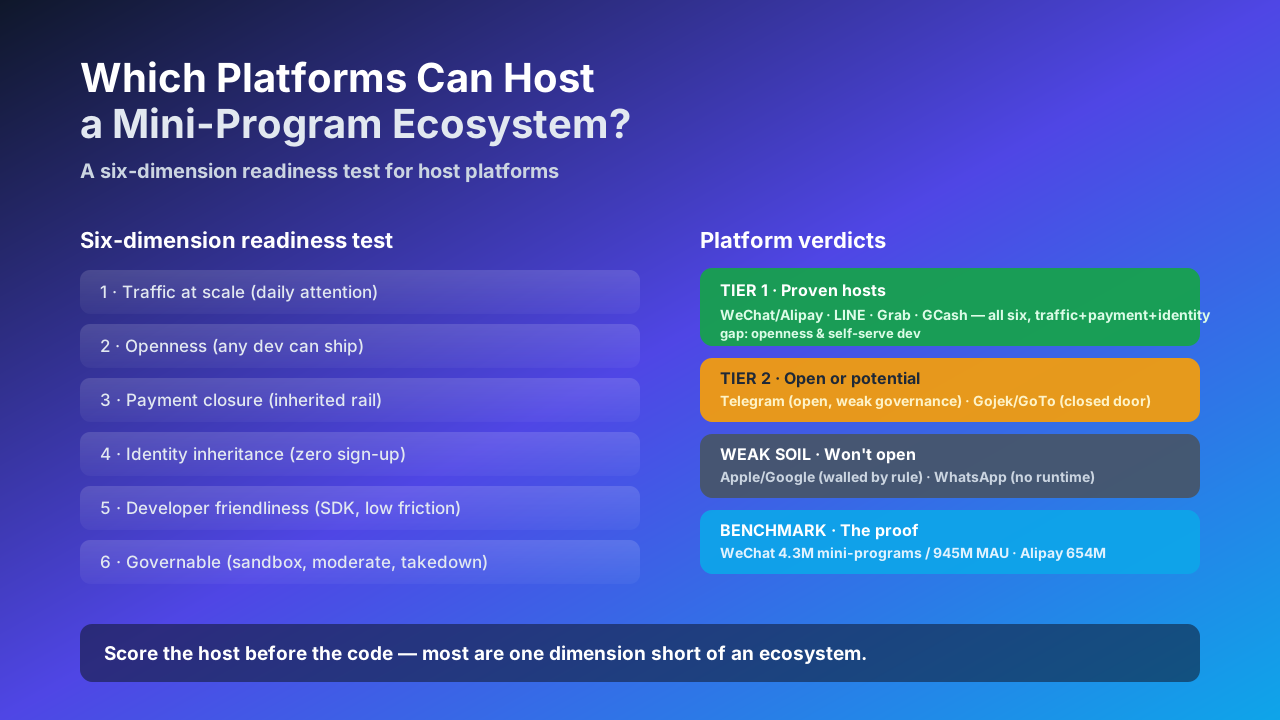
So before you tell your board "let's build a mini-program platform," run this six-dimension readiness test on the host.
The six-dimension readiness test (for host platforms)
1. Traffic at scale. Not sign-ups — daily attention a developer can borrow. A host with 50 million dormant accounts is worse than one with 5 million people who open it ten times a day.
2. Openness. Can any developer sign up and ship, or is it a curated list of hand-picked partners? Openness is what turns a feature into an ecosystem.
3. Payment closure. Does the host own a payment rail the mini-app inherits, or does the developer have to bring their own checkout? No inherited payment means the "mini-program" is just a webpage with extra steps.
4. Identity inheritance. Are users already logged in, so a mini-app opens with zero sign-up? Ask a user to register again and you have lost them.
5. Developer friendliness. Docs, SDK, review friction. A mini-program you cannot build in a week is not a mini-program.
6. Governable. Can the host sandbox, moderate, and take down bad actors? An open runtime with no governance is a liability wearing a platform's clothes.
Here is how the real platforms score.
The scorecard
Legend: S = Strong · P = Partial · W = Weak
| Platform | Traffic | Openness | Payment | Identity | Dev ease | Governance | Verdict |
|---|---|---|---|---|---|---|---|
| WeChat / Alipay | S | S | S | S | S | S | Benchmark |
| LINE Mini App | S | P | S | S | P | S | Tier 1 |
| Grab Partner Apps | S | P | S | S | W | S | Tier 1 (new) |
| GCash GLife | S | P | S | S | W | S | Tier 1 (PH) |
| Telegram Mini Apps | S | S | P | S | S | W | Tier 2 |
| Gojek / GoTo | S | W | S | P | W | S | Tier 2 |
| Apple / Google | S | W | S | S | W | S | Weak soil |
| S | W | P | P | W | S | Weak soil |
What the scores actually mean
The benchmark is brutal. WeChat runs 4.3 million mini-programs for 945 million monthly users; Alipay's mini-program surface alone reaches 654 million. They are not the competition — they are the proof that all six dimensions have to be present at once. Miss one and you get a feature, not an ecosystem.
Tier 1 is real but younger than it looks. LINE Mini App crossed 33,000 mini apps in Japan by March 2026 on the back of 94 million domestic users, and opened digital-content in-app purchases in April 2026 — but openness is still curated. Grab's Partner Apps launched in October 2025 reaching 46 million monthly transacting users across eight countries with GrabPay baked in, yet there is no public self-serve SDK; you still negotiate with Grab. GCash's GLife hosts 1,000-plus merchant mini-apps inside an 81-million-user wallet, but it is a curated marketplace, not an open dev platform. These hosts clear the bar on traffic, payment, and identity — the gap is openness and developer self-service.
Tier 2 is the interesting one. Telegram Mini Apps are the most open runtime on the list: anyone can build, no review, 5,500-plus active apps and around 144 million mini-app users as of late 2025. The catch is governance. After the tap-to-earn hype peaked at 1.44 billion monthly acts in 2024, durable usage settled near 150–190 million — and the content skews crypto and games, with moderation that is hard to police across jurisdictions. Gojek and GoTo are the opposite problem: a massive Indonesian host (66 million annual transacting users, GoPay at 85 million monthly) with a real payment rail, but no open mini-app platform for third parties yet. Huge potential, closed door.
Weak soil is weak for a reason. Apple and Google have the traffic, payment, and identity — and deliberately wall it off; their rules block third-party mini-app runtimes by design. WhatsApp has 2 billion users and almost no runtime to lend them. Do not build a mini-program strategy that depends on either opening up. They won't.
The CrossMiniApp angle
CrossMiniApp is a universal runtime plus an open catalog. You build the mini-program once and it runs inside WeChat, LINE, Grab, GCash, and Telegram — inheriting each host's identity and payment, sandboxed and governable, updatable over the air. The scorecard above is precisely why that matters: the hosts that clear all six dimensions are fragmented and partly closed, so the value is in the layer that lets one build reach all of them without renegotiating each wall.
The rule
A mini-program ecosystem is not a button you add. It is six things a host has to already be. Score the host before you write the code — most of them are one or two dimensions short of an ecosystem, and a feature dressed as a platform is the most expensive mistake in this market.
Sources
- Grab launches Partner Apps within the Grab app — Grab press
- LINE Mini App surpasses 33,000 apps, 29M MAU — LY Corp release
- Telegram Mini Apps ecosystem statistics — Axis Intelligence (FindMini.app)
- GCash GLife and the Mynt ecosystem — Globe Q1 2025 results
- WeChat Mini Programs: 4.3M registered, 945M MAU — Review42