In 2023, a single compromised advertising SDK — SpinOK — quietly siphoned user data from 101 Android apps, some with millions of downloads, all still sitting on Google Play. The developers had done nothing wrong except trust a remote dependency they could not see at runtime.
The headline-grabbing version is a malicious SDK. The everyday version is quieter, and it is sitting inside your own app: the core journeys — login, payment, profile — rendered inside a WebView that loads documents from your own server.
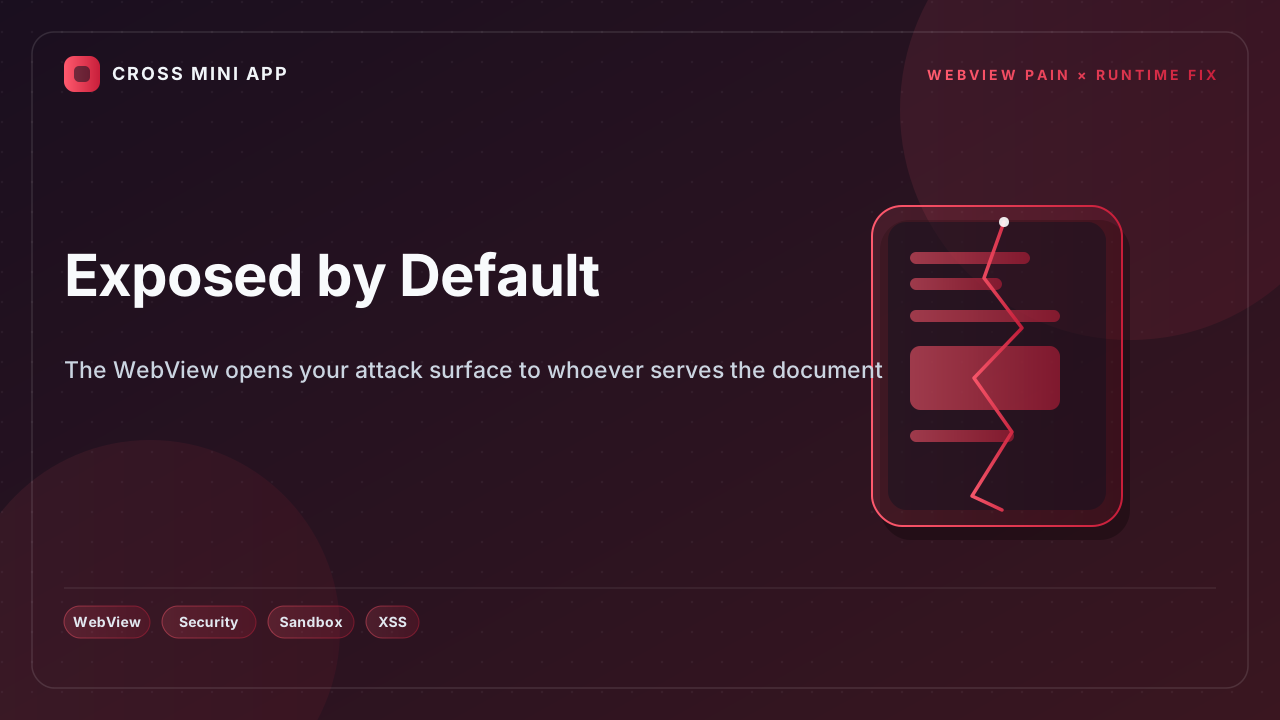
You think you control it. You shipped the app. But the moment a flow runs as remote HTML in a WebView, you have handed part of your security boundary to whoever serves that document tonight.
The WebView is not a sandbox you own
A WebView is a browser engine embedded in your app. When it loads a remote page, that page behaves like a web page. If you enabled JavaScript bridges, file access, or mixed content to make the integration work, an attacker who compromises the page — or the CDN in front of it — can pivot from web content straight into native app functions.
This is not theoretical. OWASP's Mobile Top 10 (2024) lists «Improper Platform Usage» as the top risk, and its WebView entry is explicit: WebView misconfiguration can expose native features to remote content. JavaScript enabled without strict origin controls is the classic pivot. The page you trusted becomes the page that reaches your user's token, their contacts, their wallet.
You inherit the web's entire supply chain
The deeper problem is what the remote page pulls in. Every analytics script, every CDN asset, every third-party SDK embedded in that HTML is now your attack surface — and you do not govern any of it.
OWASP added «Inadequate Supply Chain Security» as the #2 mobile risk in its 2024 revision, for good reason. The numbers are brutal:
- 91% of organizations faced a software supply chain attack in 2024.
- 85% of mobile apps contain security or privacy vulnerabilities, most traced to third-party components.
- A 2024 academic study of 158 widely used Android SDKs found 338 instances of privacy data exfiltration, and 88% falsely claimed the sensitive access they actually used.
When your payment screen is a remote web page, you have imported that entire liability. A vulnerable script in your checkout flow is your breach, not the vendor's headline.
Where the boundary actually breaks
| Dimension | Core flow in a WebView | Core flow in a host-owned runtime |
|---|---|---|
| Content origin | Remote server, mutable anytime | Signed package from a controlled catalog |
| Privilege boundary | Remote page shares WebView caps (JS-bridge pivot risk) | Capability allowlist, least privilege by default |
| Supply-chain exposure | Every embedded script, CDN, and SDK | Curated, vetted catalog of components |
| App-level controls | Store review and cert pinning never see the remote HTML | Same signing and security model as native code |
| Incident response | Wait for the CDN or third party to patch | Instant kill-switch or version rollback |
The controls you paid for don't reach the remote page
Here is the part teams miss. The app-level security you invested in — certificate pinning, code signing, store review, runtime permission scoping — stops at the WebView's edge. The remote HTML was not in your build, was not signed by you, and was never reviewed by the store. App-store approval is a distribution checkpoint, not a security boundary.
So a flow that looks like it is "inside your app" is, for security purposes, running outside every control you built.
And the cost of getting this wrong is not abstract. IBM's 2025 Cost of a Data Breach report puts the global average breach at $4.44 million (the U.S. average hit a record $10.22 million), with nearly every victim suffering operational disruption and most taking over 100 days to recover. A stolen session token from a WebView XSS is often the front door.
A host-owned runtime closes the door
The alternative is to stop renting your security boundary from a remote document. A host-owned runtime runs mini programs as first-party, sandboxed, signed components drawn from a controlled catalog:
- Origin you control. Content is a signed package, not a mutable page fetched over the network tonight.
- Capability scoping. The runtime grants only the permissions a component declares — least privilege by default, no silent JS-bridge escape hatch.
- Curated supply chain. Components come from a vetted catalog, not whatever script tag the remote page decides to load.
- Instant response. A bad component gets a kill-switch or version rollback in minutes, not a wait for a third party to patch.
You keep the web's delivery speed without outsourcing your threat model to strangers.
The bottom line
H5 dependence is sold as convenience: ship once, update from the server, skip the store review. But every time you render a core flow as remote HTML in a WebView, you trade a controlled boundary for an open one. The compliance opacity we wrote about earlier is only half the story. The other half is that the attack surface is now owned by whoever serves the document — and you will not know until the token walks out.
A universal runtime with an open, governed catalog lets you keep the speed and take the boundary back.