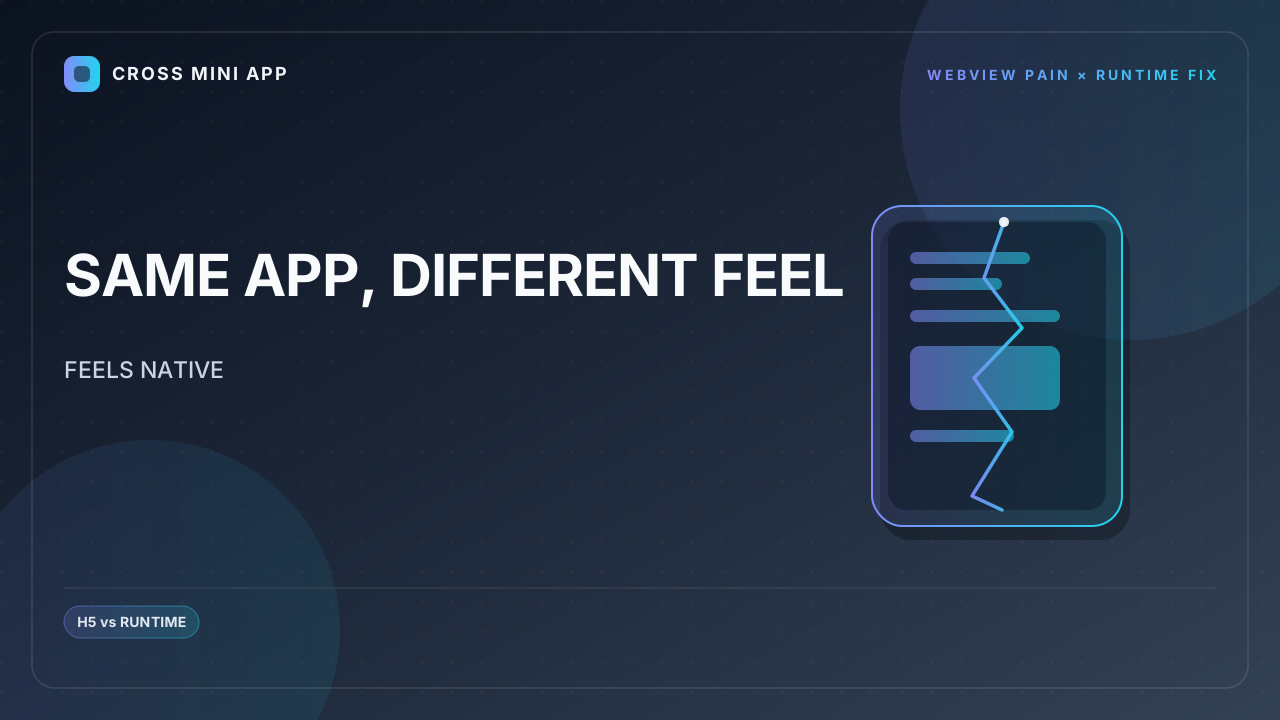
There's a specific kind of disappointment that's hard to name. A user opens your app, taps a «top up», «ride», or «insurance» entry, and lands on a page that clearly wasn't built by your team. The font is off. The scroll stutters. A button does nothing for a second, then the page reloads. They have to log in again, to a service they don't recognize. Nothing crashes. Nothing errors. But something trust-adjacent just broke, and you'll never see it in your crash logs.
I've watched this pattern for the better part of a decade, across finance, ride-hailing, and content apps. Teams obsess over the native shell and then hand the actual service — the thing that makes money — to an embedded web page. The result reads as «someone else's product,» and the user can't always tell where your app ends and the other party begins. The cost lands in conversion and retention, not in uptime.
The gap isn't one gap. It's three, and they stack.
Where the seam shows
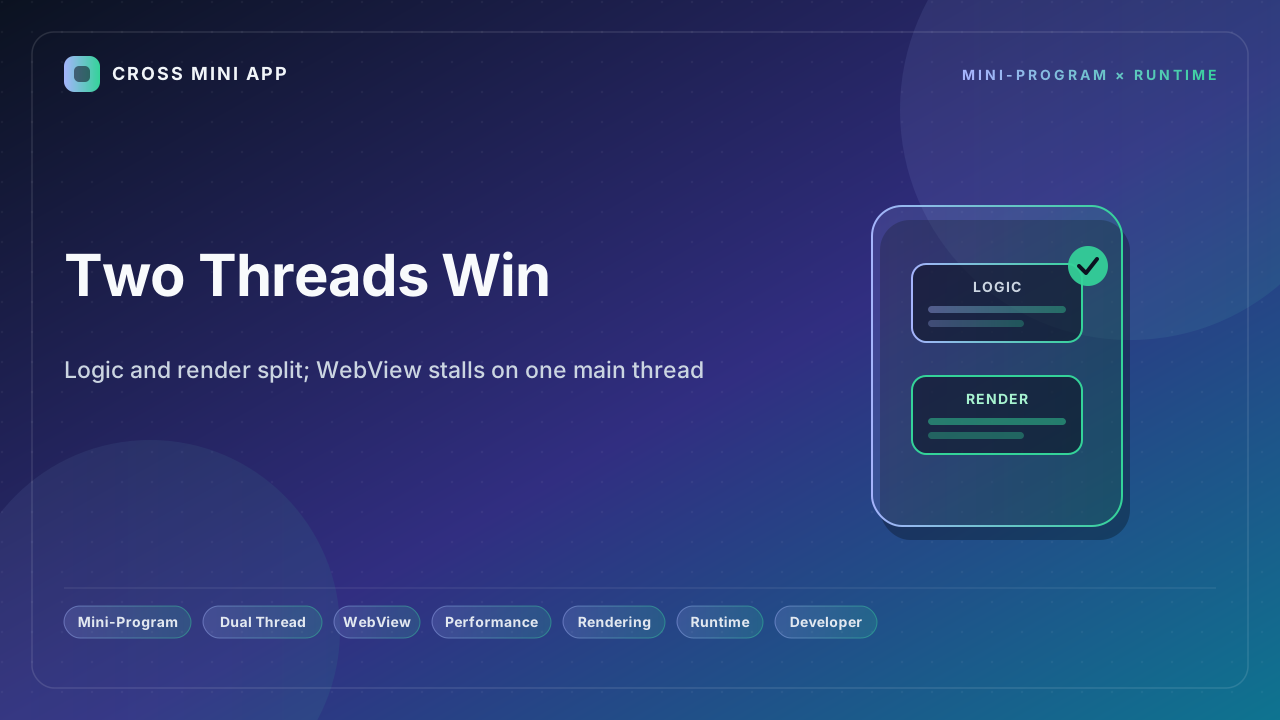
Rendering. An H5 page inside a webview renders with its own CSS, its own fonts, its own grid — a second design language living inside your first. The user feels the seam even if they can't name it. A webview is a browser engine; it does not inherit your native component system, your typography, or your motion. The page is correct, and it is also obviously not yours.
Loading. H5's first paint depends on the network. There is no preload, no pre-fetch of the bundle the way a runtime packages and stages assets ahead of the tap. This matters because speed is not a convenience metric — it's a funnel. Google's own benchmark found that 53% of mobile site visits are abandoned when a page takes longer than three seconds to load, and Core Web Vitals (LCP for paint, INP for responsiveness) have become the industry's shared definition of «usable.» A webview page often measures worse than a real browser tab: no site-isolation caching, no optimizations the host applied to its own chrome, and a cold start that's pure network.
Capability. When the service needs the camera, location, or a biometric prompt, H5 reaches across a JS bridge into a browser security model that was never designed for it. Some calls are unreliable; many trigger an extra permission dialog that reads as a warning. The flow breaks its own rhythm. A host-owned runtime exposes these through vetted, graded APIs, so the same action is a native call, not a negotiation.
Side by side
| Dimension | Embedded H5 (WebView) | Mini-program runtime (host-owned) |
|---|---|---|
| Rendering consistency | Its own styles, visibly separate | Native components, one design language |
| First paint | Network-bound, spins often | Preloaded, near-native |
| Native capability | Bridge-limited, extra dialogs | Vetted APIs, native-ready |
| Sign-in | Re-log in to a third party | One host sign-in |
| Trust signal | Reads as external link | Sandboxed, host-endorsed |
| Brand ownership | Feels like «theirs» | Feels like yours |
The damage is partly reputational. When the embedded page stutters or asks for a re-login, users rarely blame the third party. They blame your app. The one-star review says «this app is buggy,» not «this embedded service is buggy.» You carry the brand risk for an experience you didn't build and can't fully fix.
A runtime closes the seam from the other direction. Services render with native components and a shared design language, so they look — and behave — like part of your product. Assets are staged before the tap, so first paint doesn't wait on the network. Capabilities are host-provided, so the camera opens like it does everywhere else in your app. And because the runtime is sandboxed and host-endorsed, the user's instinct is «this is part of the app,» which is exactly the instinct you want.
I'd add the honest caveat. A runtime is not a miracle cure for a bad product. Its native components come with constraints — you don't get to drop in any arbitrary web library — and the sandbox that buys trust is, by definition, a set of limits. What the runtime actually does is remove the experience tax you were paying at the door: it stops you from losing the user at the moment they tap, before your service even got a chance to prove itself.
That's the quieter argument for runtime. Not «build a super-app.» Just: don't let the most important screen in your app look like it belongs to someone else.