
Ask a street vendor in CDMX how they get paid and the answer is often a QR taped to the counter — pulled up from a phone, settled through SPEI, no bank branch involved. Mexico is the underbanked opportunity: nearly half the population has no traditional account, but the rails to serve them already exist. That is why the country is such natural soil for mini-programs — the people who need lightweight access the most are exactly the ones a native app install wall excludes.
The opportunity is not another banking app nobody will download. It is a lightweight program that opens inside Mercado Pago or a messaging app, already able to pay through SPEI — and reaches the unbanked without forcing them through an onboarding maze.
The six dimensions, scored on Mexican ground
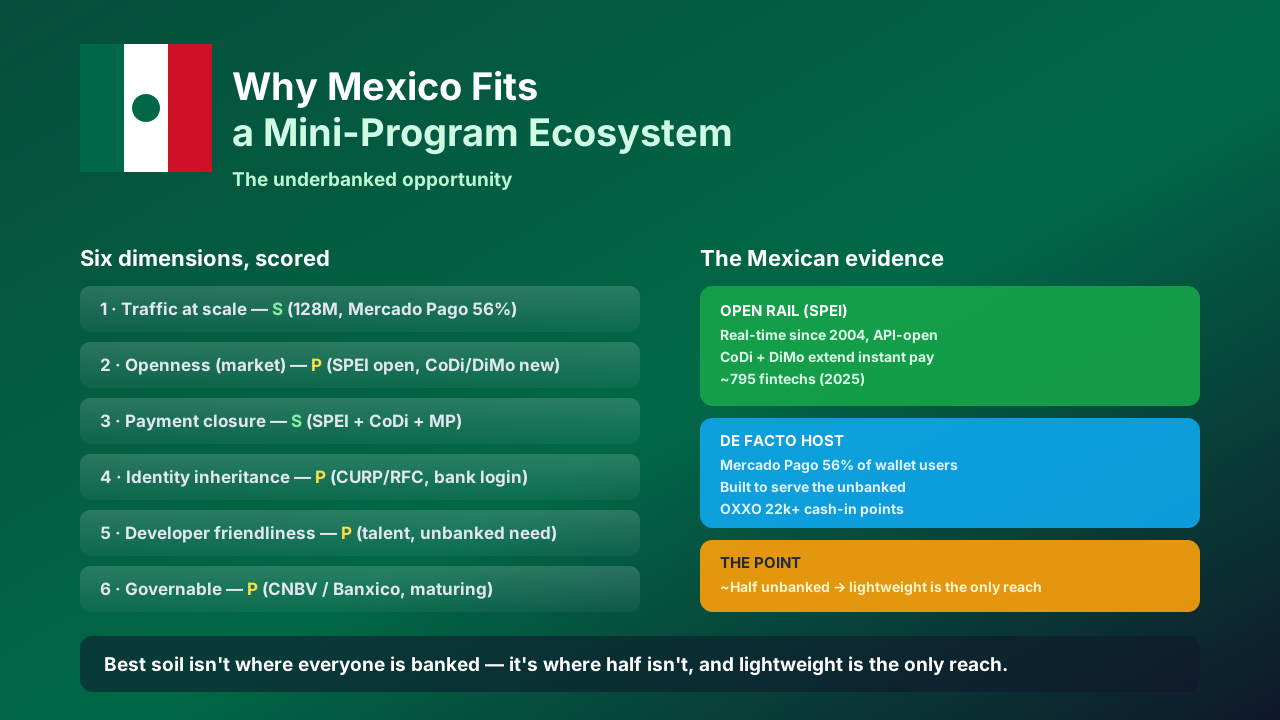
1. Traffic at scale. Mexico has 128 million people, a young median age, and high smartphone penetration. Mercado Pago alone reaches 56% of wallet users and is built to serve the unbanked. This is a large, daily-attention market.
2. Openness, at the market level. SPEI, the real-time rail run by Banco de México, has been open via API since 2004, and CoDi plus the new DiMo scheme extend instant, interoperable payment. The rail is open in principle — though adoption by smaller players is still maturing.
3. Payment closure. A mini-program inherits SPEI plus CoDi and Mercado Pago, all real-time and low-cost. With around 795 fintechs in 2025, the settlement plumbing is already widely available.
4. Identity inheritance. This is the moderate link. CURP and RFC exist as national identifiers, but mini-app login still leans on wallet or bank credentials rather than a single universal handoff. Workable, not yet WeChat-class.
5. Developer friendliness. A strong Spanish-speaking engineering community and a dense fintech scene make builds cheap. App-fatigue and low native-install tolerance among the unbanked make lightweight distribution the obviously right call.
6. Governable. CNBV and Banco de México regulate e-money and instant payments, with KYC and consumer protection enforced — a younger but rapidly maturing framework.
| Dimension | Score | Mexican evidence |
|---|---|---|
| Traffic | S | 128M people, Mercado Pago 56% wallet |
| Openness | P | SPEI open API, CoDi/DiMo emerging |
| Payment | S | SPEI + CoDi + Mercado Pago |
| Identity | P | CURP/RFC, wallet/bank login |
| Developer ease | P | Strong talent, unbanked need |
| Governance | P | CNBV / Banxico, maturing |
Why the unbanked angle is the whole point
Roughly half of Mexicans have no traditional bank account. A mini-program that opens inside a wallet they already use and settles through SPEI is the cheapest path to financial access — no branch, no native-app install, no onboarding maze. Closed hosts plus an open rail make that the obvious place for a universal runtime to win.
The CrossMiniApp angle
CrossMiniApp is a universal runtime plus an open catalog. You build the mini-program once and it runs inside Mercado Pago and the wallet surfaces — inheriting each host's identity and payment, sandboxed and governable, updatable over the air. Mexico's underbanked structure is the argument: the rail is open, the people are ready, and the value is in a runtime that reaches them without the native-app wall.
The rule
The best mini-program soil is not where everyone is already banked. It is where half the market isn't — and a lightweight program is the only thing that will reach them.