

GovTech in Your Pocket: Why Government Services Belong Inside a Trusted Host
Nations like India, Singapore, and Estonia proved national digital platforms work. The next unit of public service is the governed mini-program that lands inside the super-app, messenger, or bank a citizen already trusts.
Cross Mini App Team
August 8, 2026 · 4 min read
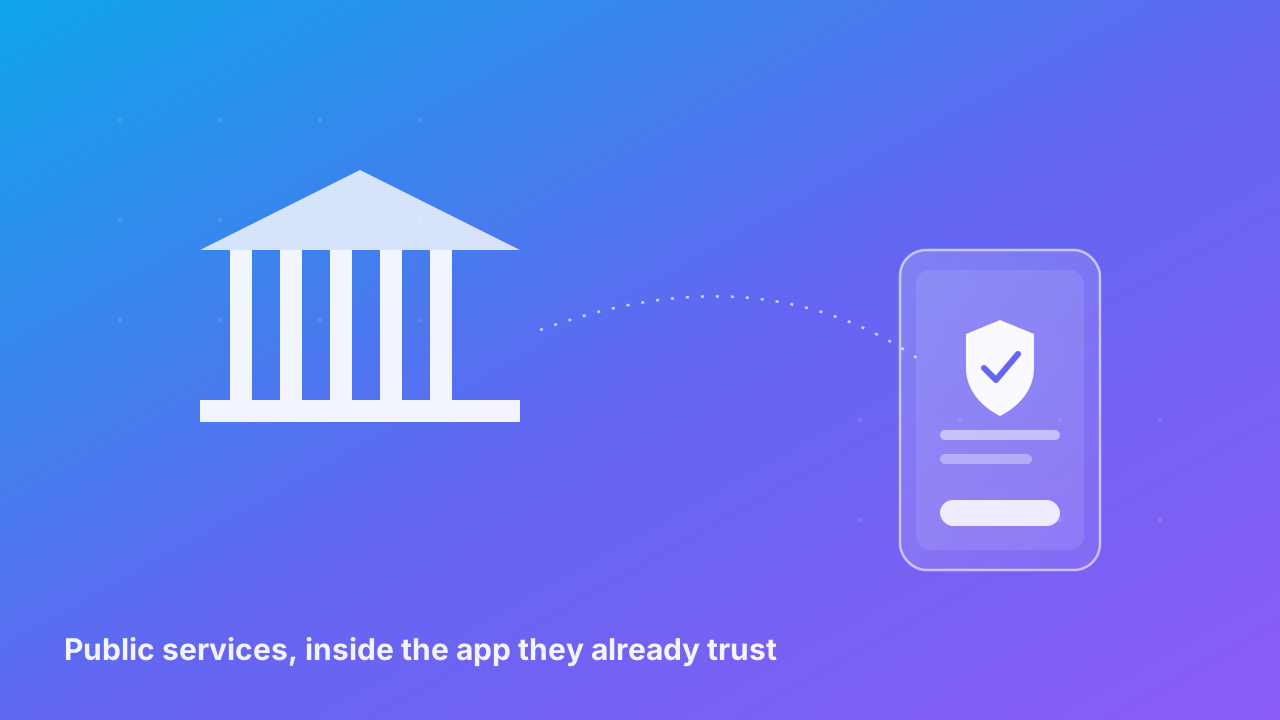
Governments built apps. Citizens live in hosts.
For a decade, public-sector digital transformation meant one thing: build an app. A tax app. A benefits app. A health app. A transit app. Each agency shipped its own silo, with its own login, its own KYC, and its own update cycle. Meanwhile, the citizen's actual digital life moved somewhere else entirely — into a super-app, a messenger, a wallet, a bank, a telecom portal. The lesson of the 2020s is that distribution and trust already live in the host. The question for GovTech is no longer "should we build an app?" but "how do we arrive inside the surface our users already trust?"
National platforms proved the model — at national scale
Three states showed what a real digital-public-infrastructure layer looks like, and each is now a global reference:
- India — DigiLocker. Launched in July 2015, DigiLocker passed 434.5 million registered users (43.49 crore) by December 2024, with 9.41 billion documents issued across 2,300+ issuer organizations — road transport, education boards, UIDAI, and state governments. The World Bank's 2023 GovTech report cites it as a global reference for digital-trust architecture. It works precisely because it is a governed layer sitting on top of an existing identity (Aadhaar) and consumed inside other apps, not a destination users must open first.
- Singapore — Singpass. More than 4.2 million app users tap 2,700+ services from 800+ government agencies and businesses, generating 41 million+ transactions a month and covering roughly 97% of residents aged 15+. MyInfo alone clears 200,000+ transactions a day and has cut application times by up to 80%. Critically, Singpass is embedded: OCBC bank, insurers like Income and Great Eastern, and even the Carousell resale platform use it for login and verification. A public identity layer, consumed inside private apps.
- Estonia — e-Estonia. 99–100% of public services are available 24/7 online over the X-Road data-exchange layer; digital signatures save the economy about 2% of GDP every year; the UN's 2024 E-Government Development Index ranks Estonia 2nd in the world (EGDI 0.9727), behind only Denmark. After the 2007 cyberattack the country added KSI blockchain notarization and later launched an e-Residency digital-citizen program and a unified State App.
The wall that remains
These wins are real — and they are national. They reach a country's own residents through a country's own stack. The moment you cross a border, or serve a sub-national jurisdiction, a diaspora, or a citizen who never downloaded the national app, the silo returns. A municipal service, a regional benefit, a consular form, a cross-border student permit — each still faces the "another app nobody installs" problem. Even inside a single country, the average resident will not keep a half-dozen government apps on a cheap Android with limited storage.
The mini-program as the public-service unit
The fix is the same unit China scaled for commerce and the one super-apps proved for daily life: the governed mini-program. Instead of asking citizens to install a new government app, the public service is shipped as a bounded, sandboxed, compliant mini-program that drops into a host the citizen already trusts — a messenger, a bank, a telco, a municipal portal.
Three reasons this wins:
- The host already owns trust and identity. Login, KYC, consent, and accessibility travel with the surface. The government service inherits them instead of re-building them.
- Distribution is free. No home-screen slot to win, no app-store review to wait on, no install funnel to lose users in. The service appears where the citizen already is.
- Compliance is explicit. A sandboxed mini-program with audited scope and consent flows is exactly the unit a bank, a super-app, or a carrier will accept across jurisdictions — far safer than handing a third party a full native app with deep device access.
What this means for public-sector builders
If your 2026 roadmap assumes citizens will find, install, and log into "your" government app, reconsider:
- Meet residents inside the host they already trust — a super-app, a messenger, a bank, an e-wallet — rather than competing for a home screen they will not give a public agency.
- Ship a bounded, governed unit hosts will embed. A sandboxed, compliant mini-program — not a full native app — is the unit a Grab, a GCash, or a municipal portal will actually accept across jurisdictions.
- Design for low-bandwidth, low-storage, multilingual reality. The next hundred million citizens are on cheap Android with patchy data. Lightweight, instant, localized experiences are the only ones that reach them.
Where Cross Mini App fits
Cross Mini App is the runtime and the open catalog for the post-install era of public services. You build a governed public-service mini-program once and drop it into every trusted host — a super-app, a wallet, an airline, a consular or municipal portal. Pre-compliant, sandboxed, and localized, these experiences reach citizens without asking them to install anything new. Hosts get vetted services they can embed in a single line; governments stop rebuilding per store and per country; citizens get identity, benefits, and permits inside the app already open. For government — where identity, consent, and local regulation make sandboxing non-negotiable — a governed cross-app runtime is the only safe unit to distribute at scale.
The future of GovTech is embedded, not installed
For twenty years the default was "build a government app, localize it, ship it to every store." In 2026 the growth is on the in-app surface, delivered as a governed mini-program through a cross-app runtime. Cross Mini App is building the shelf so the next public service reaches the citizen inside the app they already trust.
Related Posts
Telemedicine is a $152B market growing 20% a year, yet billions still cannot reach a clinician. The bottleneck is not technology — it is distribution. Here is why the mini-program, not the native app, is how care crosses the last mile.
App downloads stalled in 2025 while in-app spending climbed. Attention is concentrated, the install barrier is high — and the next billion users are not in the app store at all. Here is why install-free mini-program distribution is the growth market.
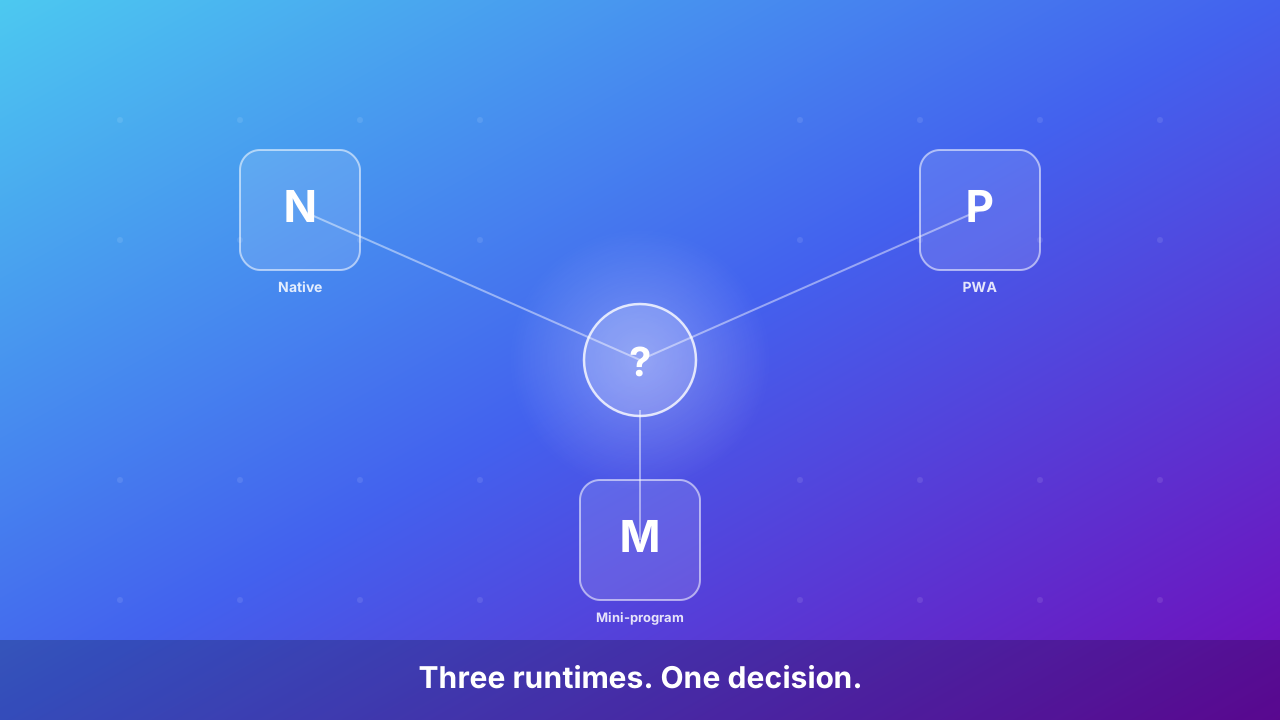
Three runtimes compete for your mobile experience in 2026: native apps, progressive web apps, and mini-programs. Here is a decision framework built on real deployment data — and why a cross-app runtime changes the math.