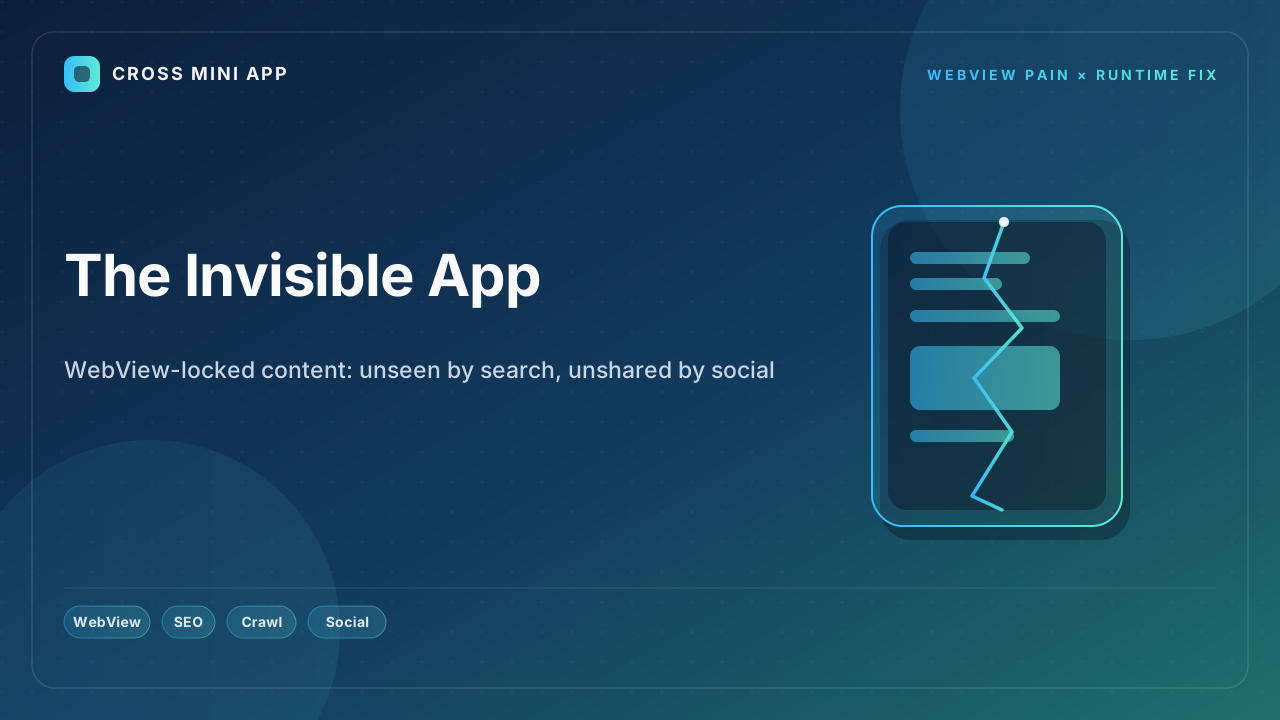
You pay for paid acquisition to get users into your app. Then you lock your most valuable content — articles, listings, catalogs, product pages — inside an in-app WebView. Search engines can't see it. Social shares render as blank cards. You have sealed off the two cheapest growth channels with your own hands.
Search visibility goes to zero. BrightEdge's channel-share research puts organic search at 53% of all trackable web traffic — the single largest channel, ahead of paid search (15%), social (5%), and direct. In verticals like healthcare (55–70%) and finance (50–60%) it is the majority. This is the acquisition engine traffic apps need most: high-intent users typing real queries. But Google does not crawl your in-app WebView; it crawls the public web (Prerender.io, Vmobify). Content rendered only inside the app's embedded browser has no public URL for the crawler to fetch, so it simply does not exist in search. You paid to acquire one user, then gave up the channel that acquires the next one for free.
Social share cards break. Even when a user wants to share, the link falls apart. The Open Graph protocol — what Facebook, LinkedIn, X, Slack, WhatsApp, and iMessage read to render a preview card — requires og:title, og:description, og:image, and og:url to be present in the raw server HTML. Social crawlers do not execute JavaScript (ogpreview.app, opengraphgenerator). A WebView page loaded from your server has no public, server-rendered URL at all, so there is nothing for the scraper to read. The share shows your homepage title, a generic fallback image, or nothing. Click-through on a blank card collapses, and because platforms cache aggressively, the broken preview sticks for days.
Discovery has moved back to the web. This is not a tuning problem; the underlying mechanism changed. Google retired Firebase App Indexing, and the Android Search App no longer uses locally indexed in-app content (Vmobify). Discovery returned to the web. Today the only way an app screen earns any search signal is to map to an indexable public web URL, backed by a Digital Asset Links file proving you own both. A WebView that loads a remote document has none of that by construction.
The two approaches, on visibility
| Dimension | Content locked in WebView | Content compiled by a runtime |
|---|---|---|
| Public URL / crawlable | None | Yes (real page emitted) |
| Search indexing | Invisible to Google | Indexed like any web page |
| Social share card | Blank / fallback (no OG in raw HTML) | Full OG tags server-rendered |
| Acquisition leverage | Forfeits the 53% organic channel | Captures it |
| Build cost | Duplicate web + app effort | Compile once → app + web |
The fix. A host-owned runtime compiles the mini-program once and emits two artifacts from the same source: the in-app component that runs fast inside your app, and a real, crawlable, OG-tagged static web page for every screen. The same content is instant in-app and findable on the open web — you stop choosing between speed and discoverability.
A traffic app lives or dies by being found and being shared, not merely by being downloaded. Locking that content in a WebView forfeits both. The runtime gives you in-app speed without sacrificing the web's discovery and virality.
Sources
- BrightEdge — Organic search is 53% of trackable web traffic: https://www.brightedge.com/resources/research-reports/channel_share
- ogpreview.app — Social crawlers don't run JavaScript; OG tags must be server-rendered: https://ogpreview.app/guides/open-graph-preview
- Prerender.io — Google crawls the public web, not your in-app WebView: https://www.prerender.io/
- Vmobify — Google no longer indexes in-app screens; discovery moved to the web: https://vmobify.com/blog/app-seo-google-search-installs