

Travel Light: Why a Mini-Program Beats Installing a Dozen Local Apps
International tourism hit 1.4B arrivals in 2024, yet the cross-border traveler still faces a wall of incompatible local apps. The governed, embeddable mini-program — available instantly inside a trusted host — is becoming the universal travel layer.
Cross Mini App Team
August 8, 2026 · 4 min read
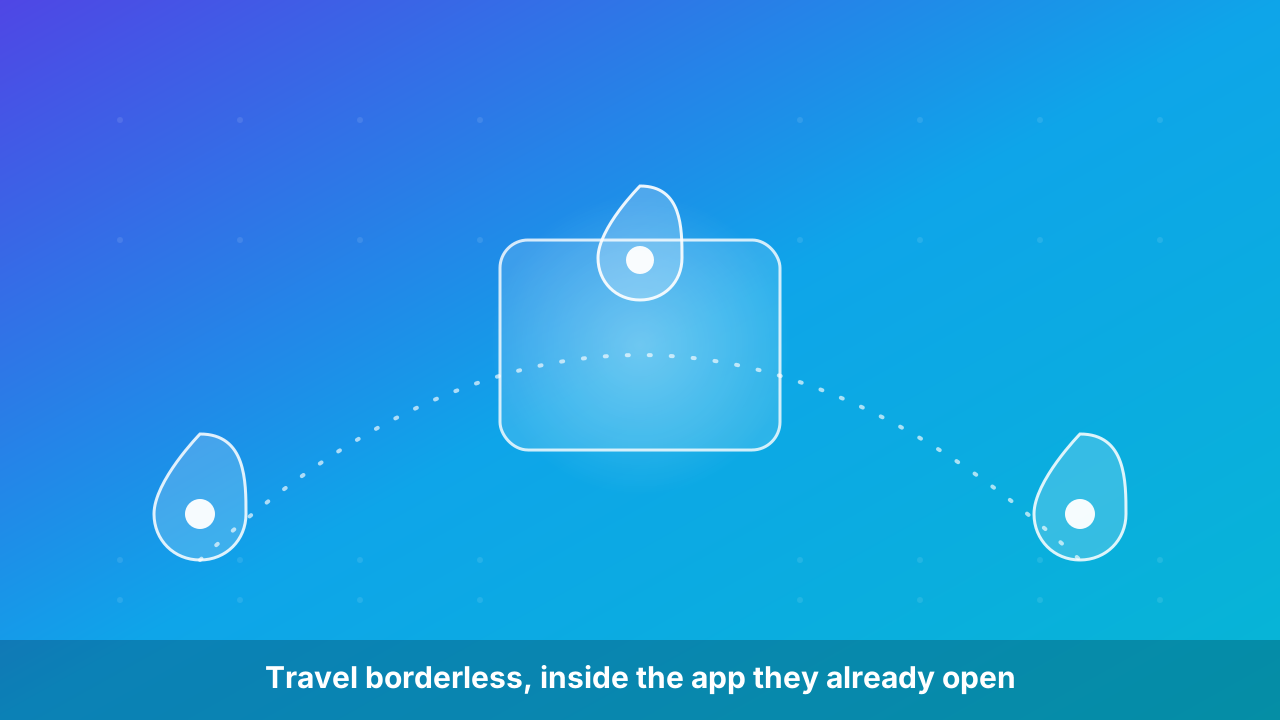
The traveler arrives, the app wall appears
A tourist lands in Bangkok, Jakarta, or São Paulo. To move, pay, eat, and book, they are told to install a local ride-hailing app, a local wallet, a local transit app, a local food app, a local ticketing app — each with its own sign-up, its own KYC, its own currency friction. The open web promised "one web for everyone." In practice, cross-border travel rebuilt the wall as a dozen silos.
The numbers behind borderless travel
The demand is unmistakable. International tourist arrivals reached 1.4 billion in 2024, completing the sector's full recovery to pre-pandemic levels, while global tourism revenue hit US$1.6 trillion, up 3% on 2023 UN Tourism. China — the world's largest outbound source market — sent 146 million residents abroad in 2024, who spent US$250.6 billion, up 29% year on year and accounting for roughly 14% of global outbound travel spending China Tourism Academy; SAFE. These travelers visited 210+ countries and regions. Every one of them hit the same friction.
Payments already crossed the border
Money moved first. Alipay now reaches 70+ countries with 800 million overseas merchants; during the 2024 Spring Festival, Chinese outbound tourists' transaction count hit 107% of the same 2019 period while transaction value jumped 140% year on year, and WeChat Pay's overseas transaction volume ran at nearly 2.4× its prior-year level [China Daily / Sohu / Eastmoney reporting]. The rail, wallet, and QR standards proven at home are now accepted at foreign checkout counters. Payment was the first layer to go borderless.
The super-app proved the model
Southeast Asia showed what a unified surface looks like. Grab reported 41.3 million monthly transacting users in 2024 (up from 35.5 million in 2023) across eight countries, branding itself "the everyday everything app" — ride-hailing, deliveries, and financial services in one place [Grab FY2024 results / Nasdaq]. Rival Gojek serves 40 million+ monthly users. The lesson is not that one app wins; it is that users reward a single trusted surface over a folder of disconnected ones.
Fragmentation is the real tax
Yet the model does not travel. A visitor still needs Grab in Jakarta, a different wallet in another city, a separate transit app in Tokyo, a separate ticketing app in Paris. Each install is a new account, a new KYC, a new currency switch, a new trust decision. The cost is not the download — it is the cognitive and compliance tax paid again in every new country. For the next billion travelers on cheap Android with patchy data, that tax is fatal to adoption.
The mini-program as the travel operating layer
The fix is the unit China already scaled: the governed mini-program. Alipay's overseas ride-hailing mini-program already aggregates Lyft, Gett, Taxify, Grab and others across the US, Singapore, Australia, Indonesia, Vietnam, the Philippines, Thailand and the UK; WeChat HK and Alipay HK mini-programs plug Tongcheng Travel's flights, hotels, trains, tickets and local experiences — in 16 currencies — straight into a messenger people already trust [Sohu / China Daily]. No new install. Shared identity and payment. The host absorbs the trust; the mini-program delivers the service.
What this means for builders
If your travel product assumes users will find, install, and log into your app in every market, 2026 is the year to rethink it:
- Meet travelers inside the host they already trust — a super-app, a messenger, a bank, an airline app — instead of fighting for a home-screen slot they will never give a foreign service.
- Ship a bounded, governed unit hosts will embed. A sandboxed, compliant mini-program — not a full native app — is the unit a Grab, a Gojek, or a carrier will actually accept across jurisdictions.
- Design for low-bandwidth, low-storage, multi-currency reality. The cross-border traveler is often on roaming data and a foreign app store. Lightweight, instant, localized experiences win.
Where Cross Mini App fits
Cross Mini App is the runtime and the open catalog for the post-install era of travel. You build a governed travel mini-program once and drop it into every trusted host — a super-app, a wallet, an airline, a destination portal. Pre-compliant, sandboxed, and localized, these experiences reach travelers without asking them to install anything new. Hosts get vetted services they can embed in a single line; developers stop rebuilding per store and per country; travelers get transit, payment, and booking inside the app already open. For travel — where money movement, identity, and local regulation make sandboxing and explicit consent non-negotiable — a governed cross-app runtime is the only safe unit to distribute at scale.
Travel goes borderless as a mini-program
For two decades "build a travel app, localize it, ship it to every store" was the default. In 2026 the growth is on the in-app surface, delivered as a governed mini-program through a cross-app runtime. Cross Mini App is building the shelf so the next borderless traveler moves, pays, and books without installing a thing.
Related Posts

Telemedicine is a $152B market growing 20% a year, yet billions still cannot reach a clinician. The bottleneck is not technology — it is distribution. Here is why the mini-program, not the native app, is how care crosses the last mile.
App downloads stalled in 2025 while in-app spending climbed. Attention is concentrated, the install barrier is high — and the next billion users are not in the app store at all. Here is why install-free mini-program distribution is the growth market.

Three runtimes compete for your mobile experience in 2026: native apps, progressive web apps, and mini-programs. Here is a decision framework built on real deployment data — and why a cross-app runtime changes the math.