

The Runtime Wars: Why an Open Mini-Program Catalog Beats a Walled Garden
Every mini-program platform today is a walled garden — WeChat, Alipay, Telegram, LINE. Great for the host, punishing for developers. An open runtime with a portable catalog is the model that actually serves global distribution.
Cross Mini App Team
September 19, 2026 · 3 min read
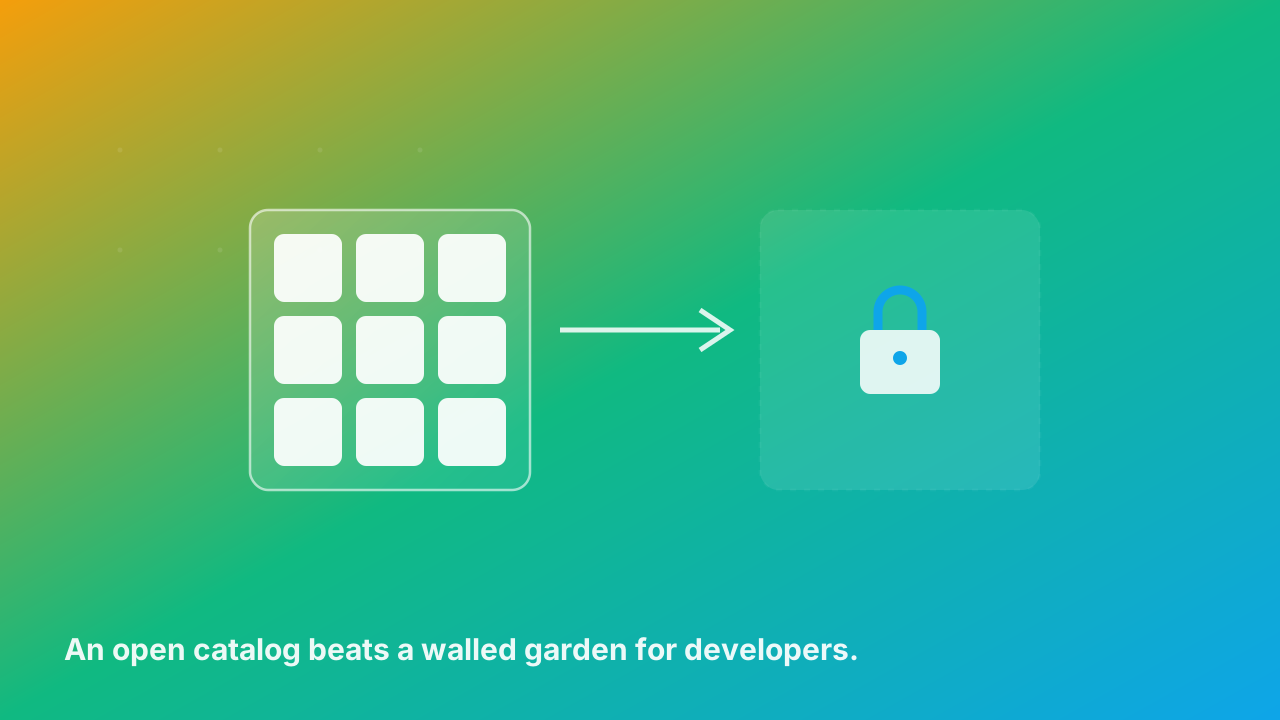
Every garden has a wall
The mini-program model won. WeChat, Alipay, Telegram, LINE, Grab, Gojek — each proved that governed programs inside a trusted host beat cold app installs. But notice who won: the hosts. Every one of these platforms is a walled garden. A program built for WeChat does not run on Alipay. One built for Telegram does not run on LINE. Developers who embraced mini-programs traded the app-store bottleneck for a dozen private ones.
What the wall costs the developer
- Rewrite per garden. Each host has its own framework, review process, and data rules. Shipping across three platforms means building three times.
- Rent and policy risk. The garden owner sets the take rate, the visibility algorithm, and the compliance bar — and can change any of them overnight.
- No portability. Your users, your logic, your investment are locked to one host's fortunes and one market's regulations.
- Discovery captivity. You reach users only through the host's discovery surface, on the host's terms.
This is the app-store problem, multiplied — and it is the single biggest thing holding the global mini-program model back from its China-scale potential.
What an open runtime changes
An open runtime is a single execution environment any host can embed, and an open catalog is a portable registry of governed programs that run on it. The shift is structural:
- Build once, distribute everywhere. One governed program drops into any host that embeds the runtime — a wallet, a maps app, a super-app, a marketplace — with no per-garden rewrite.
- Inherited trust, portable. Identity, payment, and consent flows come from the host, exactly like a native mini-app, but the program is not owned by the host.
- Compliance travels with the unit. The sandbox, scope, and consent design are part of the program, so a vetted service passes review across markets instead of re-proving itself each time.
- No single point of rent. Developers negotiate with many hosts, not one gatekeeper. Competition keeps the ecosystem honest.
Why this matters for global distribution
China showed the model at a billion-person scale but kept it behind national walls. The rest of the world is a patchwork of regional super-apps with no shared runtime. An open layer is what lets a program authored once reach a Telegram user in Latin America, a LINE user in Japan, a wallet user in Southeast Asia, and a maps-app user in Europe — without becoming ten different codebases.
The winners of the next decade won't be the garden with the tallest wall. They'll be the developers and hosts who plug into an open shelf and reach users on every surface they already trust.
Where Cross Mini App fits
Cross Mini App is that open shelf. It is the runtime and the open catalog for the post-install era: you build a governed mini-program once and distribute it across many trusted hosts, inheriting identity, payment, and consent instead of rebuilding them. Pre-compliant, sandboxed, and localized, these programs are portable by design — host-agnostic, market-ready, and free of any single gatekeeper's rent. Hosts get vetted services they can embed in a line; merchants stop rebuilding per store, per platform, and per country; users get the service inside the app they already open.
The garden or the shelf
Walled gardens optimized for the host. An open runtime optimizes for distribution itself. As mini-programs go global, the open catalog is the unit that lets the whole ecosystem — developers, hosts, and users — win at once. Cross Mini App is building that shelf.
Related Posts
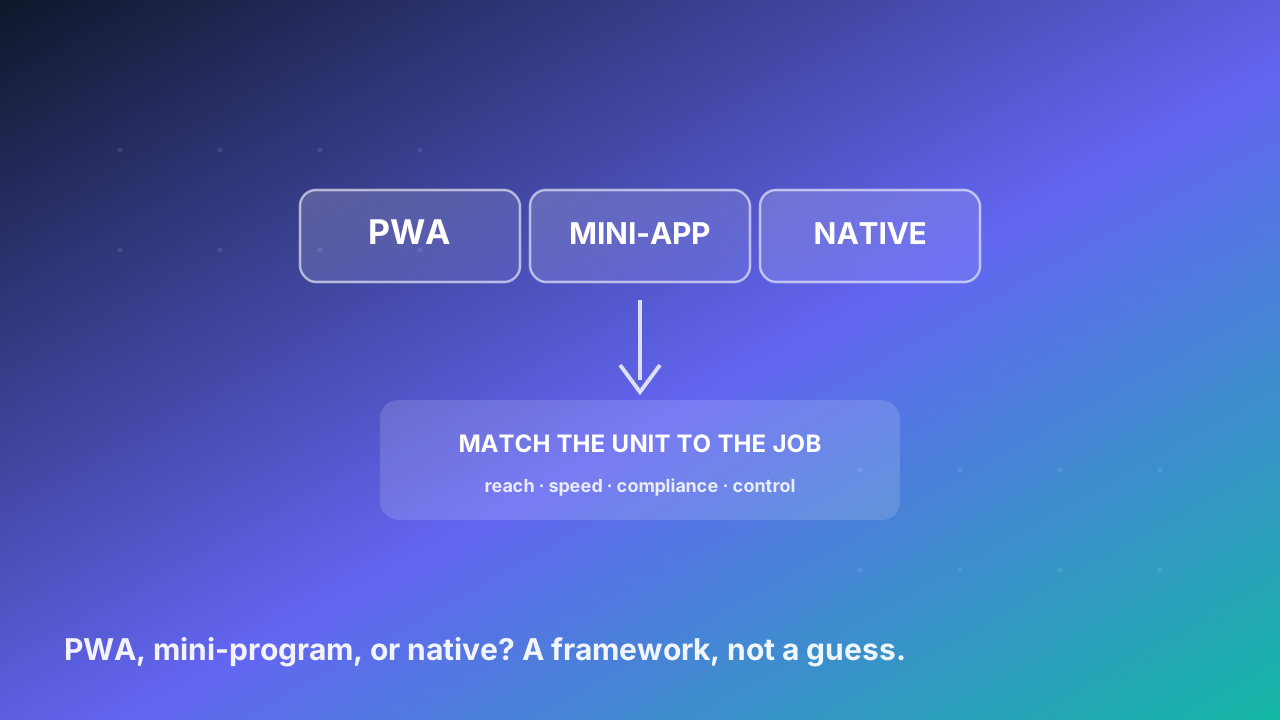
Stop guessing which app form to build. A practical 2026 framework maps your real constraints — reach, time-to-market, compliance, payment, control — to the right unit: PWA, native, or a governed mini-program.
Generosity is a moment — a story, a disaster, a friend's fundraiser. The gift is won or lost inside the app the donor already trusts, and a governed mini-program delivers it with proof.
China didn't adopt mini-programs — it built an alternative internet on top of them. WeChat alone runs ~4.3 million programs with ~945M monthly users and over ¥8 trillion in 2024 GMV. Here's how the model works and why it scales.