When Knight Capital pushed a software update on August 1, 2012, one of eight servers missed the new code. Dormant logic woke up, and in 45 minutes the firm lost roughly $440 million. The post-mortem is brutal in its simplicity: no second technician checked the deploy, and there was no kill switch keyed to total exposure. Someone stopped it by hand, 45 minutes in.
That is what a "full launch, no rollback" failure looks like at scale. Most traffic apps will never move $400 million in 45 minutes. But the same structural mistake is baked into how they ship core product logic: when your critical flows run in a WebView loading remote documents, every server-side change is a full launch to 100% of users, with no canary, no staged rollout, and no kill switch that respects your app's trust boundary.
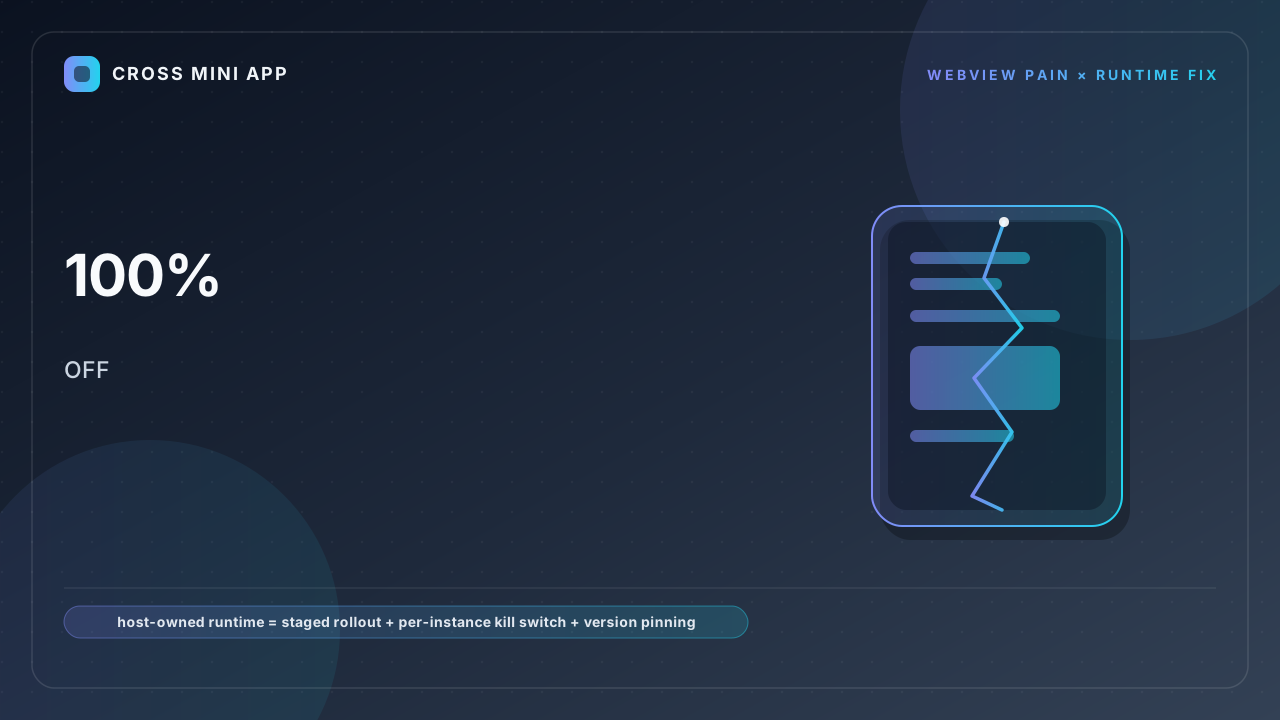
A remote change is a full launch
On the web, a bad deploy is survivable: you canary, you roll back, you flip a flag. The mobile industry learned this and largely adopted it — IDC's DevOps survey found around two-thirds of organizations are expanding, using, or piloting progressive delivery, with 45% using feature flags to do so. Teams that do recover fast: in LaunchDarkly's 2024 survey, 86% recovered from incidents in a day or less, 42% within the hour.
A WebView-based flow throws that maturity away. The remote HTML is fetched on every session, so the moment you change it on the server, every user on every device sees the new logic at once. There is no percentage rollout, no canary, no built-in kill switch. If the change is wrong, your only fix is another server-side change — which also hits 100% instantly. The blast radius is the entire audience, by construction.
Version fragmentation is the silent tax
The second problem is drift. A native app binary is frozen the moment it ships, and it stays in the wild for months:
- Android 16 reached only 7.5% of active devices seven months after release, with a long tail still on Android 11, 12, 13, and 14.
- A typical mobile product, six months after a major release, still has 20–30% of active users on the previous version and 5–10% on versions more than six months old.
- App store review adds 1–7 days before any native fix even reaches users.
So your server-side web logic keeps moving while the native shell stands still. A checkout flow you "fixed" server-side can break on the quarter of users whose binary expects the old contract — and you cannot force them to update. The web team and the app team are now shipping different versions of the same feature to the same user, and nobody owns the mismatch.
Where the control actually breaks
| Dimension | Core logic in a WebView | Core logic in a host-owned runtime |
|---|---|---|
| Rollout | 100% at once, no canary | Staged percentage rollout, canary by design |
| Rollback | Another server push hits 100% | Instant kill-switch per app instance |
| Version consistency | Frozen native shell + mutable web drift apart | Signed package version, pinned per app |
| Blast radius of a bad change | The entire audience, instantly | A bounded segment |
| Incident MTTR | Wait for the next deploy | Minutes |
What a host-owned runtime gives you back
A host-owned runtime treats mini programs as versioned, signed packages rather than mutable remote pages:
- Staged rollout. A new component version goes to 1%, then 10%, then 100% — canary by design, not by heroics.
- Kill switch. A bad version is disabled per app instance in minutes, not by praying the next server push works.
- Version pinning. Each app version maps to a known-good component version, so the quarter on an old binary still gets logic that matches its contract.
- Audit trail. Every shipped version is signed and recorded — you can answer "what did users see at 14:00?" instantly.
You keep the web's update speed without surrendering the release engineering the rest of the industry already standardized.
The bottom line
The WebView sells you "just update the server." What it actually sells is a deployment model from 2011: full launch, no canary, no kill switch, and a version matrix you don't control. Knight Capital's $440 million was an extreme case of the same shape — a change went everywhere at once, and nothing could stop it fast.
A universal runtime with an open, governed catalog lets you keep the speed and take the controls back: staged rollout, instant rollback, version pinning, and a signed audit trail. Your users stop being the canary.
Sources
- SEC — In the Matter of Knight Capital Americas LLC (Order)
- LaunchDarkly / IDC — De-Risking Releases with Progressive Delivery
- Flagsmith — Mobile A/B Testing and version fragmentation
- Yashveer Labs — The Mobile API That Survives App Versions
- Android version distribution, Dec 2025 (Android 16 at 7.5%)