Attribution breaks the moment you ship in many places
A standalone game measures one install source. A mini-game ships inside a super-app, a messaging tab, a wallet, a browser — sometimes five hosts in the same week. Each host has its own share link, its own deep-link, and its own idea of where a player "came from." Traditional last-click or last-touch attribution cannot reconcile that, so studios either over-credit one channel or trust numbers that do not add up.
The 2025 measurement landscape makes this worse. AppsFlyer's State of App Marketing shows iOS advertising spend rising +27% year over year (Q1 2024 → Q1 2025), yet gaming-specific iOS spend actually fell −13% — a low-competition buying window that rewards teams who can measure precisely. At the same time the global mobile advertising market reached roughly $319.5 billion in 2025, up about 15%. More money, less certainty: in AppsFlyer's survey, 30% of marketers named "limited first-party data" their top challenge and 26.5% named "inaccurate attribution."
| Signal | 2025 reading | Why it matters for mini-games |
|---|---|---|
| iOS ad spend YoY | +27% overall, −13% gaming | Gaming is cheap to buy now — if you can measure it |
| Mobile ad market | ~$319.5B (+15%) | Demand is there; attribution is the bottleneck |
| Top marketer pain | 30% limited 1st-party data | Hosts own the user; you need shared events |
| Attribution pain | 26.5% inaccurate attribution | Multi-host last-click silently mis-credits |
SKAN, ATT, and the death of the clean funnel
Apple's SKAdNetwork (SKAN4) collapses fine-grained install data into coarse postbacks, and the recommended 48-hour postback window means you learn about a cohort days late. App Tracking Transparency (ATT) lets users opt out of identifier-level tracking entirely. Add the self-attributing networks (SRNs) like Meta and Google that report on their own terms, and a single game now needs a single source of truth (SSOT) that blends SKAN, ATT consent state, probabilistic modeling, and SRN reports.
For a mini-game running in ten hosts, that SSOT is impossible to build per-host. Each host's analytics silo sees only its slice.
One runtime, one event schema
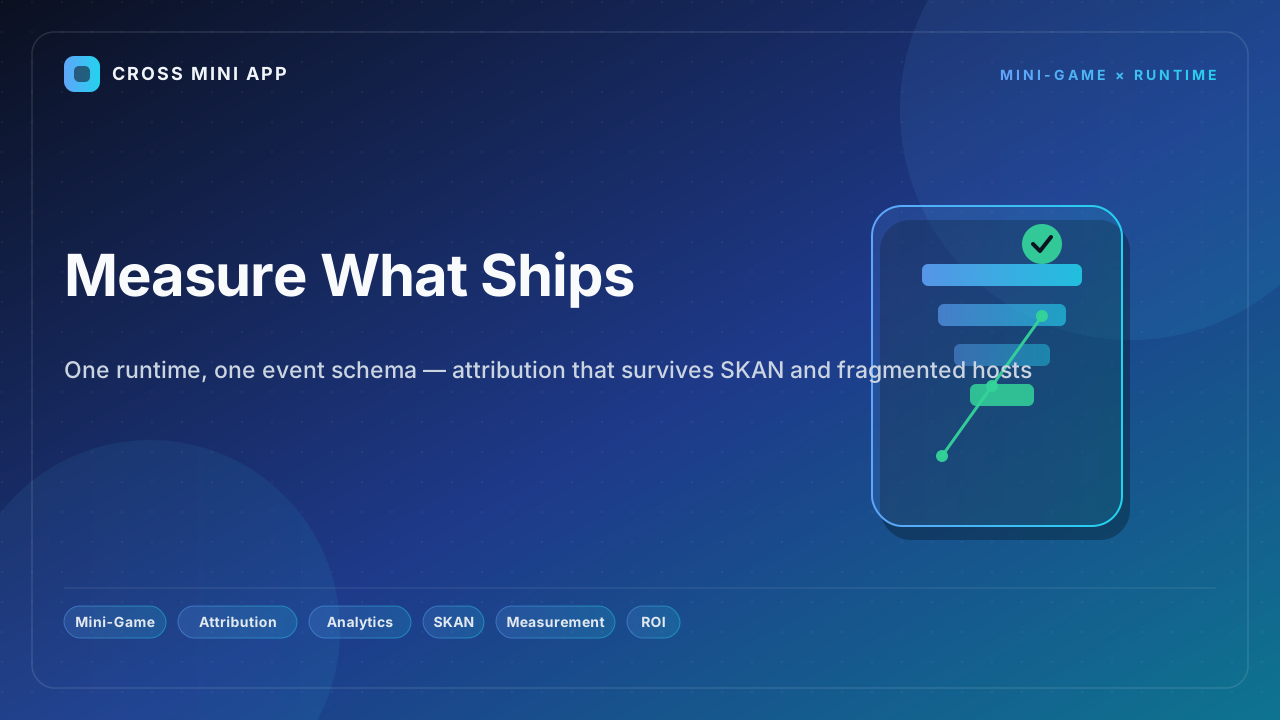
A shared runtime fixes this at the root. Instead of each host emitting its own events in its own format, the runtime defines one event schema — install, session, level, ad impression, purchase — and fires it consistently everywhere the game runs. The host supplies the distribution; the runtime supplies the measurement contract.
That means:
- One cohort view. A player who arrives via Host A's share card and later returns through Host B's wallet tab is the same player, because the runtime keys on a stable runtime identity, not the host's login.
- One SKAN integration. The runtime handles SKAN conversion-value management once, rather than ten hosts each guessing at it.
- One reconciliation layer. Probabilistic and SRN data merge against the same event log, so "where did this payer come from" has one answer.
What this unlocks for developers and hosts
For a studio, distribution across many hosts stops being a measurement tax. You compare host efficiency on identical definitions, kill the underperforming share path, and double down on the one that compounds — without rebuilding analytics for each launch.
For a host app, offering a runtime with built-in attribution is a moat: developers ship to you because they get clean, comparable numbers, not despite the fragmentation. You become the host where growth is legible.
Cross Mini App gives every mini-game one runtime and one event schema, so attribution survives SKAN, ATT, and a dozen hosts — and "which channel paid back" is finally a question with one answer.