Your Creative Is the Real Targeting
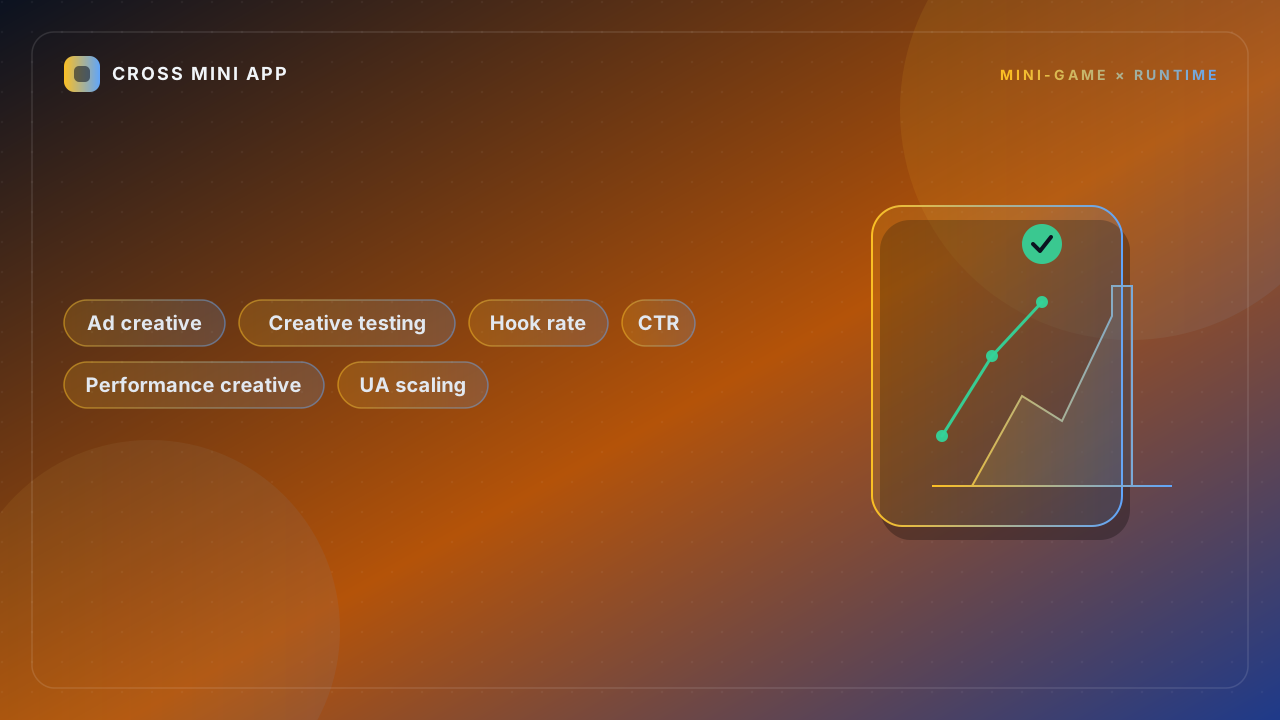
You can have the perfect bid and the wrong audience and still lose, because the creative is what the algorithm actually optimizes against. For mini-games — short, visual, easy to misread as "just a game clip" — creative is the single biggest lever on CPM and scale. The teams that treat creative as a testing pipeline, not a one-time asset, are the ones that find a winner before the budget runs out.
Q: Why does creative matter more than targeting for mini-games?
Because the ad network's algorithm uses creative performance to find your audience. A strong hook tells the system who to show the next impression to; a weak one burns spend finding them. For mini-games specifically, the loop and the "one more try" feeling have to show in the first two seconds, or the scroll wins. Targeting narrows the pool; creative decides whether anyone in that pool ever installs.
Q: What is the hook, and how do I test it without guessing?
The hook is the first one to two seconds — the frame that makes someone stop. Test it as a variable separate from the body: same gameplay, three opening frames — fail-first, reward-first, curiosity-first — and let CTR and hook-rate decide. Run 10–15 concepts in a batch, kill the bottom half fast, and double down on the top. The goal is to find one creative that holds a low CPI at scale, not to make every ad pretty.
Q: How many cuts per network, and why does one size not fit all?
Each network has a different default player and format. A 15-second vertical that wins on TikTok-style inventory can die on a rewarded-interstitial slot; a 6-second bumper that works as a pre-roll flops as a feed ad. Produce per-network cuts from the same raw gameplay, and let the placement dictate length and aspect ratio, not your editor's habit.
Q: What stat actually predicts whether a creative will scale?
Not CTR alone — a high CTR with weak post-install retention just buys you expensive, churny users. The stat that predicts scale is the combination of strong CTR and a healthy D1 and D7 from the cohort that creative brought in. When those two move together, the algorithm has found a real audience and your CPI holds as you raise budget. Watch that pair, not the pretty CTR number.
| Where creative wins | Where it backfires |
|---|---|
| Strong hook feeds the algorithm | Weak opener → spend burns finding audience |
| Batch test 10–15, kill the bottom fast | One hero ad, no pipeline → dead at scale |
| Per-network cuts match the placement | One cut everywhere → dies on some slots |
| CTR plus D1/D7 together → scales | CTR only → churny, expensive users |
Creative is not the pretty part you do last. It is the input the algorithm is optimizing against, and for mini-games it decides whether anyone ever sees your targeting. Build a testing pipeline, separate the hook from the body, cut per network, and judge by CTR and early retention together. That is how a small team finds a winner before the budget is gone.