The Payment Method List Is the Real Monetization Design
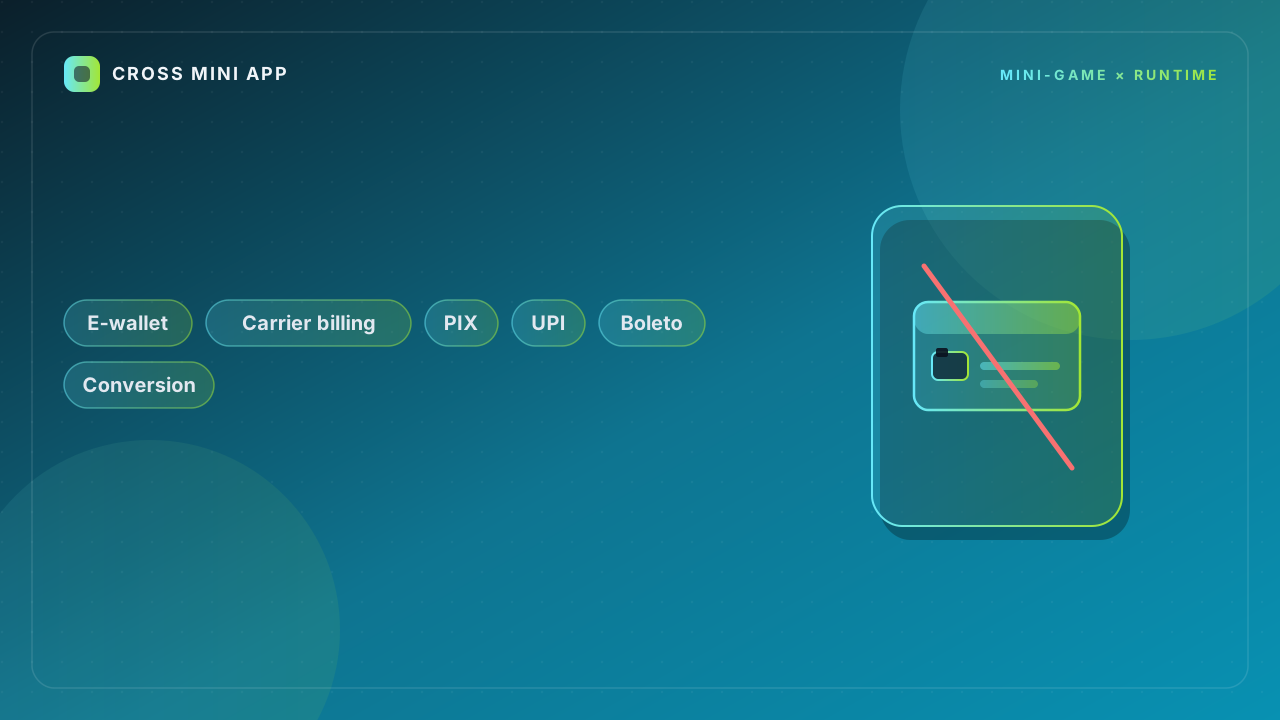
You can build the perfect monetization loop and still watch it fail at the last step, not because players don't want to pay, but because the button they're willing to press isn't on the screen. In most of the world, "pay with card" is a minority option, and a card-only checkout is a quiet filter that removes more than half your potential payers before they ever see a price. The payment method list is not back-office plumbing — it is the front line of your monetization design.
Q: Why does supporting only credit cards quietly exclude half your potential payers?
Because card penetration is the exception, not the global rule. Look at account and instrument data from the World Bank's Global Findex or GSMA's Mobile Money tracks: in large parts of Southeast Asia, Latin America, the Middle East and Africa, a minority of adults hold a usable card, while e-wallets and mobile money accounts outnumber them. When your SDK only speaks cards — usually because it was built on a US/EU assumption — you've inherited a filter you never chose. The cruel part is it doesn't show up as a "failed payment" you can see; it shows up as a player who never converts and whom you blame on "weak demand." The fix isn't a better price. It's a longer list of ways to pay.
Q: Which local rails actually move the needle — e-wallets, carrier billing, transfers, cash?
Four families matter, and they don't substitute for each other. E-wallets — GCash, Paytm, Mercado Pago, OVO, GoPay, M-Pesa — dominate daily life in their markets and feel native to players. Carrier billing is frictionless and reaches the unbanked, but it carries a 15–30% fee and low per-transaction caps, so it's a micro-transaction tool, not your premium tier. Real-time bank rails — PIX in Brazil, UPI in India, PromptPay in Thailand — are instant, near-free, and have adoption most card networks envy; they usually want a local entity. And cash and vouchers — OXXO, Boleto, convenience-store top-ups — are still enormous in LatAm and can't be ignored. The tradeoff is always reach versus fee versus ticket size versus how fast you get settled.
Q: How do you measure whether adding a rail was worth it — not just "we added it"?
Incrementality, the same discipline as any growth experiment. The question isn't "do we now support Boleto," it's "did payer conversion in Brazil rise, net of the integration cost and the fee drag?" Watch two numbers together: payment success rate (how many checkouts that reach the pay screen actually complete) and ARPPU. A new rail often lifts success rate more than it lifts total users, because the leak you're plugging is "your card was declined or not supported," not "your price was too high." If you can, hold out a market or a cohort that didn't get the rail and compare. A rail that raises success rate by double digits but barely moves volume is still a win — it's the difference between a checkout that works and one that quietly hemorrhages.
Q: When does payment localization become a compliance problem rather than just UX?
The moment money crosses a border or touches a minor, UX ends and rules begin. Some markets restrict cross-border card flows or require a local entity to even receive funds. Loot-box-style mechanics get reclassified as gambling in several jurisdictions, and the payment rail is exactly where that block lands. Carrier billing is so easy a child can use it, which is precisely why age-gating and COPPA-style rules make it a compliance landmine for kids' games. And settlement — FX, withholding tax, the local bank account you need to actually receive payouts — is where monetization meets the tax man, the same wall we hit in cross-border settlement. The rail you pick doesn't just decide convenience; it decides whether the revenue is even legally yours to keep.
| Rail | Where it wins | Fee drag | Best ticket | The catch |
|---|---|---|---|---|
| E-wallet | SEA, LatAm, Africa | Low–mid | Mid | KYC, per-wallet work |
| Carrier billing | No-bank users, global | High (15–30%) | Micro | Low caps, minor risk |
| Bank transfer (PIX/UPI) | Brazil, India, Thailand | Very low | Any | Local entity often |
| Cash / voucher | LatAm | Mid | Mid | Slow settlement |
| Card | US, EU, Gulf | Mid | High | Excludes unbanked |
Pick the rails your players already trust, and the conversion problem often solves itself.