Do You Actually Need Server-Authoritative Logic for a Casual Mini-Game?
Every security conversation starts with "we need server authority" and ends with a six-figure infra bill nobody approved. The honest answer is: it depends on what's at stake, and most casual mini-games have less at stake than the security team fears. A threat model tells you more than a firewall ever will.
Q: What do cheaters actually do in a casual mini-game?
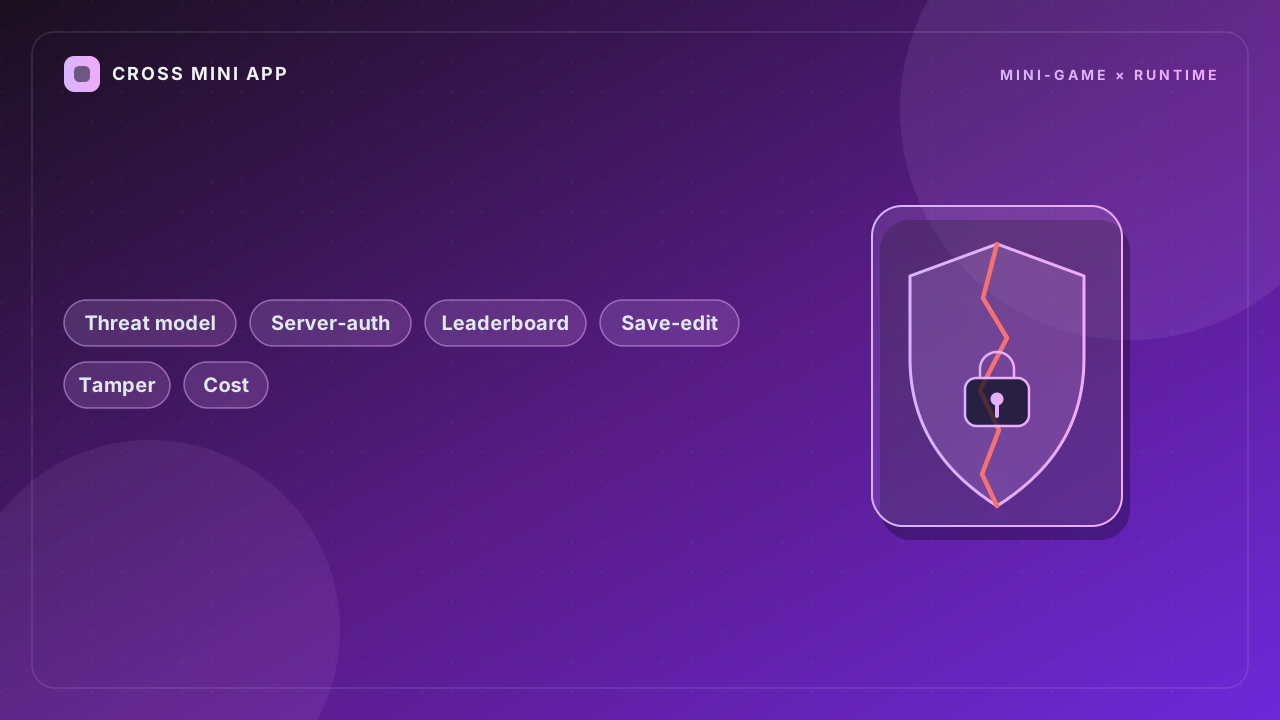
Three patterns dominate. Speed and value cheats: memory-editing the client to move faster, earn faster, or skip cooldowns — easy precisely because the client holds the truth. Save-file edits: the local save is a file, and a file can be opened. Leaderboard fraud: when rank carries status or prizes, people fake scores, and a client-trusted score is a suggestion, not a fact. Notice none of these require "hacking" — they require the client being trusted with state it should never own.
Q: When is the cost of server authority actually worth it?
When there is real value on the line that a cheat destroys. A ranked ladder with cash prizes? Authoritative. A real-money economy where duplicated currency is spendable? Authoritative. A single-player time-killer with a cosmetic shop and no leaderboard? The cheat costs you nothing a polite "please don't" couldn't, and server authority costs you latency, complexity, and a server bill. The test: if a cheater wins and the only victim is their own leaderboard rank, you don't need server authority — you need to stop caring.
Q: What is the spectrum between "trust the client" and "server authoritative"?
It isn't binary. Selective authority: keep scoring and economy on the server, leave animation and feel on the client. Authoritative scoring: the client predicts, the server adjudicates the result. Signed receipts: the client does the work, but the server issues a tamper-evident token the client can't forge. Most games land somewhere in the middle, and that is correct — full authority is the expensive end you reach only when the value at stake forces it.
Q: What does client-side tamper protection actually buy you?
A higher floor, not a wall. Obfuscation, integrity checks, and root detection deter the casual cheater who downloads a trainer and gives up when it crashes. They do nothing against a determined reverse-engineer. If your threat model is "keep the lazy 95% honest," client-side is enough and cheap. If it's "stop a motivated adversary from draining a real-money pool," client-side is theater and you need the server. Match the defense to the adversary you actually have.
| Layer | Stops | Misses | Cost |
|---|---|---|---|
| Trust the client | nothing | everything | zero |
| Client tamper checks | casual cheaters | motivated reverser | low |
| Selective server auth | scoring / economy fraud | client-feel hacks | medium |
| Full server authority | all state fraud | little meaningful | high |