

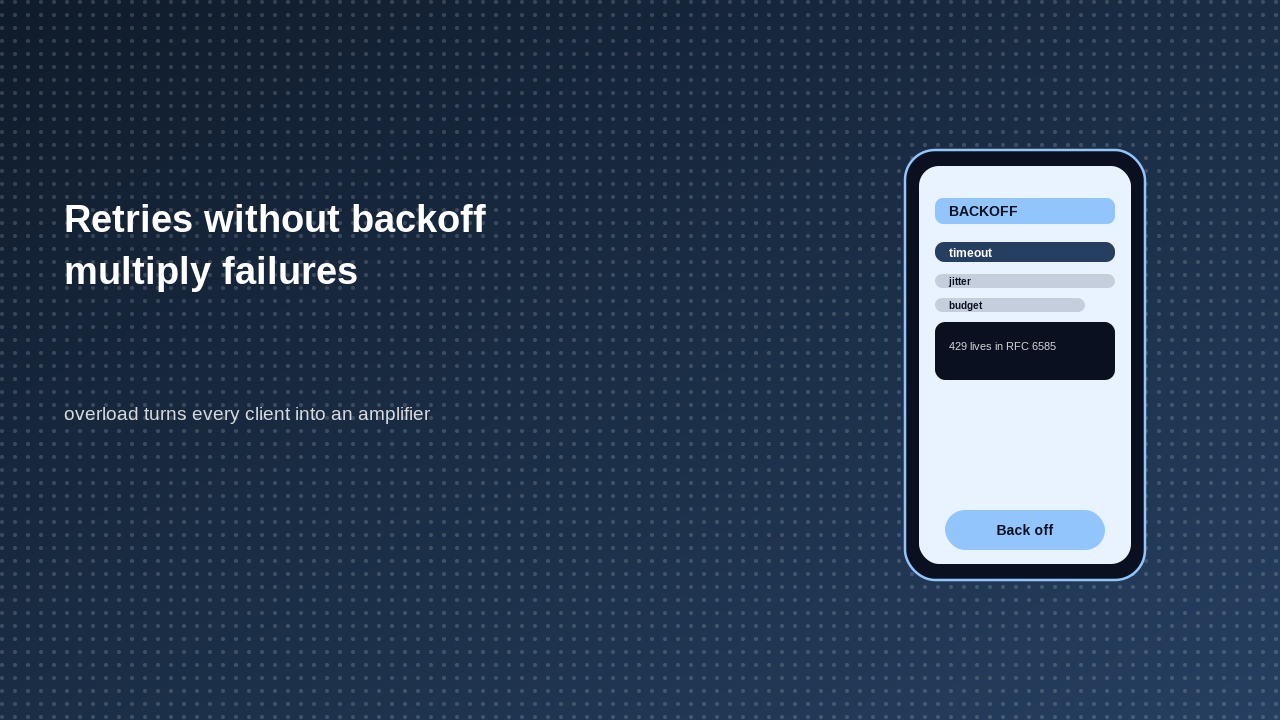
A multiplier hiding in five layers
A 2019 article in the Amazon Builders' Library puts a number on a habit that looks harmless. Five services in a chain, each retrying a failed downstream call three times, turn a single database request into 3⁵ attempts — 243. The figure comes from an arithmetic derivation on the layer count; no production incident stands behind it, and the distinction matters. It describes what happens when retry policy gets decided locally at each layer and never summed up at the top.
The same article uses a blunt word for the motive: retries are "selfish." A client asks the server to spend more of its resources in exchange for a better chance of success. During an occasional transient fault, that trade works well enough. During overload it turns around. Every client that sees a failure retries at roughly the same moment, and a small failure ratio grows into a full stop. The industry has two names for this — retry storm and thundering herd — and both describe independent clients synchronising on the same signal.
A citation that quietly goes wrong
The detail that derails more drafts than the arithmetic is the provenance of 429. The 429 Too Many Requests status is defined in RFC 6585, section 4, published in April 2012. RFC 9110, dated June 2022, is where Retry-After receives its normative definition, in section 10.2.3. RFC 9110 does not define 429 at all; its list of 4xx statuses ends at 426. A citation that assigns 429 to section 15.5.29 of RFC 9110 points at a section that does not exist.
The two documents also speak with different force. RFC 6585 says a 429 response should explain the condition, may carry Retry-After, and must not be cached. RFC 9110 says a client should not automatically repeat a request after a 503 unless the request is known to be idempotent, and must not automatically retry other requests even when Retry-After is present. A timing hint stays a timing hint; it does not hand a client blanket permission to retry.
| Signal | Defined in | Sensible client response |
|---|---|---|
| 429 Too Many Requests | RFC 6585 §4 (2012) | Slow down; the header is optional, so keep a local cap |
| 503 Service Unavailable | RFC 9110 (Retry-After) | Repeat only when idempotence is already known |
UNAVAILABLE | AIP-194 (2019) | The one status Google expects clients to retry |
CANCELLED, DEADLINE_EXCEEDED | AIP-194 (2019) | Honour the cancellation or deadline, leave it alone |
| A write with side effects | HTTP semantics | Retry only behind a key or token |
What backoff buys and what it leaves behind
Capped exponential backoff stretches the gaps between attempts. It does not break the alignment. Once every client reaches the cap, they settle into the same interval and the spike shifts to a new position rather than disappearing.
Marc Brooker's 2015 AWS Architecture Blog article simulated N clients competing for one resource. Total work grew on the order of N², while completion time grew linearly, because each round delivered roughly one success. In the hundred-client scenario, full jitter cut total calls by more than half. The article sets out three algorithms: Full Jitter (sleep = random(0, cap)), Equal Jitter (keep half the delay and add a small random slice), and Decorrelated Jitter (grow the range from the previous sample). Full and Equal landed close together, Decorrelated cost more, and plain exponential backoff without jitter came last on both work and elapsed time — the author's phrase was a "clear loser." Those formulas come from a simulation and an engineer's recommendation. No IETF specification cited here tells a client how to randomise.
Two qualifiers belong to that result. The model assumed a ten-millisecond mean network delay with four milliseconds of variance, and jittered backoff leaves the N² scaling intact. What it changes is the volume of work at ordinary levels of contention, enough for the author to recommend it as standard practice for remote clients. The simulation describes a shape; it says nothing about a specific percentage in a production system. A system with different latency and concurrency will land somewhere else.
Four pieces that travel together
Backoff is half a policy at best. The 2019 Builders' Library article pairs it with three other tools and one precondition.
Timeout comes first, chosen from downstream p99.9 latency at an acceptable false-timeout rate. The article's 0.1% is an Amazon-internal working example, not a universal threshold. Next comes a ceiling on both the delay and the attempt count: capped backoff keeps clients knocking at the cap rate until a retry budget stops them. Then jitter, with a token bucket limiting local retries after the bucket empties — the AWS SDK added that behaviour in 2016. Last comes idempotency for anything with a side effect; a token on a call such as EC2 RunInstances is what makes a second attempt safe.
There is a date on SDK support as well. A May 2023 update to the 2015 article says most AWS SDKs had built-in backoff and jitter in their standard and adaptive modes. That claim carries a year. Reading it as a default present in every client and language, at any point in time, overstates what the update actually said.
Which errors earn a retry
Google's AIP-194, approved in 2019, keeps the automatic-retry list short. UNAVAILABLE is the one status the document expects clients to retry, covering network flapping and other transient conditions. CANCELLED, DEADLINE_EXCEEDED, INVALID_ARGUMENT and DATA_LOSS are explicitly out — a cancellation or a deadline is a decision made by the application, and a retry would quietly override it. RESOURCE_EXHAUSTED, INTERNAL, UNKNOWN and ABORTED generally stay out too, with ABORTED better handled at a transaction boundary higher up the stack.
Older Google guidance described some of these codes differently. A draft that mixes the two generations will give contradictory advice on DEADLINE_EXCEEDED and ABORTED, so the citation needs a document name and a year. AIP-194 also declines to auto-retry transactional requests whose repetition would change state. That is the point where idempotency stops being a nice-to-have and becomes the price of admission.
Where the policy lives
A shared runtime and an open catalog change the integration cost structure. One capability reaches several host surfaces, so a retry policy settled once can be applied wherever the host permits it. That is a mechanism. No first-hand figure exists here for mini-program retry success rates, or for failure ratios before and after jitter, and inventing one would repeat the very category error this article has been tracing: a number detached from its sample and its year.
What travels instead is the contract. Status codes keep their provenance, attempt budgets stay bounded, jitter names its source, and every call that changes state carries an idempotency key. Cross Mini App gives those rules a single place to live across hosts, so one set of limits can be enforced instead of renegotiated surface by surface.


