

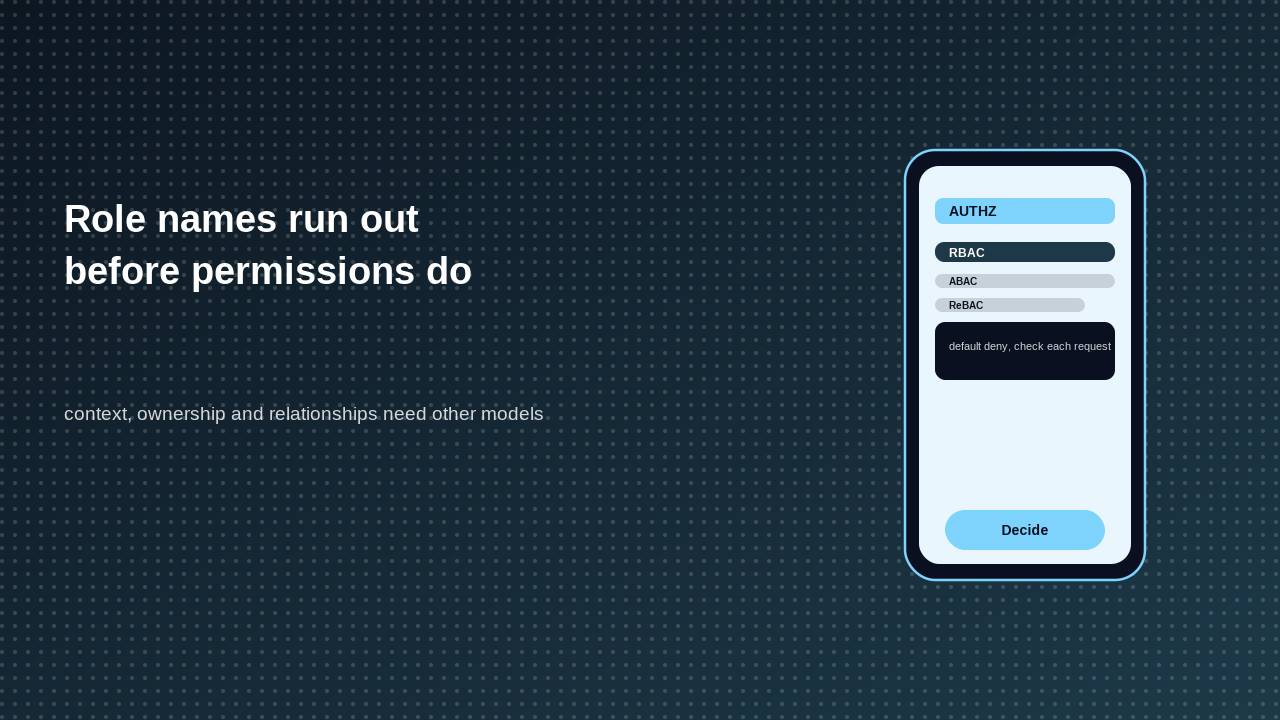
The role list grows until nobody can read it
A shared document gets an editor role. Then an editor role for one tenant, an editor role with an expiry date, an editor role that excludes contractors, and an editor role for documents created inside the same team. Each name is a workaround for a condition the role model cannot express. The permission system still works, but the vocabulary has stopped describing anything a person can hold in mind. That is role explosion, and it arrives well before the underlying permissions become genuinely complicated.
What a role actually decides
The NIST RBAC project page records that the model was formalised in 1992 by David Ferraiolo and Rick Kuhn. The NIST model was adopted as ANSI/INCITS 359-2004 in February 2004 and revised as INCITS 359-2012. Users are assigned one or more roles, roles are assigned one or more permissions, and the resulting controls sit close to the shape of an organisation. Software handles mutually exclusive roles and role hierarchies.
Two sourcing notes belong here. The project page is marked ARCHIVED, so it documents a model rather than an actively maintained programme; the 2010 economic study linked from it is old research and not a current conclusion. Neither note changes the definition, but both change how the page should be cited.
When the answer depends on the object
OWASP defines RBAC as granting or denying access from the roles assigned to a user. Permissions attach to roles rather than to individuals, and user-role assignments are usually many-to-many with room for hierarchy. The strength is also the limit: the decision looks at whether a role is present, not at whose object is being touched, which tenant owns it, or what else is true at request time.
The OWASP Authorization Cheat Sheet calls out object-level and horizontal access control as cases where a role-only decision falls short, along with decisions that need several factors at once. It lists role explosion as a failure mode: too many roles make testing and auditing harder, and RBAC does not fit multi-tenant or cross-organisation access well. The page recommends preferring ABAC or ReBAC in application development. That is engineering advice from a cheat sheet, not a clause in a standard.
| Model | Decision basis | Where it stays comfortable | Where it starts to strain |
|---|---|---|---|
| RBAC | Roles assigned to the user | Organisational boundaries, coarse grants, separation of duties | Object ownership, tenant context, time-bound access, many near-identical roles |
| ABAC | Attributes of subject, object, action and conditions | Policies that combine department, sensitivity, time or device type | Keeping attribute sources fresh and explaining a complex policy |
| ReBAC | Relationships between the actor and the resource | Ownership, sharing circles, group membership, inherited access | Storing relationships consistently and answering reachability queries |
Attributes bring the context back
NIST SP 800-162, dated January 2014, defines attribute-based access control as a logical access control method in which authorisation is determined by evaluating relevant attributes of the subject, the object, the requested operation and, in some cases, environmental conditions against policies, rules or relationships. The verification for this article covers the CSRC abstract page for that January 2014 version. Secondary references mention an August 2019 update that was not confirmed there, and the PDF full text was not retrieved, so no claim is made about a later edition or about specific pages of the document.
OWASP examples of environmental or dynamic attributes include time, device type and geographic location. Boolean combinations of those attributes give finer control and support least privilege in places where a role would otherwise have to be invented for every variation. The cost moves elsewhere: policies need readable structure, and the attributes feeding them need an owner.
Relationships as a first-class input
ReBAC answers a different question. OWASP defines it as access granted from the relationship between a resource and an actor, with the example that only the creator of a post may edit that post, and describes social applications where data stays within chosen friends, family or followers. Ownership and sharing are not decoded into a role name; they are the rule.
The Zanzibar paper at USENIX ATC 2019 describes a global system for storing and evaluating access control lists, with one data model and configuration language serving hundreds of Google internal client services including Calendar, Cloud, Drive, Maps, Photos and YouTube. The paper reports trillion-scale ACLs, millions of authorisation requests per second, p95 latency below ten milliseconds, and availability above four nines over three years. These are figures reported by the vendor about its own production environment. They are not industry benchmarks, not a service level any other system should assume, and not evidence about any mini-program platform.
The less glamorous part of relationship authorisation is consistency. Relations have to be stored, updated and queried, and stale edges grant stale access. Zanzibar's causal ordering and external consistency come from its particular architecture; a generic graph database does not inherit them.
The checks that do not change with the model
Whichever model carries the decision, the general OWASP controls still apply. Deny by default. Check permission on every request. Treat client-side checks as usability rather than authorisation; the real check belongs at the server, gateway or serverless function. A carefully designed relationship graph does not rescue a check that never reaches the boundary.
Layering, not replacement
The three models coexist in most real systems. Roles handle coarse grants that mirror the organisation, attributes refine those grants with context, and relationships settle questions about ownership and sharing. Nothing in the sources says RBAC has been retired, and nothing here claims a particular mini-program platform uses one of these models.
Cross Mini App has a shared runtime and an open catalog, which makes the layering visible: a coarse role can open the catalog while an attribute or a relationship decides which item is actually readable. The useful work is deciding which model owns each decision before the role list starts growing again.


