

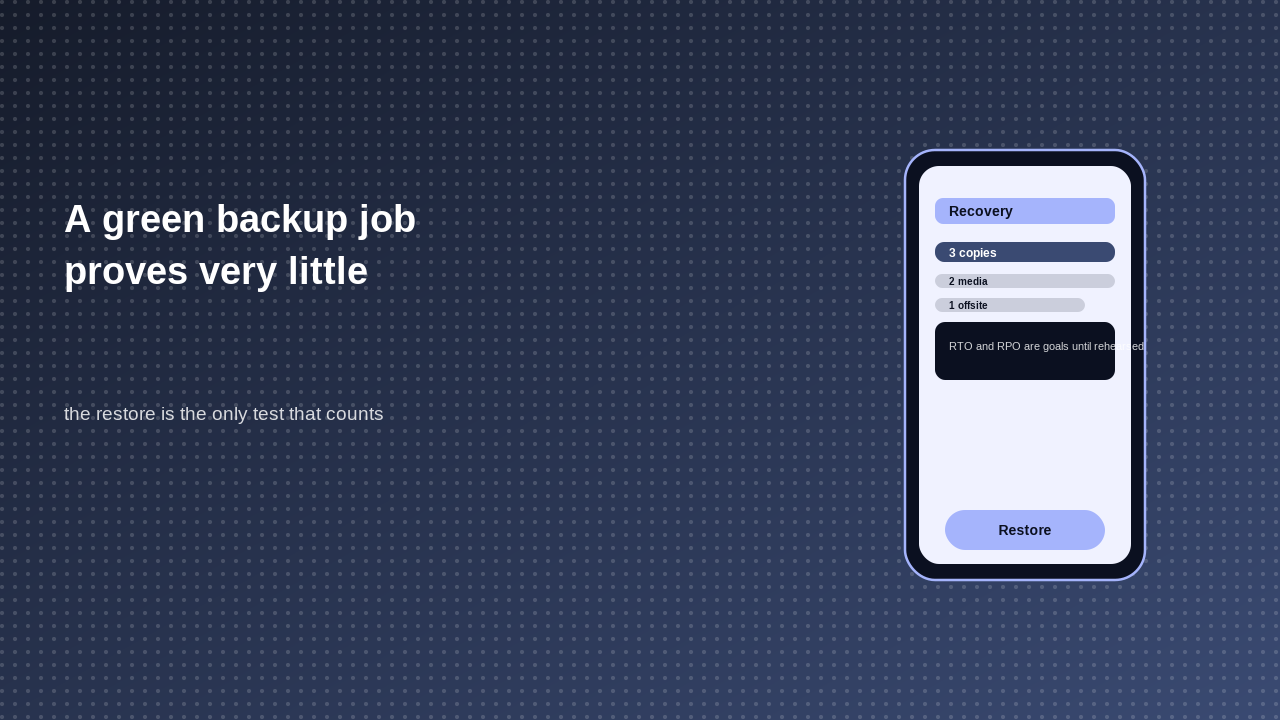
The checkmark that lies
For eleven months the nightly job reported success. There was a date, a duration, a green status, and a tidy line in the weekly report saying the data was protected. On the twelfth month, a corruption forced a restore, and the newest copy could not be read: the database files were inconsistent, the object store had quietly dropped a bucket policy, and the encryption key lived on an account nobody had included in the runbook. Nothing about the twelfth month was unusual. The eleventh month had been lying the whole time.
Finishing a backup job says something about a write path. Reading it back months later exercises a different path, one that shares little with the first beyond the disk it lands on. A 2021 report from Veeam, based on a Vanson Bourne survey of more than 3,000 IT decision makers in 28 countries, said that 58% of recoveries fail — while the headline of the same release described 58% of backups failing. The two labels disagree, and the numbers are self-reported perceptions from large enterprises, not instrumented measurements and certainly not mini-program data. The inconsistency is the useful part: even the people selling protection could not keep the two concepts separate.
What the maxims actually promise
| Maxim or capability | Origin and year | What it genuinely covers | What it leaves open |
|---|---|---|---|
| Three copies, two media types, one offsite | US-CERT Data Backup Options, 2012; footnote credits Peter Krogh's The DAM Book, 2009 | A risk-spreading heuristic inherited from photographic workflow | Not a law; no offline or immutable requirement; the three copies include the original |
| RTO and RPO | AWS Well-Architected REL13-BP01, current framework page | Business-set targets for tolerable outage time and data loss measured in time | Not measured results, not a storage volume, not MTTR |
| Immutable vaults and restore testing | AWS Backup feature documentation, vendor self-report | Configurable WORM locks, logical isolation, restore tests | Locks are off by default and do not protect the control plane or keys |
| Production recovery drills | Azure Well-Architected RE:09, current guidance | Verifying that the targets actually hold, after a non-production rehearsal | A badly staged drill can itself cause an outage |
The three-two-one rule survives because it is short, not because it is law. The 2012 US-CERT guide defines three copies as one original plus two backups, two different media types rather than two disks, and one copy stored offsite — where cloud storage counts. Its footnote traces the phrase to Peter Krogh's 2009 book on digital asset management, and the paper can confirm that attribution but not who first coined it. Older mainframe origin stories circulate freely; the earliest verifiable written source is that book. Crucially, the original rule says nothing about keeping a copy offline or immutable. That addition belongs to the industry's three-two-one-one-zero extension and does not appear in the CISA document. Calling three-two-one a compliance requirement misstates its entire nature.
The two recovery targets carry a similar trap. AWS defines RTO as the maximum acceptable span between interruption and restoration, and RPO as the maximum acceptable data loss measured in time from the last recoverable point. RPO is a duration, not a number of gigabytes. RTO is a ceiling for a single event, which is a different thing from a mean time to repair averaged over many. One workload can carry a long RTO and a short RPO at the same time, because the two are independent choices about consequences. AWS also states outright that zero downtime and zero loss are usually unaffordable, and that a workload cannot recover faster than the dependencies it waits on.
Vendor capabilities help but oversell themselves when quoted carelessly. AWS Backup documents vault locks with WORM immutability, logically isolated vaults, and restore testing. The locks are configurable retention policies, and Compliance mode becomes irrevocable once engaged, which is not the same as being switched on by default. A locked vault still leaves the control plane, the account itself, and the key management service as live attack surfaces. Immutability is one control in a chain, not a substitute for a separate account boundary or a real restore.
The Azure guidance names the real gap. A disaster recovery plan means little until it has been exercised under realistic conditions, and a production drill is the only way to confirm that the targets hold. The same page warns that staging such a drill directly in production can introduce a severe failure, so the sensible order is to rehearse in a non-production environment first. A job printing success and a system that actually restores are two separate claims, and only the second survives contact with reality.
The cost of taking it seriously
There is a price for this honesty, and it is worth naming. Immutable locks consume extra storage and make legitimate deletions awkward. Cross-account isolation adds operational overhead to routine changes. Restore drills occupy people who could be shipping features, and a poorly bounded drill risks exactly the outage it was meant to prevent. A team that reports the backup succeeded gets a clean dashboard and no uncomfortable conversations; a team that reports the restore took far longer than the stated target gets an argument. The second number is the one that improves systems. The temptation to treat the green checkmark as the deliverable is strong, because it is cheap and it closes the ticket. That temptation is precisely what leaves the quiet failures of the eleventh month unnoticed.
Where the shared runtime fits
Mini-programs have no published recovery statistics of their own, and inventing one would repeat the mistake this article is about. The honest connection is structural. A runtime delivered through an open catalog gives an operator one place to repair a broken capability and one place to publish a verified restore path, instead of asking every host app to maintain its own copy of an aging runbook. Cross Mini App reduces the number of places where a configuration can drift; by itself it does not perform the restore drill. The drills, the keys, and the unglamorous question of whether the last copy can actually be read still belong to the team. What a shared runtime can do is carry the answer along with the capability — one tested recovery procedure reused across surfaces, with the same target measured the same way each time.


