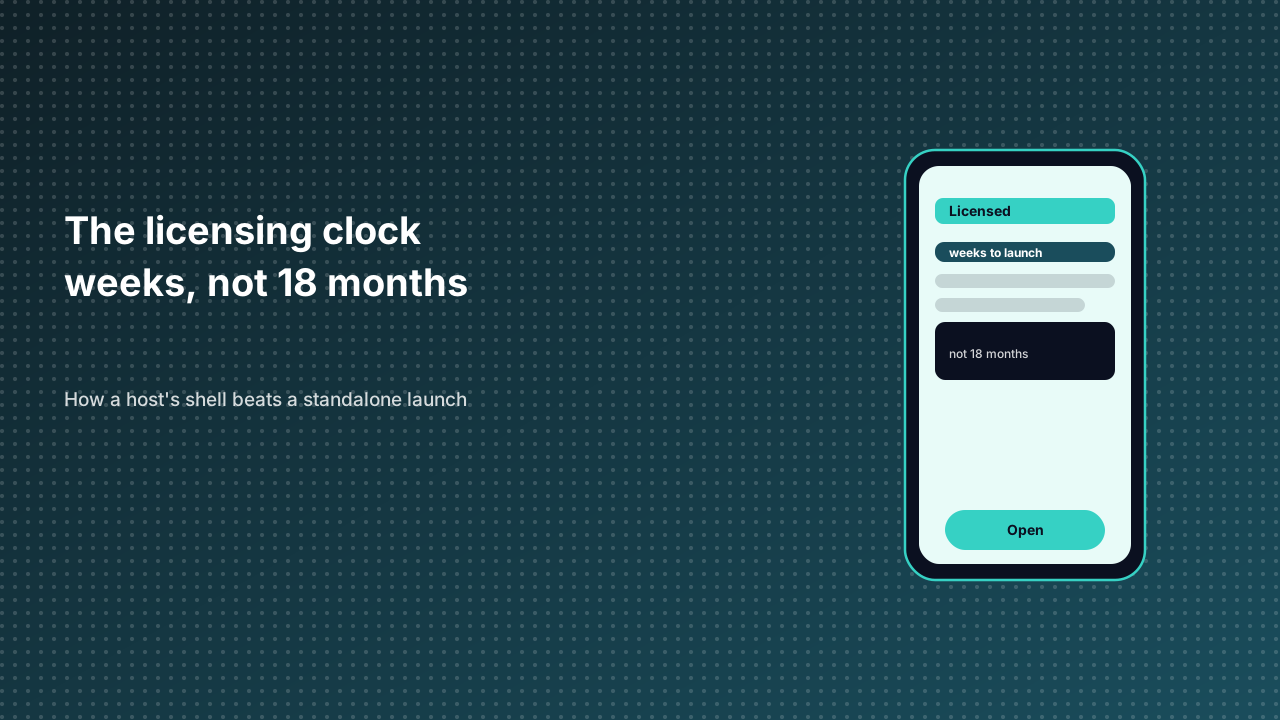
There is no global fintech license. An EU authorization passports across the EEA, but the United States, United Kingdom, and most other jurisdictions each require their own. For a team that wants to ship a financial surface in emerging markets, the licensing clock is often the longest pole in the tent — and a mini-program that rides a host's compliance shell can skip most of it.
How long the clock runs
Getting an own-account EMI or payment institution license typically takes 12 to 18 months and costs hundreds of thousands in legal, compliance, and staffing. A full banking license runs well over a year. The United States money transmitter license across all states carries $500k–$2M in initial cost and $200k–$500k annually. Singapore's MAS license lands at $100k–$250k. A partner-bank or agent arrangement, by contrast, can let a team launch in weeks, because it relies on someone else's license.
What the standalone path actually buys
The control argument is real: owning the license means owning the roadmap, the funds flow, and the customer relationship. When a sponsor bank changes its risk appetite, a rented compliance shell can be offboarded with 30 days' notice and customer funds frozen. That durability matters for a company whose core is money movement. But most catalog services — a booking flow, a loyalty program, a content purchase — sit adjacent to regulated money movement rather than inside it. The compliance clock they trigger is disproportionate to the risk they carry.
The host already holds the license
A regulated super-app host has already cleared KYC, AML, and the payment license for its market. A mini-program that processes payments through the host's rail inherits that posture: the host carries the licensing burden, the merchant carries the product. This is not a loophole; it is the structural advantage of embedded finance, where non-financial platforms distribute regulated services without becoming regulated entities themselves. The 2025 embedded-finance shift in the US was driven partly by exactly this — specialized infrastructure abstracting compliance away from platforms.
The table that frames the trade
| Path | Time to launch | Upfront cost | Control |
|---|---|---|---|
| Own EMI / PI license | 12–18 months | Hundreds of thousands | Full |
| US MTL (all states) | 12+ months | $500k–$2M | Full |
| Singapore MAS | 6–12 months | $100k–$250k | Full |
| Partner-bank / host shell | Weeks | Low | Shared |
Where the arbitrage closes
Compliance is drifting, not static. Brazil's central bank tightened PIX service-provider rules in November 2025, with effect from February 2, 2026, opening a 270-day transition window. ASEAN's cross-border linkages multiply the jurisdictions a standalone must satisfy. A team that treats licensing as a one-time task discovers the rules do not stay solved. The host's shell absorbs that drift for the services it covers — but a merchant still owns the compliance of anything it builds outside the host's perimeter.
Conclusion
The evidence points one way: for catalog services that sit next to money movement, riding a host's compliance shell converts a 12–18 month, six-figure licensing clock into a launch measured in weeks. The trade is control for speed, and for most non-core financial surfaces that is the right trade. A portable runtime such as Cross Mini App lets a merchant plug into a host's already-cleared compliance posture instead of rerunning the licensing marathon. The teams that win emerging markets are the ones that ship the product first and earn the license later, on the volume the product proves.
Sources
- Integrated Finance — Modular BaaS without the licensing overhead — EMI/PI timeline and cost.
- White Label Banking — 2025 global licensing guide — jurisdiction cost comparison.
- 4IRE Labs — When your fintech needs a license — partner-bank vs own-account timelines.
- dLocal — Payment rails and compliance drift — Brazil PIX rule changes.