

The byline on a 2006 article
On 12 June 2006, martinfowler.com first published "Consumer-Driven Contracts: A Service Evolution Pattern". The author is Ian Robinson. Martin Fowler hosted the article and appears in its acknowledgements, which is likely how the pattern came to be credited to him. On 12 January 2011 Fowler published an entry of his own on the same subject, then titled Integration Contract Test; the page was retitled Contract Test on 1 January 2018. Three details that are easy to collapse into one, yielding an account that reads smoothly and never happened.
Robinson's contribution was a definition with teeth: provider contracts emerge to meet consumer expectations and demands. A contract derived in this way is closed, complete, single, and bounded by consumers. He placed it beside two other kinds in a three-way table. A provider contract is closed, complete, single, authoritative, bounded by space-time. A consumer contract is open, incomplete, multiple, non-authoritative, bounded by space-time. The consumer-driven variant keeps the first three traits, drops authority, and swaps the space-time bound for a consumer bound.
Then came the retractions, written into the same article. Consumer-driven contracts are "not a business metric" and "not intended to express Service Level Agreements". They do not necessarily reduce coupling between services; they excavate coupling already present and put it on display. "A breaking change is still a breaking change." A pattern for evolving services is on offer here, with no quality score attached.
What each check actually looks at
| Technique | What the check looks at | What stays unverified |
|---|---|---|
| Static schema (OpenAPI 3.1.0) | Possible paths, parameters, request bodies, responses and media types | Whether a real consumer calls the API correctly |
| Consumer-driven contract test | The request and response shape one consumer depends on | The complete user path across services |
| Provider verification | Provider behaviour against recorded interactions | Latency, throughput and error budget |
| can-i-deploy | Verification records between a candidate version and the target environment | Business-level availability or any SLA promise |
| End-to-end test | A path that crosses system boundaries | The exact shape of a single boundary |
A double calibrated on the supplier's schedule
Fowler's 2011 bliki is where the test-double framing starts. A contract test checks whether calling a test double produces the result the real external service would produce. The article is specific about cadence: these tests need not run in the regular deployment pipeline, because the thing being tracked is change in the external service rather than change in the consuming codebase. Running once a day is often enough. A failure raises a consistency task instead of breaking the build. The scope is format rather than data — the entry states that contract tests check the contract of external service calls, but not necessarily the exact data. Fowler suggested that supplier teams keep a copy of the tests in their own build pipeline.
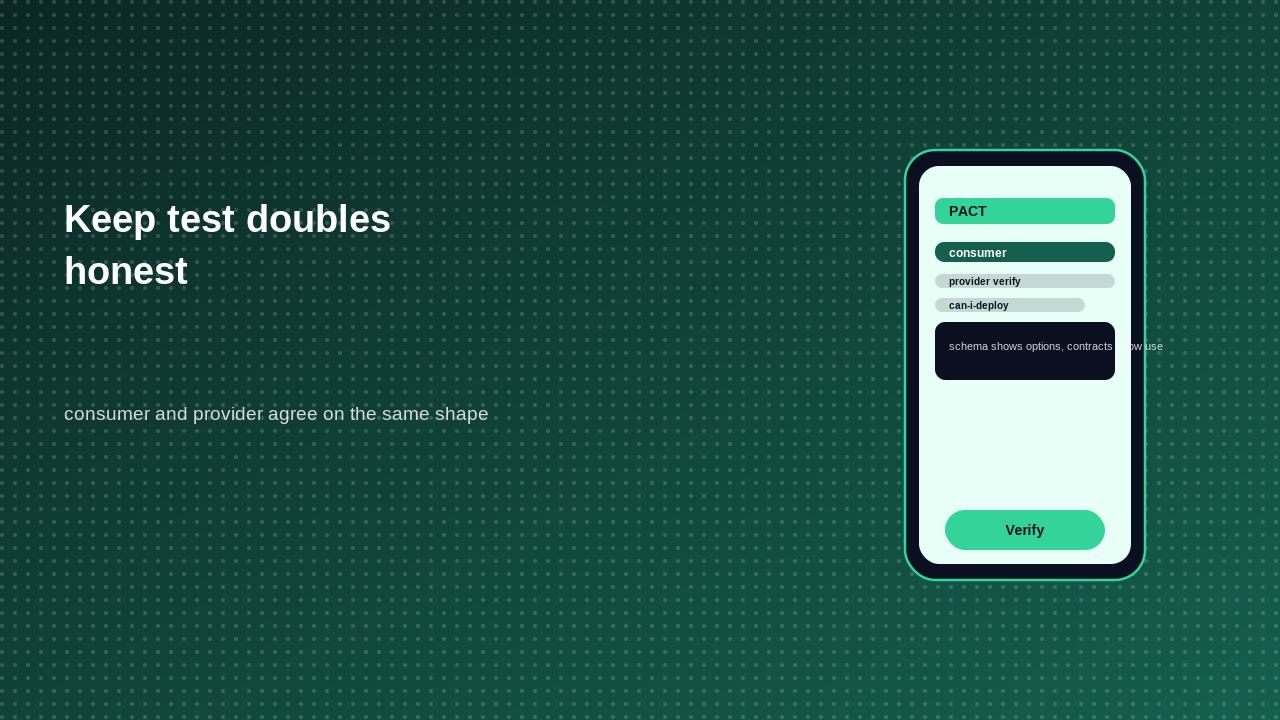
Pact made the idea code-first. Its documentation, last updated 25 August 2026, describes contract testing as checking each application in isolation at an integration point, with the roles fixed as consumer and provider. Pact calls its form "contract by example" and contrasts it with a static artefact that describes all possible states of a resource. The distinction runs deeper than terminology. Pact's own docs state that provider contract testing alone only confirms a provider matches its documentation; it provides no test-based assurance that consumers call the provider correctly. The OpenAPI Specification v3.1.0, published 15 February 2021, is a programming-language-agnostic interface description for HTTP APIs: paths, operations, parameters, request bodies, responses, media types, schemas and examples. It describes possibility. A contract test executes the interactions a consumer actually relies on. Schema validation and example-by-example contracts answer different questions, so each covers the other's blind spot.
The gate that answers with an exit code
The Pact Broker turns accumulated verification results into a matrix of consumer and provider versions verified against each other. Its can-i-deploy documentation, last updated 5 October 2022, shows a call such as pact-broker can-i-deploy --pacticipant Foo --version 23 --to-environment production, where exit code 0 means yes and exit code 1 means no. Deployments are recorded separately, with a command like pact-broker record-deployment --pacticipant Bar --version 56 --environment production. Older Broker setups track environments through tags; newer ones use environments, deployments and releases. The answer is a deployment gate evaluated against recorded verification results. It carries no service-level promise. Treating exit code 0 as an availability guarantee mixes a CLI result with a runtime SLA.
That boundary deserves a paragraph of its own. A passing verification says a recorded interaction still matches across two versions; it says nothing about whether the whole user path works, and nothing about latency, throughput or error rates. Contract tests therefore sit alongside end-to-end tests and performance tests, and replace neither. Schema validation and provider verification are complements as well: the first enumerates what an API may look like, the second exercises what a caller does look like. Robinson's warning about breaking changes survives every tool in this stack — a renamed required field is still a breaking change even when the Broker matrix is green. The source material contains no first-hand measurement of how much faster a mini-program team ships with any of this. A shared runtime changes how often an integration gets repeated, which is a mechanism; the material offers no defect-rate figure.
Where the reuse lands
An open catalog and a shared runtime change the unit of integration work. A capability that reaches several host surfaces through one runtime carries a single boundary contract, and a verification recorded against that boundary travels with it. The payoff is structural: fewer places where the same request shape has to be restated and rechecked, and a sharper question to ask when a host changes its side of the call. The four URLs below are the primary record; everything above is a boundary condition worth keeping in view.


