

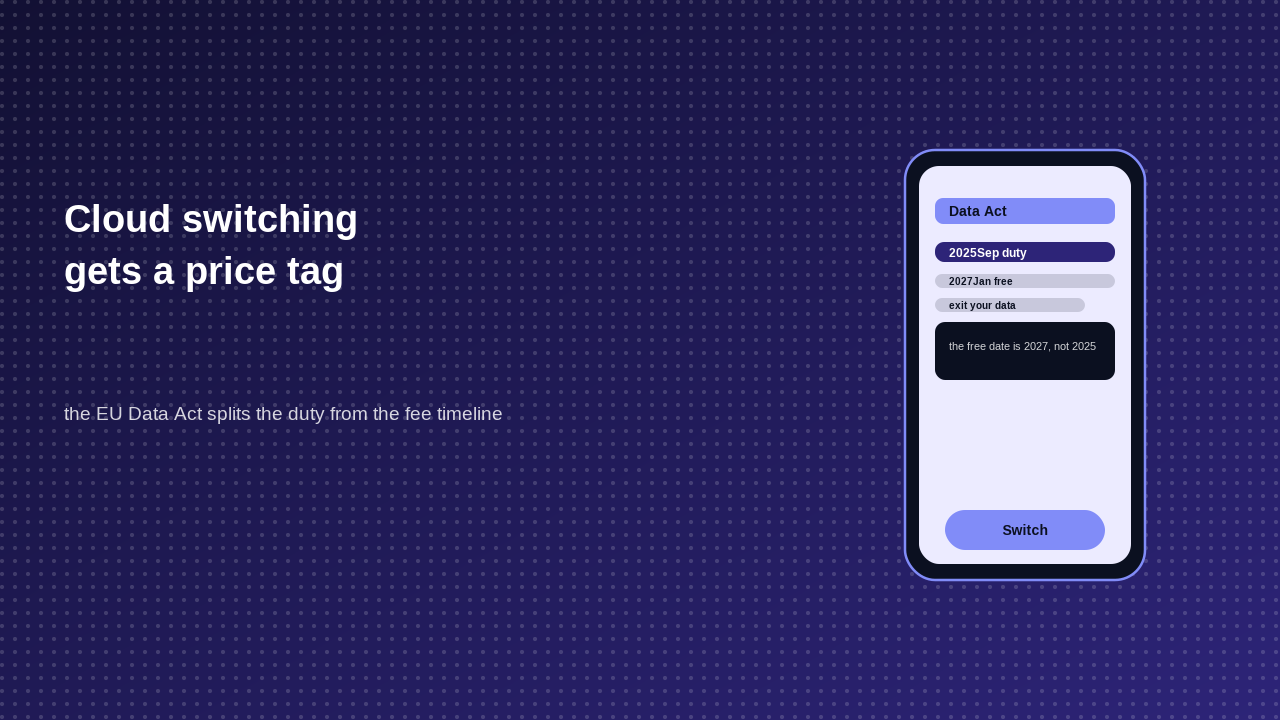
A charge that outlived the rule
Between 11 January 2024 and 12 January 2027, a cloud provider could still bill a customer for the actual cost of leaving — including during the stretch in which the Data Act's switching duties were already applicable. That overlap is the part most summaries skip. Regulation (EU) 2023/2854 entered into force on 11 January 2024, its Chapter VI obligations began applying on 12 September 2025, and the charges did not fully disappear until 12 January 2027. Three dates, three different legal states. A procurement team reading only the first headline would conclude that exit charges were already illegal in 2024; a team reading only the last one would conclude that nothing changed in 2025. Both readings miss the middle, where the duty to remove switching obstacles coexisted with a lawful charge for the actual cost of exercising it.
Seven milestones, five worth tabulating
The legislative record is longer than the operative calendar. The Commission proposed the act on 23 February 2022, political agreement followed on 28 June 2023, the act was dated 13 December 2023 and published in the Official Journal on 22 December 2023. A proposal and a political agreement are not law. Entry into force came on 11 January 2024, main application on 12 September 2025 — twenty months later — and the end of the charging regime on 12 January 2027.
| Date | Legal status | Practical effect |
|---|---|---|
| 23 February 2022 | Commission proposal | Not law; a starting point only |
| 13 December 2023 | Act adopted | Published in the Official Journal on 22 December 2023 |
| 11 January 2024 | Entry into force | Regulation alive; duties still dormant |
| 12 September 2025 | Application date | Chapter VI switching and interoperability duties apply |
| 12 January 2027 | Transition ends | Switching fees and data egress charges prohibited |
What Chapter VI actually asks
From 12 September 2025, providers of data processing services — cloud and edge — must remove obstacles to switching and to parallel use of several providers. PaaS and SaaS providers must offer open interfaces and export data in a commonly used machine-readable format; IaaS providers must take functionally equivalent measures. Portable data covers inputs, outputs and metadata, while excluding material protected by intellectual property or trade secrets. Chapter VIII adds the interoperability framework for data spaces and cloud interoperability, including standards and specifications.
Recitals (88) and (89) explain the cost phase-out. During the transition a provider may charge the actual cost incurred by switching and data export; after 12 January 2027 those charges end. Standard service charges sit outside that category, and a customer who asks for extra services can still be billed for them. Saying that the cloud can no longer charge for egress flattens a distinction the text deliberately keeps.
The boundary, and the tradeoff
The obligation falls on providers of data processing services and on the contracts they sign, not on every business that receives a cloud invoice. It is an EU regulation with EEA relevance, not a worldwide pricing rule. The Commission's explanatory page carries a legal notice stating that it does not represent an official position — useful policy explanation, not a binding interpretation. No Data Act fine figure has been verified here, so none belongs in this article. Likewise, "intercloud" is not a term used in the text, and interoperability under the regulation is a framework still being built rather than a finished single standard.
There is a tradeoff worth naming. Portability work competes with feature work, and a 2027 deadline gives a small team no extra leverage when negotiating with a large provider. The regulation lowers one barrier, the contractual one, while leaving the engineering barrier exactly where it was. Lock-in becomes easier to audit because exit terms and export formats turn into statutory expectations, but the work of making an application portable — clear data ownership, machine-readable exports, a second provider tested in advance — stays with the engineering side.
Where the shared runtime fits
A shared runtime and an open catalog do not remove a cloud invoice, and no claim is made that they do. What they change is the shape of the migration: one build, one set of data-export adapters, reused across host surfaces, so that switching providers touches a small number of seams instead of every feature. For a product team building mini-programs on rented infrastructure, the consequence arrives through procurement and architecture rather than through a new personal duty.
An open catalog lets a capability be discovered and reused without a fresh install on each host surface, and a shared runtime keeps the integration surface area small enough that a provider change can be absorbed rather than feared. That is a structural inference, not a measured saving, and the honest version of the claim stops there. The regulation sets a date for removing contractual friction; the engineering discipline that makes switching cheap has to be built before that date, not by it.


