

The number was already three tables downstream
A dashboard shows a session count that nobody trusts. By the time the question reaches the data team, the offending value has been copied into a staging table, aggregated into a daily summary, and merged into a report that a partner exported hours ago. Of the original record, nothing survives in the chart except the damage. The instinct is to add a check to the dashboard. The move that pays is walking upstream to the door where the value first arrived and putting the assertion there.
One scene carries the whole argument. Quality checks earn their keep at the point of birth. A check that runs late inherits every copy of the error, and the context that could explain the value has already been discarded.
Six words, seven dimensions, several owners
The vocabulary everyone reaches for is a familiar half-dozen: accuracy, completeness, consistency, timeliness, uniqueness, validity. Those words travel well because they give a product team, an analyst and a platform engineer the same nouns to argue over. The count deserves a footnote. The repeated six is a convention, while the official documentation consulted for this piece lists seven dimensions, adding freshness and volume. ISO 8000-8 does not supply the six; it discusses syntactic, semantic and pragmatic quality. The DAMA six-dimension material lives in a PDF that was not verified here. Folding those two claims into one sentence produces a lineage the sources do not support.
Google Cloud's document also shows how opinionated a dimension list can be. Custom dimension names are permitted, restricted to uppercase letters and capped at thirty characters, which is why one team declares TIMELINESS where another writes FRESHNESS for the same concern. A single scan takes up to a thousand rules. Those are product limits in one vendor's documentation, not properties of data quality itself.
The four pairs that get mixed up
| Dimension | What the check actually looks at | Where it misleads |
|---|---|---|
| completeness | Whether a field inside a record carries any value at all | A filled field can hold the wrong value; emptiness is the only thing measured |
| validity | Whether an existing value fits a format, range or allowed set | A well-formed phone number can still belong to somebody else |
| accuracy | Whether the value reflects the real-world thing it describes | Hard to assert without an external reference, so it is often assumed instead of tested |
| consistency | Whether two systems agree with each other | Both systems can store the same wrong value and pass |
| volume | How many records arrived in total | A healthy row count says nothing about whether the rows are filled |
The distinction that earns its keep is between validity and accuracy: a value can be valid without being accurate. Consistency has the same trap in a different direction. Two systems agreeing is evidence of agreement and very little else. Completeness asks only whether a slot is occupied; volume counts the slots. None of these substitutes for another, and a clean result on one leaves the others unexamined.
An assertion is a query with an opinion
Great Expectations puts it plainly: an Expectation is a verifiable assertion about data. The built-in library, at the version documented here (0.18.21), reports more than fifty Expectations, covering non-null columns, unique values and row-count bounds. Expectations are grouped into Suites, and a Checkpoint is the usual way to run them in production. dbt takes a different shape. A data test is an assertion about models and other project resources, including sources, seeds and snapshots. Underneath it sits a select query that returns failing rows; zero rows means the test passes. The current documentation lists four generic tests — unique, not_null, accepted_values and relationships — and allows generic tests to be declared on sources.
Both counts are version-sensitive. "More than fifty" is a library self-report, and the four generic tests are one frame of the current dbt docs. Treating either as a permanent inventory ages badly.
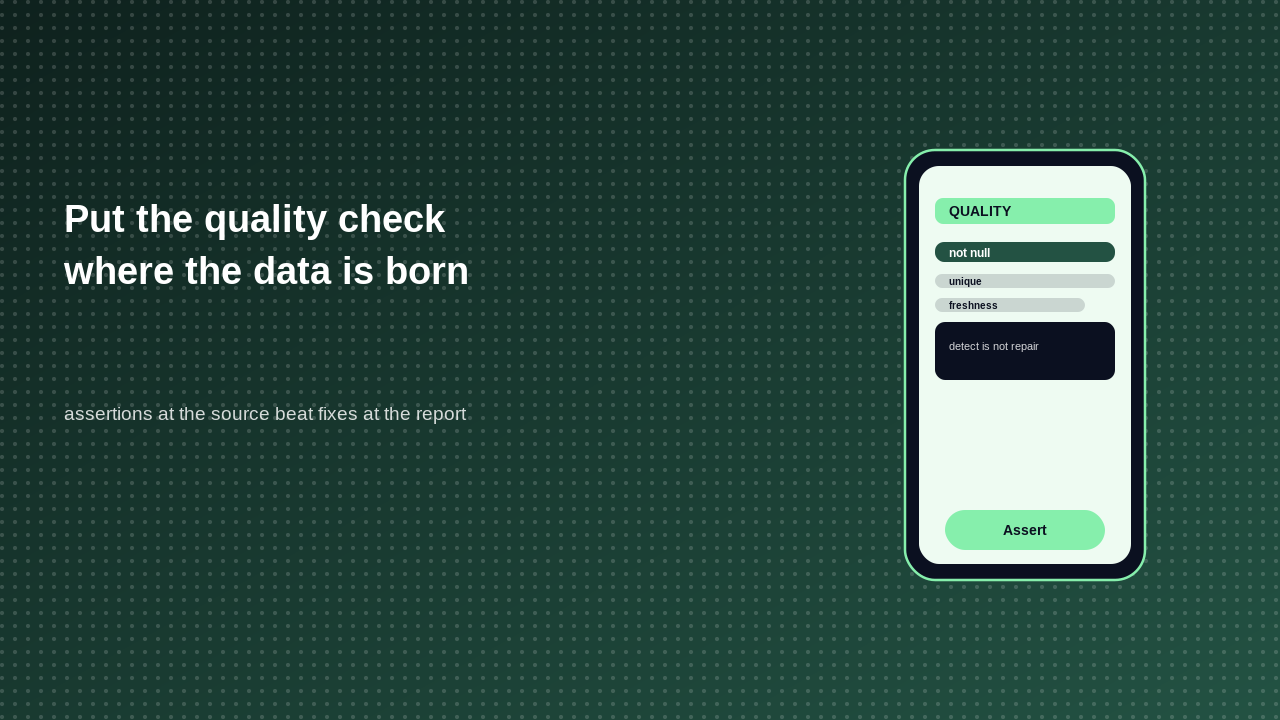
The shared detail matters more than the count. Both tools let a check live on the source. That is exactly where cheap, high-yield checks belong: freshness, nulls, uniqueness, a row count that looks too small. These are the assertions worth left-shifting, because a source is the last place where a bad value exists in only one copy.
Detecting a problem and fixing it are two jobs
Here is the honest limitation. A dbt test returns failing rows. A Great Expectations Checkpoint reports a failed assertion. Neither repairs anything, and neither explains why. A Monte Carlo vendor article draws a line between data testing, data quality monitoring and data observability, and argues that tests struggle with coverage and root cause. That framing is a vendor's classification rather than a standard; the five pillars it proposes — freshness, quality, volume, schema and lineage — belong to the same framework. The article also carries rhetorical figures about firefighting time and table share that belong inside a vendor blog post and should never be promoted to an industry benchmark.
A team that treats an assertion as a repair will be disappointed. The assertion is a tripwire. The repair is separate work with an owner, a cause, and a decision about whether the upstream producer changes its behaviour. There is a real trade-off. Every assertion added at the source is a contract someone must maintain, and a check that fires constantly teaches everyone to ignore it. Restraint is part of the craft.
Where the shared runtime fits
Cross Mini App provides a shared runtime and an open catalog as access points: one place to register a source, one place to attach a check, one place for a consumer downstream to see that a value failed. They do not manufacture quality, and this article carries no measured mini-program figures about null rates or duplicate rows. The architecture makes left-shifting practical; choosing which assertion deserves to exist remains a human decision.
Start with the field that looks most harmless. Write the assertion at the moment that field arrives, before the first join multiplies it. Waiting for the dashboard to go crooked means writing it after the value has already crossed three tables.


