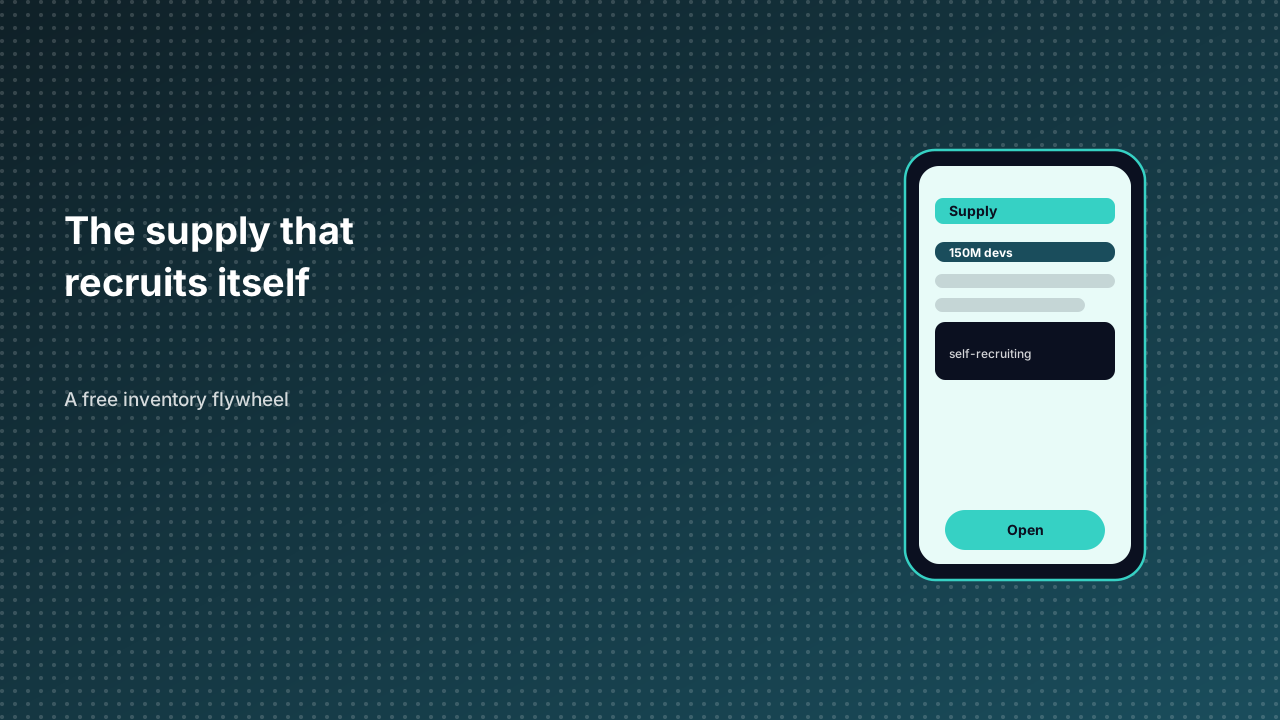
The hard part of a catalog is not the software. It is the supply. Recruiting developers — paying for hackathons, evangelism, incentives — is a cost center that scales with ambition. The operators who win do not pay for supply; they build a flywheel where developers recruit themselves. A host that already has that flywheel turns a catalog's biggest expense into a free input.
The scale of an existing flywheel
WeChat's mini-program platform alone聚集 over 150 million developers, more than 1 million published mini-programs, over 5 million cumulative registrations, and 5,000+ third-party platforms across 200+ industries. The mini-game segment pushes past 400,000 developers, 80% of them teams of 30 people or fewer, with 70% of listed game companies already participating. JetBrains' 2025 survey found 30.27% of Chinese professional developers building mini-programs — it is no longer a niche, it is a default.
How the flywheel turns for free
The mechanism is not a bonus, it is infrastructure. WeChat's 2026 "AI applications and online tools growth plan" offered free cloud resources, 100 million Tencent Hunyuan tokens, and traffic incentives; 63,000 mini-programs joined, more than 60% from individual developers. AI-application mini-programs grew nearly 40% in half a year, and a one-sentence generation tool lets a non-developer describe an app and get a working draft. A hackathon drew 800+ developers and 500+ community members in two weeks. None of this was bought by a catalog operator — it was borrowed.
| Source of supply | Cost to the catalog operator | What it yields |
|---|---|---|
| Standalone recruiting | CAC per developer, events, incentives | Uncertain, slow |
| Host flywheel | Zero marginal | 150M developers, self-serve |
Why borrowed supply compounds
When a developer builds once and the catalog offers it to many hosts, the same unit of supply serves multiple distribution channels at no extra recruitment cost. The host's flywheel — free tooling, free compute, community, traffic — does the acquiring. The catalog operator's job shifts from "find developers" to "curate and route what already exists." The supply that recruits itself is the supply that scales without a line item.
The trade-off to name
Borrowing a host's developer flywheel means the catalog lives by the host's rules — its review process, its revenue share, its technical ceiling. A business that must own the developer relationship, or that needs capabilities the host does not offer, will build its own supply and pay for it. But for reach, the self-recruiting flywheel is the cheapest inventory in tech: it costs nothing and compounds anyway.
The flywheel compounds across hosts
The neat trick is that borrowed supply does not reset at each host boundary. A developer who builds once and publishes to an open catalog is instantly available to every host running the same runtime, so the same recruitment event serves multiple distribution channels. The catalog operator's inventory grows each time the host's flywheel turns, with no additional spend. Supply that recruits itself and then multiplies across hosts is the closest thing the catalog model has to free growth — and it is the reason a catalog's value accelerates with each new host rather than being diluted by it.
Sources
- WeChat mini-program ecosystem 2025 — 150M developers, 1M+ published, 50B cross-border uses.
- Developer ecosystem detail — 400k mini-game devs, 80% <30 people, 30.27% of devs.
- WeChat AI growth plan — free tokens, 63k joined, >60% individual.
- Tencent Cloud Agent Hackathon — 800+ developers, 150k cash pool.