

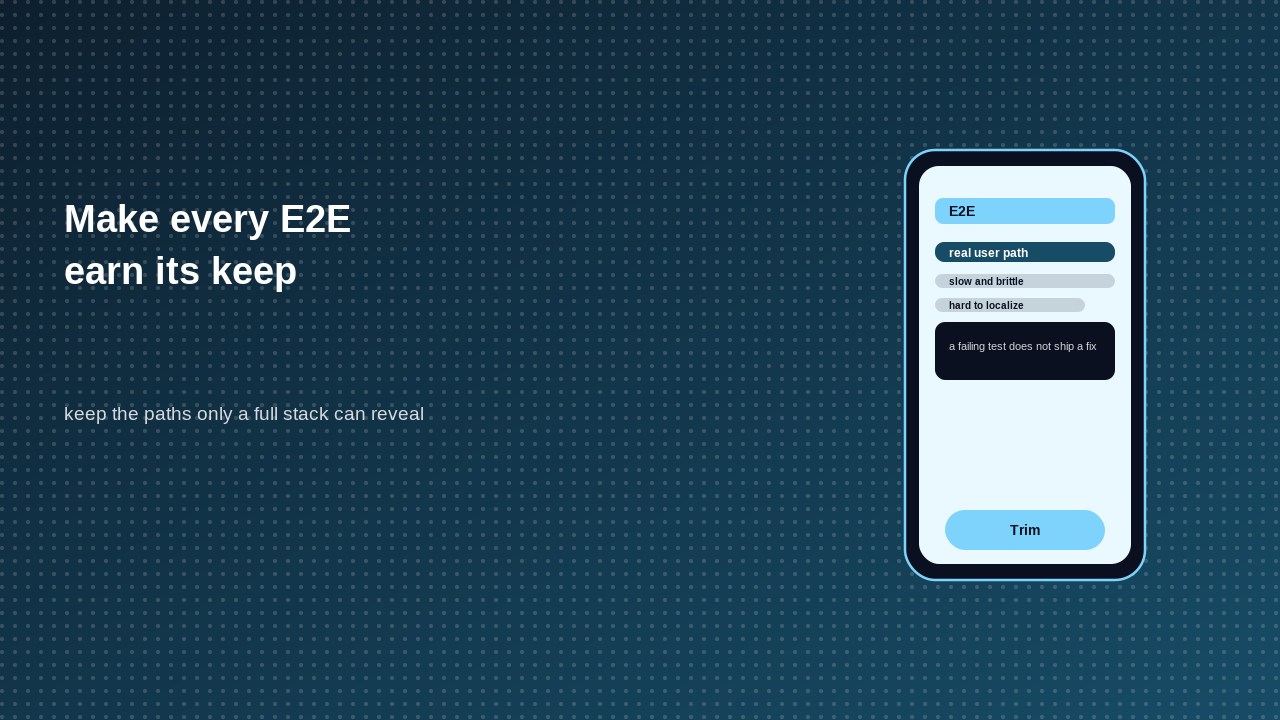
The 2015 line that changed the question
On 22 April 2015, Mike Wacker published a post on the Google Testing Blog containing a sentence that still cuts through most testing debates: a failing test does not directly benefit the user, while a bug fix does. The distinction sounds pedantic until a release is blocked by a long, slow end-to-end suite. That suite has done nothing for the person waiting on the app. What matters is the whole feedback loop — from a broken behaviour to a diagnosis a developer can act on — and whether it is fast, reliable, and narrow enough to be useful.
The reframing moves the question from defect counts to how quickly a team can fix and prevent defects. A layer is judged by the loop it creates. Counting red marks tells a different and less useful story.
Three properties, one honest comparison
Wacker described an ideal feedback loop as fast, reliable, and able to isolate failures. In his comparison, end-to-end tests lead on simulating a real user and trail on the other three. Fowler's Broad Stack Test bliki, dated 22 April 2013, supplies the positive case: such a test finds "bugs in the interaction between components in the way that component tests cannot." The value sits at the seams between systems. The cost sits there too.
| Property | What the sources actually say | What it does not justify |
|---|---|---|
| Simulates a real user | Wacker's 2015 comparison puts end-to-end tests ahead here | That a red test directly benefits the user — the same post credits the fix |
| Fast feedback | "One tenth of a second is considered slow for unit tests" is the author's own threshold | Treating that tenth of a second as an end-to-end performance target |
| Reliable | Flakiness in end-to-end suites "tend[s] to be a fact of life" | Counting retries as a repair rather than a cover-up |
| Isolates failures | After an end-to-end failure, "that bug could be anywhere in the product" | Reaching for end-to-end tests first when diagnosing a failure |
| Cross-system seams | Fowler says a broad stack test finds interaction bugs component tests cannot | Crediting the Google post with the seam argument, which is Fowler's |
The exceptions that do not dissolve the rule
In April 2015 Wacker offered a 70/20/10 split — roughly 70 percent unit, 20 percent integration, 10 percent end-to-end — and immediately called it "a good first guess," adding that "the exact mix will be different for each team." As a standard it is wrong. As a starting point that keeps a pyramid shape, it is useful. The two failure shapes he named travel well: the ice cream cone, where end-to-end work dominates, and the hourglass, with heavy unit and end-to-end layers but almost nothing in between.
Fowler's Test Pyramid bliki, first published 1 May 2012 and revised in 2016 and 2017, is usually quoted for the instruction to keep many more low-level tests than broad-stack ones running through a GUI. It is just as clear about the boundary. Broad-stack tests are described as brittle, expensive to write, and time consuming to run, and a failure at that level should first be reproduced with a unit test. The same bliki records a real exception: if high level tests are fast, reliable, and cheap to modify, lower-level tests are not needed. That is a conditional judgement about a specific suite, not a general licence to skip unit tests. It further warns that end-to-end tests, UI tests, and customer-facing tests are orthogonal characteristics that teams routinely conflate.
Two source-level cautions belong alongside that. The canonical Google Testing Blog page returned only its title, date, author, and comments when opened; the argument above was checked paragraph by paragraph against the blog's Blogger mirror, so no claim is made here about having captured the canonical full text. W3C's WebDriver document at /TR/webdriver2/ is a Working Draft dated 09 November 2026 on the Recommendation track, not a finished Recommendation. The protocol itself is worth knowing: a platform- and language-neutral remote control interface, derived from Selenium WebDriver, that lets a separate process introspect and control a user agent. Status matters when a team writes "the standard requires" in an internal document.
Playwright is often named as the default end-to-end framework. The current official docs describe it as bundling a test runner, assertions, isolation, parallelization, and rich tooling across Chromium, WebKit, and Firefox, on Windows, Linux, and macOS, with mobile emulation for Chrome on Android and Mobile Safari. Those browser, platform, and Node.js version lines — currently 22.x, 24.x, and 26.x — shift with releases. Treating the list as permanent, or as a mini-program capability, is a category error.
Where a small suite pays off twice
No mini-program benchmark appears in the sources reviewed, and none is needed. The mechanism is structural. A shared runtime and an open catalog let one capability reach multiple host surfaces without a fresh download-and-install cycle on each, so a seam worth testing is often the same seam on every surface. One well-chosen end-to-end path across that seam can be specified once and exercised wherever the host allows it, while fast unit and integration layers carry most of the feedback near the code that changed. Cross Mini App is the connective tissue here; no timing figures are attached to it. Treat end-to-end coverage as a scarce budget and the seam argument starts to make sense.


