

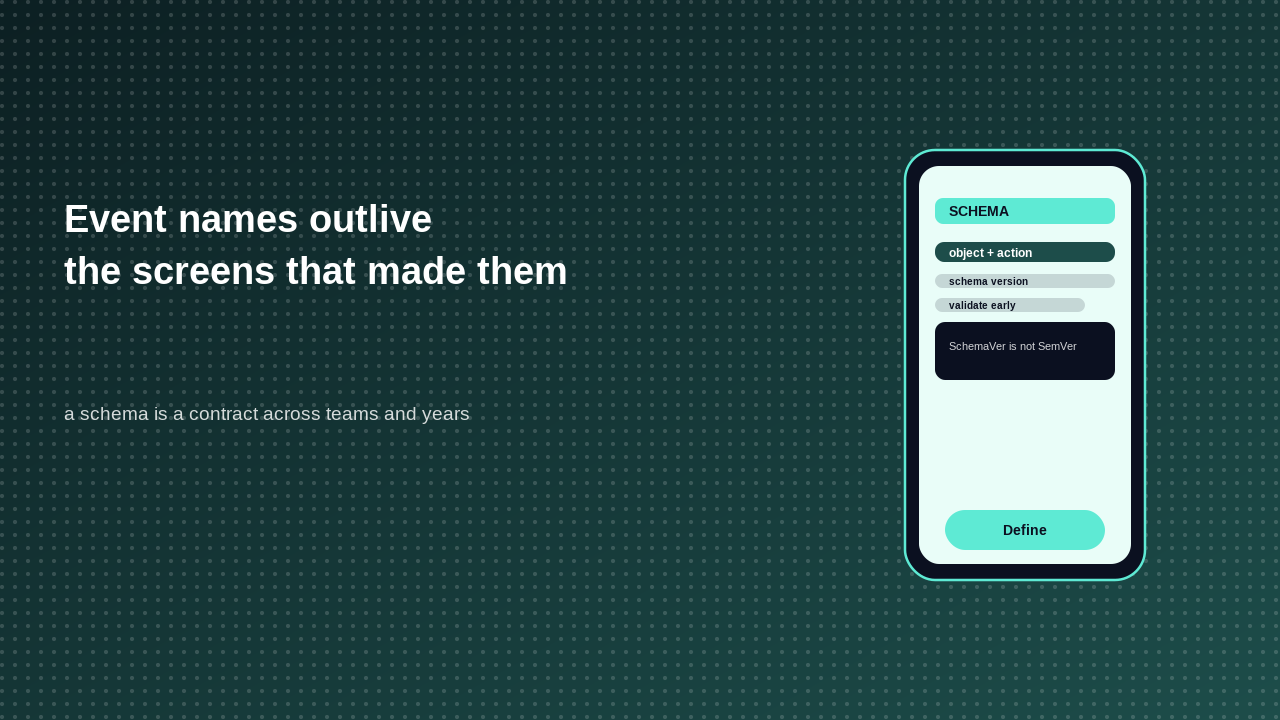
The screen goes away; the name stays
A checkout sheet ships in one release, gets redesigned, and is finally removed. Months later the weekly report still filters on the event name invented for that sheet, because the funnel definition, the downstream table and the archived quarter all reference it. Nobody remembers the screen. The string is still load-bearing.
That gap is the real subject of event schema work. A name is picked in an afternoon by whoever writes the instrumentation call. It then gets bound to reports, funnels, warehouse columns and historical data, none of which can be quietly rewritten when a better name occurs to someone later. Calling this a contract is accurate in the engineering sense. It is a set of expectations shared across teams and enforced by code. It carries no legal weight, and treating it as law tends to produce a policy nobody follows.
Four systems, four dialects
Naming advice is not universal, and the disagreements are concrete. Google Analytics 4, documented in this research on Google's official Chinese mirror, uses short snake_case recommended events such as purchase, login and sign_up. Segment asks for Title Case event names and snake_case property keys, built from an Object plus an Action, as in Blog Post and Read. Amplitude recommends a noun followed by a past-tense verb, and insists on consistent casing, grammar and actor. Snowplow cares less about casing and more about a schema that can be resolved and validated before data lands.
| System | Event-name shape | Property-key convention | What the convention actually fixes |
|---|---|---|---|
| GA4 | Short snake_case names such as purchase | snake_case parameters | Reserved names, prefixes and the 40-character limit |
| Segment | Title Case, Object plus Action | snake_case keys fixed at design time | One tracking plan treated as the source of truth |
| Amplitude | Noun plus past-tense verb, consistent casing | Bounded property sets | Casing, word order and the performer of the action |
| Snowplow | Name, vendor, format and version | Entities reused across events | Validation against a schema fetched before storage |
The same event can therefore be correctly named in several ways depending on the system in use. A team that copies Segment conventions into GA4, or assumes Amplitude's word order is a requirement everywhere, has imported a rule without its context. The dialect belongs to the vendor system, and the rule only makes sense inside that system.
Keep changing values out of names
The most useful piece of Segment guidance is a prohibition. A date, an identifier or a plan tier belongs in a property value, never inside the event name. A name like User Signed Up (11-01-2019) creates a fresh event every day and fractures a continuous trend into a scatter of unrelated rows. The same logic rules out dynamically generated property keys such as feature_1 and feature_2. Each key becomes a column in downstream tools, so a naming habit turns into a schema problem at scale.
The alternative is less glamorous and more durable. Keep one event such as Workspace Created and attach account_tier=business as a property. Segment's tracking plan records three things for each event: what is collected, where in the code it fires, and why the business needs it. That document is the single source of truth the rest of the analysis refers back to. Starting with a small set of core events carrying rich properties beats accumulating a verb list of near-identical names.
Amplitude adds a different consistency test. Song Played and song played are counted as two separate events, and so are Song Played and Played Song. The actor has to hold steady as well, so Message Sent should mean the same sender and recipient on every call. The official guidance recommends no more than twenty properties per event, and the same figure for user properties. That number is a vendor recommendation for implementation. Reading it as a platform hard limit, or carrying it into another tool, overstates what the documentation says.
Versioning is a separate grammar
SchemaVer and SemVer follow different logics, and the difference reaches into how historical data behaves. Snowplow's three segments are model, revision and addition. A model change is breaking, comparable to moving to a new table in a relational warehouse. An addition is fully compatible with existing data. A revision sits awkwardly in the middle: the documentation says it may interact with historical data, which is a careful way of saying that a backfill and a fresh event may not line up. Reading revision as backward compatible is the classic mistake.
A model bump from one to two can create a new table or new columns in the warehouse, with column suffixes changing alongside it. The schema key itself has four parts, name, vendor, format and version, and the current format is jsonschema, a subset of one version of that standard. An event is validated against the schema fetched from Iglu before it is accepted into storage, and anything that fails is handled separately. That ordering matters more than any naming convention, because the moment before storage is the last point at which a bad event can still be caught.
Snowplow's framing is worth keeping. A schema has to carry data meaning, data quality and data governance at once. The constraints are agreed in advance between consumers and developers, then enforced by the pipeline. A reusable entity, such as an article object attached to a scroll, a page view or a click, shows why the split helps. The entity carries the shared description, while each event keeps its own action.
The expensive part is retirement
Anyone can invent a good name. The hard work starts when a name turns out to be wrong after reports and history depend on it. A rename behaves like a migration across dashboards, funnel definitions, downstream tables and archived periods. Treating it as a search and replace in the instrumentation code misses most of the work. Some of that history cannot be reconstructed at all, which is why time spent on a naming argument early looks cheap in retrospect.
The tradeoff is real. A stricter naming process slows the first release, and a schema that tries to anticipate every future question becomes its own bottleneck. A workable middle ground is a short tracking plan, a naming dialect chosen to match the vendor system in use, and a version segment that states plainly what kind of change is being made. Ceremony for its own sake has no place here. What matters is keeping the number of names that outlive their screens small enough to remember.
A shared runtime and an open catalog let one capability reach several host surfaces, which raises the stakes of a single naming decision. The screen that prompted an event may be gone by the next release. The name keeps answering questions long after that.


