As third-party cookies disappear across browsers and app-tracking restrictions tighten, the scarce asset is no longer reach — it is verified, privacy-compliant, high-intent first-party data. Super-apps sit on the most valuable variant of it: transactional data, not just behavioral. A host running a mini-program catalog already captures that signal with every launch, and the monetization gap is the part most operators leave on the table.
Transactional beats behavioral
Social platforms capture intent — likes, clicks, searches. A super-app captures the act: where a user lives, what they eat, how much they spend, whether they pay on time. Grab's advertising business reached a $236 million annualised run-rate by mid-2025, growing 45% year-on-year, built entirely on that transactional signal. Shopee's advertising revenue grew over 70% year-on-year in Q3 2025. The targeting capability rivals Google and Meta's — and in some ways surpasses them, because the data is real spend, not inferred interest.
The CPM premium
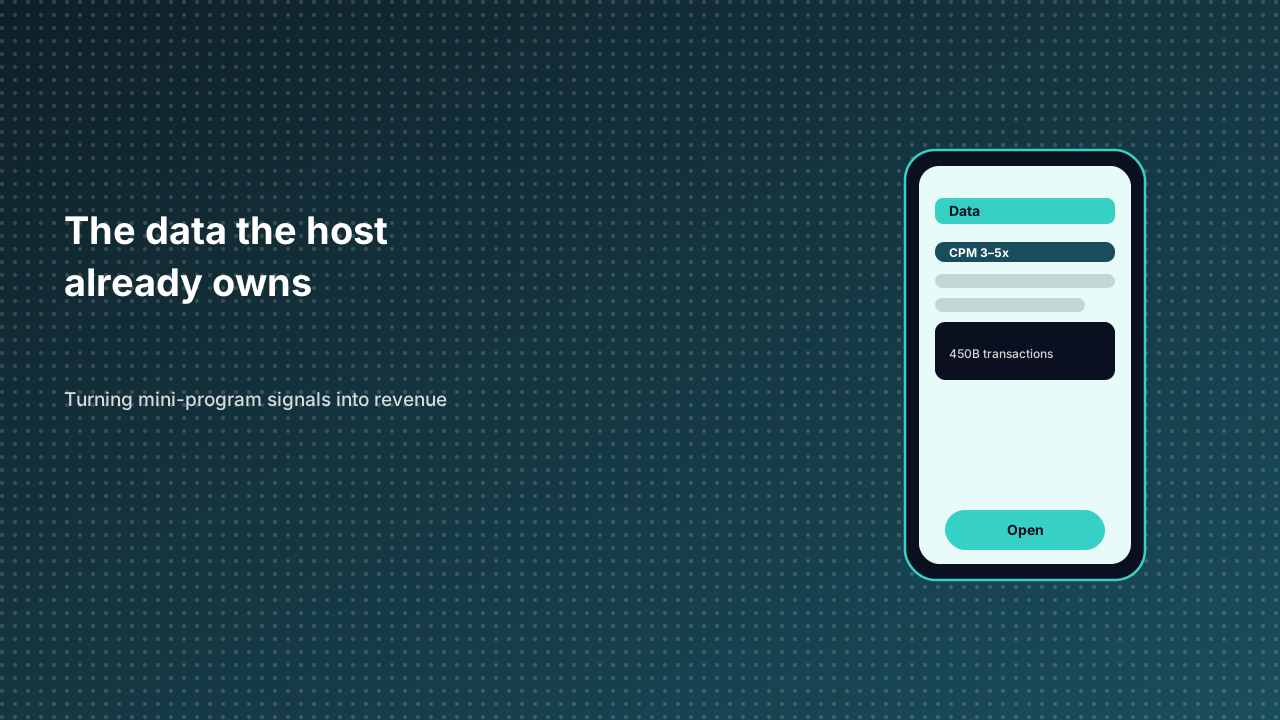
Advertisers pay for certainty. The top five global card issuers processed data from over 450 billion consumer transactions in 2025, and audiences built on transactional signals command CPM premiums averaging 3x to 5x open-market rates. Investment in data clean-room technology — which lets brands match their data with financial segments without either side exposing raw personal data — grew over 120% in 2024–2025. The direction is clear: closed-loop, consent-managed first-party data is becoming the compliant alternative to the open web, and it is priced like one.
Where the host captures it
A mini-program catalog is the instrument. Every launch, every in-app purchase, every cross-sold service is a labeled signal attached to a known identity inside the host's perimeter. The host does not buy this data; it generates it as a byproduct of running the surface. That is the structural advantage over a standalone ad network, which must reconstruct identity from cookies it no longer has.
The data revenue table
| Signal | What it reveals | Monetization precedent |
|---|---|---|
| Spend category | Lifestyle, income proxy | GrabAds $236M run-rate |
| Repayment behavior | Creditworthiness | Sea Monee $9.2B loans, 1.1% NPL |
| Frequency | Habit, churn risk | Shopee ads +70% YoY |
| Cross-service use | Upsell timing | Grab financial rev +37% YoY |
Where the data story breaks
The monetization only works inside consent-managed, closed-loop environments. A host that leaks raw personal data, or activates it without explicit consent, trades a durable asset for a fine and a churn event. The 450 billion transactions are valuable precisely because they sit behind a regulated perimeter. The discipline — clean rooms, consent, attribution — is the cost of the revenue, and the part most catalogs skip when they rush to monetize.
Conclusion
The evidence shows the host already owns the most valuable data asset in digital advertising: verified transactional signal captured at the moment of intent, inside a compliant perimeter. As cookies vanish, that asset appreciates, not depreciates. A mini-program catalog is the collection instrument; the monetization is the part operators consistently underbuild. A portable runtime such as Cross Mini App gives a host the catalog without rebuilding the surface — and the data it generates is the margin the host was not counting.
Sources
- Digital in Asia — Asia's super apps business models — GrabAds, Shopee ads, transactional data.
- Market Intelo — Financial services retail media networks — CPM premiums, clean-room growth.
- AppsFlyer — Sub-Saharan Africa app marketing 2025 — first-party data and mobile money.
- Digital in Asia — Super app data density — Sea Monee, Grab financials.