The waiter was busy. Not rude — just slammed on a Saturday at 7pm, the kind of night where flagging someone down means standing up and looking like a tourist in your own city. So the table did what the regulars in Chengdu have done for years: scanned the code, picked three dishes, split the bill four ways, and paid. No menu that sticks when you turn the page. No awkward wave. The food came; the table turned. That loop — order, pay, leave — is the quiet engine of Chinese dining, and almost nowhere in the West has it as a default.
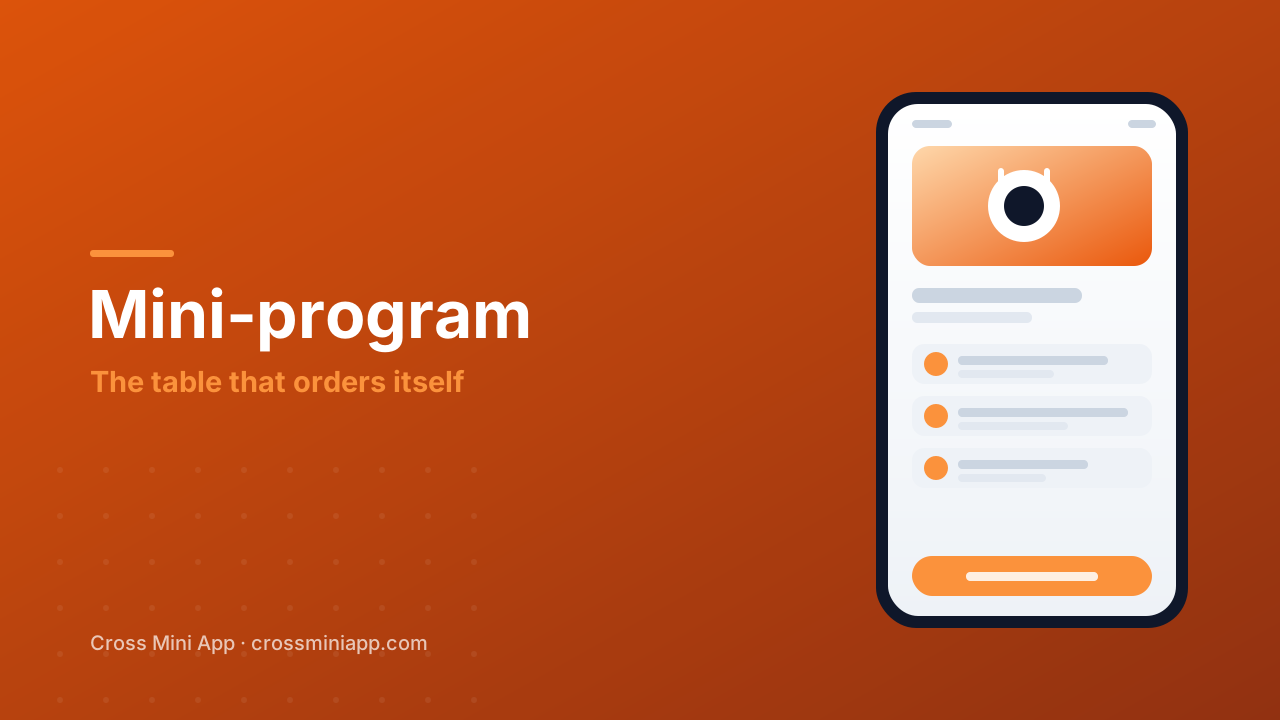
A restaurant is the perfect mini-program surface because the intent is local, immediate, and repeatable. You're already at the table. You don't want to install a branded app for a meal you'll have once a month. A mini-program that opens from a QR on the table, or from the map entry of the host app, meets the intent exactly where it lives. For the operator it means fewer missed orders, faster table turns, and a payment that doesn't depend on catching a server's eye.
| Diner moment | What the mini-program does | Why it beats the website |
|---|---|---|
| Seated, hungry | Menu opens from the table QR | No app install, no "create account" wall |
| Group of four | Splits the bill in seconds | The math isn't a group-chat negotiation |
| Order in | Sends straight to the kitchen | No misheard item, no server as middleman |
| Done | Pays and leaves, no wait | The table frees up without a checkout line |
Here's the pushback the POS industry won't like. The story they sell is that you need a full point-of-sale overhaul to do QR ordering. You don't. The ordering flow is a thin front end on top of the kitchen ticket you already print. The hard part was never the menu; it was the closed ecosystem that locked the menu to one vendor's hardware. A portable mini-program runtime untangles that — the restaurant keeps its kitchen, and the ordering UI travels with the customer's host app instead of the vendor's tablet.
And the loop compounds. A first-time scanner becomes a repeat because the next visit, the table remembers the usual, the payment is one tap, and the loyalty stamp lands without a separate card. Restaurants live and die on table turns and repeat rate; a mini-program that shortens both is not a gimmick, it's margin. The places in China that won at this didn't add features, they removed steps.
The local angle is the part Western operators underestimate. Dining discovery is hyper-local — you pick the place two streets over, not a chain you researched for a week. Mini-programs are discovery-light: the diner finds the restaurant through the host's map, a friend's share, or the code on the door. That's cheaper and stickier than a paid install campaign for a restaurant app nobody asked for, and it already proved out in Chinese cities where the scan-to-order habit is now the baseline, not the novelty.
The thesis worth stating plainly: the scan-order-pay flow that already runs millions of tables a day in China doesn't need reinventing for Bangkok, São Paulo, or Lagos. The behavior is identical — sit, scan, eat, pay. What's missing is a runtime that renders the same flow inside whatever super app or messenger a market already lives in, plus an open catalog of restaurant templates so a local owner doesn't start from a blank screen. You don't export a Chinese dining app; you export the proven pattern and let a universal runtime render it inside the local host.
I won't pretend it's trivial. Menus are local — language, spice levels, modifiers, and the tax-and-tip math differ by country. Payment rails that feel native in one market feel foreign in the next, and splitting a bill across wallets that don't interoperate is a real headache. A template catalog helps only if someone maintains it; a stale menu is worse than a paper one. The honest risk is treating restaurants as a demo and skipping the kitchen-integration and settlement work that real F&B actually demands. We shouldn't.
But the direction is clear. The diner is already at the table. The kitchen already prints tickets. The payment already clears. The only missing piece is a runtime that carries a proven Chinese ordering flow into the app a Bangkok or Lagos regular opens every lunch. Build that catalog, keep the integrations local, and the table orders itself.
Sources
- StatCounter — Mobile market share — why a host app, not a new download, is the realistic front door.
- Think with Google — Consumer behavior — how diners discover and order nearby on mobile.
- World Bank — Commodity Markets and local commerce — where small-merchant payment and digitization gaps show up.
- web.dev — Web platform guidance — the runtime and performance basics behind a portable mini-program.
- MDN Web Docs — Web tech reference — the standards a portable ordering UI should build on.