Every layer between a maker and a buyer takes a cut, and each cut is a margin the maker never recovers. Direct-to-consumer models exist to reclaim that margin, and mini-program runtimes are the lightest way to do it: a brand reaches the customer through a host's existing app without surrendering the 15 to 25 percent a marketplace charges or the 30 to 50 percent a wholesale and retail chain keeps.
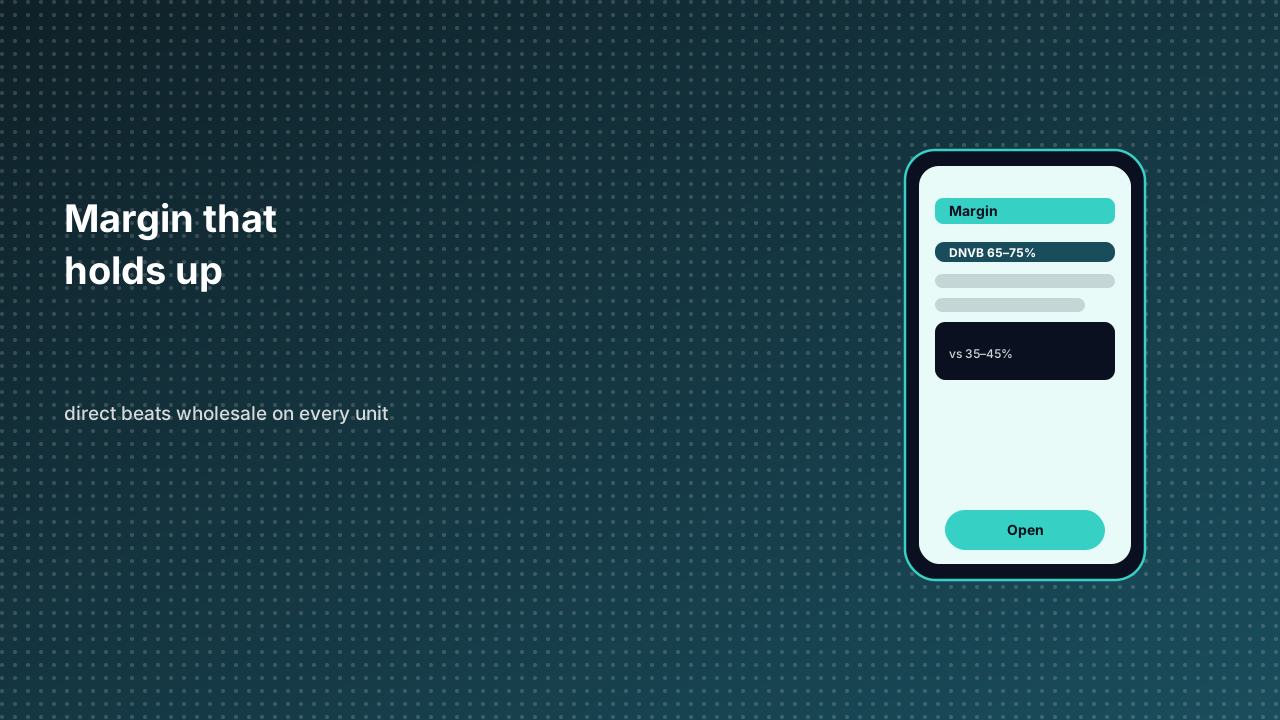
The numbers are not subtle. Brazilian digitally native brands operating their own D2C channels report gross margins of 65 to 75 percent, against 35 to 45 percent in the traditional wholesale model, a 30 to 40 percentage-point swing. Marketplaces sit in between, taking 15 to 25 percent of the sale value in commission. A mini-program inside a host app typically charges a negotiated revenue share that is settlable per transaction, and the brand keeps the customer relationship and the margin in between.
| Channel | Gross margin | Who keeps the customer |
|---|---|---|
| Wholesale + retail | 35–45% | Retailer |
| Marketplace | 50–75% (after 15–25% fee) | Marketplace |
| Owned mini-program | 65–75% | Brand / host partner |
The catch is that gross margin is not net margin. D2C carries per-order fulfillment, returns, and acquisition costs that wholesale pushes onto the distributor. One analysis of six brands found D2C gross margins ran 14.7 points below wholesale for the first 9 to 14 months, only turning margin-accretive around month 15 once repeat purchase exceeded 35 percent and returns settled below 18 percent. A mini-program does not repeal that curve; it compresses the timeline, because the host already supplies the traffic and the trust that a standalone D2C site must buy.
The strategic value is control of the relationship and the data. A marketplace owns the customer; a wholesale chain owns the shelf. A mini-program run by the brand, inside a host with scale, lets the brand keep first-party data and the full margin story while borrowing the host's reach. That combination is why disintermediation via runtime beats both pure D2C (which pays to acquire every visitor) and pure marketplace (which surrenders the customer).
The risk is margin dilution through undisciplined discounting. A brand that treats the mini-program as a clearance channel erodes the very gross margin it came to capture. The discipline that protects the gain is pricing parity across channels and treating the runtime as a flagship, not an outlet.
The point for a host is that margin return is a distribution argument. Opening the runtime lets partners reclaim 30 to 40 points of gross margin versus wholesale, which is a stronger recruitment pitch than a lower fee alone, because the partner's whole economics improve, not just one line item.
The measurement that matters is contribution margin after the runtime's take, not gross margin before it. A brand comparing channels should net out fulfillment, returns, and the revenue share paid to the host, then judge which surface leaves the most per order. On that basis the mini-program often wins not because its headline gross margin is highest, but because the fixed acquisition cost a standalone site must carry disappears into traffic the host already paid to acquire.
Sources
- DNVB margins in Brazil (D2C vs wholesale) — 65–75% D2C vs 35–45% wholesale.
- Margin difference wholesale vs D2C — 40% wholesale, 70% D2C gross margin.
- D2C brand strategy 2026 — 30–50% retailer margin removed.
- D2C year-one cost reality — 14.7pt gross margin gap first 9–14 months.