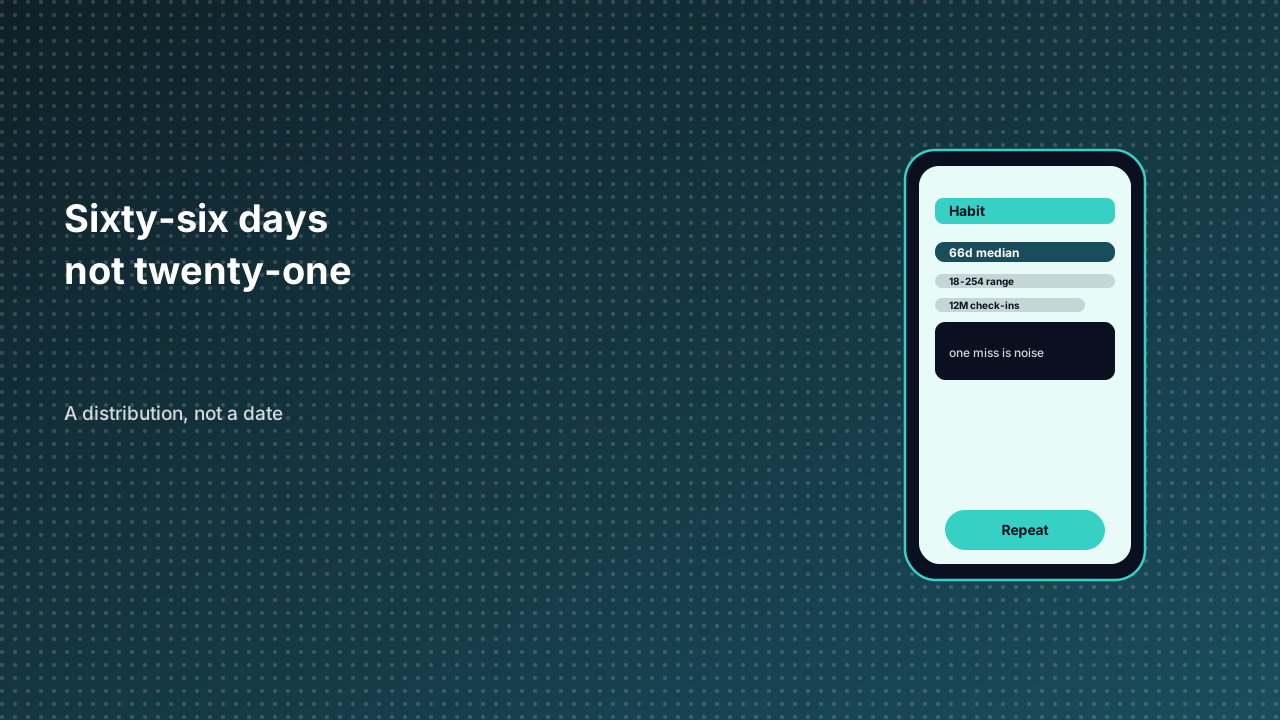
Twenty-one days is a sticker, not a finding. It came from a plastic surgeon's 1960 notebook, an observation about how long patients took to get used to a new face, and it has been sold ever since as the time required to install a habit. The real number, from the study people actually cite when pressed, is sixty-six days at the median, with a spread from eighteen to two hundred and fifty-four.
Lally and colleagues at University College London followed ninety-six volunteers for twelve weeks, asking them to pick one behaviour and do it daily while reporting how automatic it felt. The curve flattened slowly. Habit strength kept climbing toward ninety-five percent of its plateau for a median of sixty-six days. Some people arrived inside three weeks; others were still climbing at eight months. Crucially, missing a single day did not materially dent the process. The streak was never the mechanism.
| Claim | What the evidence supports |
|---|---|
| A habit forms in twenty-one days | Median sixty-six days, range eighteen to two hundred and fifty-four |
| Missing a day resets progress | A single miss is close to noise in the data |
| All behaviours take the same time | Gym attendance took months; hand-washing took weeks |
| Timing does not matter | Morning repetition predicts stronger habits |
The twenty-one-day story survives because it is short and it sells calendars. Maltz was describing a minimum observation about self-image in Psycho-Cybernetics, not running a controlled habit study. Marketing teams borrowed the number because a three-week challenge fits a campaign. The mismatch is not harmless: a product that promises a habit in twenty-one days sets its users up to conclude, on day twenty-two, that they have failed.
Scale changes the picture in a useful way. A 2023 study in the Proceedings of the National Academy of Sciences looked at more than twelve million gym check-ins and over forty million hospital hand-washing observations. Both are repetitive behaviours with clear triggers, yet gym attendance built over months while hand-washing settled in weeks. The behaviour itself sets the clock. A 2024 meta-analysis by Ben Singh and colleagues, covering twenty studies and twenty-six hundred participants, found that frequency, timing, behaviour type, self-chosen goals and enjoyment all predicted stronger habits. Morning repetition beat evening repetition. Enjoyment was not a nice-to-have; it was a variable.
Here is where product thinking often gets it backwards. Streaks are the most visible habit tool and possibly the most fragile. A streak turns a single missed day into a lost chain, so the person who forgot once feels pushed back to zero — when the research says that miss barely registered. Designers keep the chain because it is legible on a screen; they discard the finding because it is not. A counter that forgives a miss and celebrates the tenth return after a gap is less satisfying to look at and more faithful to how automaticity actually builds.
For a host platform, the practical lever is repetition with low cost per return, not intensity. A shared mini-program runtime makes the tiny daily action cheap to serve: a quick log, a balance check, a commute lookup, all reachable from the host app already on the screen and all able to update without a store release. The runtime cannot choose a better behaviour or move the repetition to the morning. What it can do is remove the friction that turns a two-second action into a five-minute setup, and keep the surface consistent while the slow clock runs. Sixty-six days is a long stretch of time to ask someone to keep opening a half-built thing. Make the opening trivial, and the number stops being a threat.
Sources
- The truth about habit formation and the twenty-one-day myth — Lound — where the sticker number actually came from.
- How long habit formation really takes — FutureYou — the sixty-six-day median behind the experiment.
- The habit formation myth — Family Checklist — why a surgeon's note became common knowledge.
- How long habit formation really takes — FutureYou — a second look at behaviour type and timing.