WeChat reported more than ¥4 trillion (4万亿元) in mini-program GMV in 2025 across 650 million daily active users — yet the figure most operators copy into a forecast is the wrong one to model. The ¥4 trillion is an outcome, not a mechanism. The mechanism is what a development team should budget for, and most ARPU models miss it.
The catalog is a trigger, not a revenue line
A development team that launches a mini-program catalog rarely sees a direct "catalog revenue" line appear on the balance sheet. The lift shows up elsewhere: users who stay longer, transact more often, and expose more ad inventory. WeChat's 2025 numbers illustrate the scale — 4.5 million live mini-programs spanning 200+ industries, with 1.2 trillion daily launches handled at sub-180ms session latency on flagship devices. The platform did not earn ¥4 trillion by selling catalogs; it earned it because the catalog kept users inside a surface where spending compounded. The catalog was the trigger, and the compounding was the return.
Retention is the first multiplier
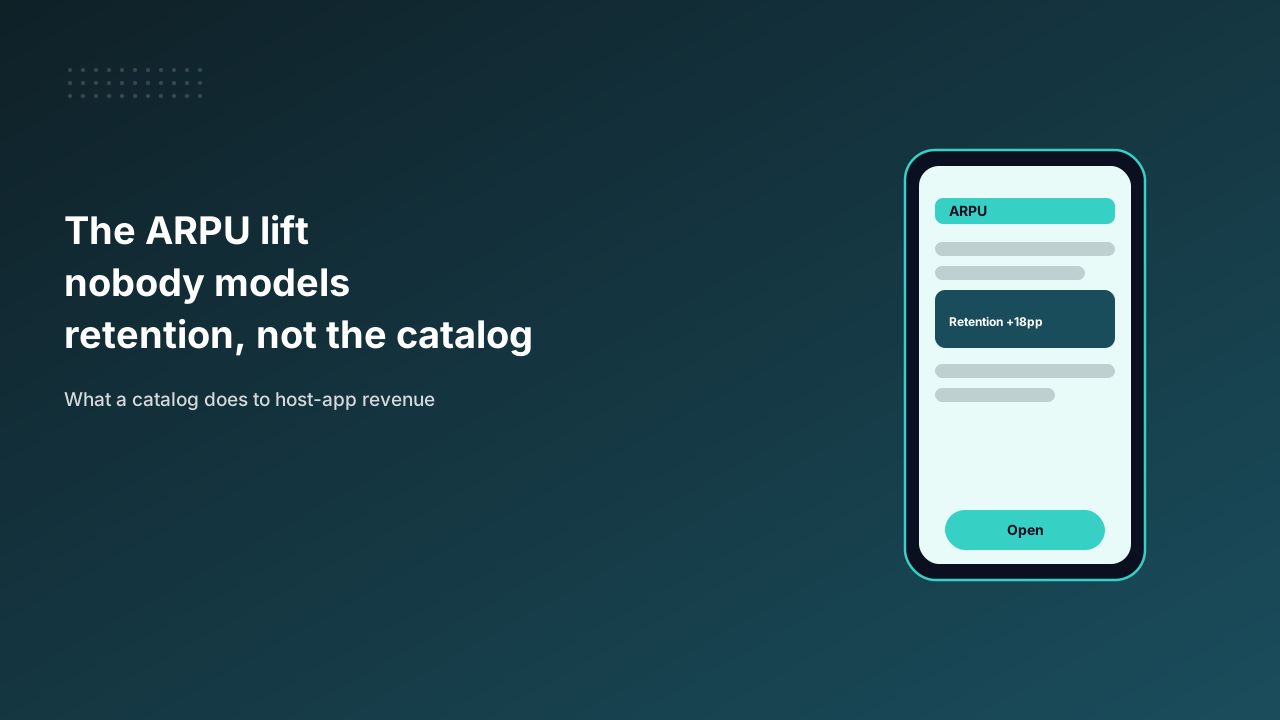
LINE's data makes the retention effect concrete. Users who adopted two or more non-messaging services — payments, e-commerce — retained at a rate 18 percentage points higher on a monthly basis than single-service users. A catalog is the cheapest path to move a single-purpose user into that multi-service band: instead of acquiring a new user for a second need, the host cross-sells an existing one. The 18-point gap is the part most ARPU models leave out, because retention is counted at the app level, not the service level where the catalog acts.
Cross-sell converts idle sessions into transactions
Kakao offers the starkest structural example: mini-apps generated 41% of total company revenue in 2025. That share did not come from a single hero service but from a catalog that routed users across many small ones. Grab's ad network tells the same story from the inventory side — GrabAds exceeded 1.7% of GMV with 75% merchant retention, meaning merchants kept spending because the cross-promoted surface kept converting. The catalog turns a one-query user into a multi-query user, and each additional query is a transaction the host previously lost to a separate app.
The ARPU table most forecasts skip
| Per-user metric | Before catalog | After catalog |
|---|---|---|
| Monthly retention | Single-service baseline | +18pp (LINE multi-service) |
| Transactions / user | One core action | Multiple cross-sold services |
| ARPU | Baseline | 7x QoQ observed (ZCITY) |
| Ad inventory | Limited to host content | +1.7% of GMV (GrabAds) |
The ZCITY case shows how far the corner can move. In Q4 2025 the Malaysia-based platform grew ARPU 7x quarter-over-quarter and lifted high-frequency users to 70.1% from 43.9%, reaching 2.71 million registered users and 2,000+ merchants. The catalog did not invent demand; it captured demand already sitting inside the app and routed it to the right merchant at the right moment.
Where the model breaks
The lift is not automatic. A catalog that surfaces low-quality or redundant services dilutes session time and depresses the cross-sell rate. WeChat's sub-180ms latency budget only matters because 1.2 trillion daily launches would collapse a heavier runtime — most operators underestimate the engineering cost of keeping a catalog fast at scale. The ARPU gain assumes the host curates, not merely hosts. A governance process that ranks services by retention and transaction yield is what separates a compounding catalog from a directory nobody opens.
Conclusion
Analysis shows the catalog's value is structural, not cosmetic. The host app that treats a mini-program catalog as a retention and cross-sell engine — and funds the curation and latency to make it real — captures ARPU growth the way WeChat, LINE, Kakao, Grab, and ZCITY each did. A portable runtime such as Cross Mini App makes the same pattern available to host apps without rebuilding the surface from scratch.
Sources
- Tencent — Investor relations — WeChat 2025 mini-program GMV, DAU, and launch volume.
- LINE — Official corporate site — multi-service retention findings.
- Grab — Investor relations — GrabAds GMV share and merchant retention.
- Kakao — Investor relations — mini-app revenue contribution.
- Treasure Global (ZCITY) — Investor relations — Q4 2025 ARPU and user growth.