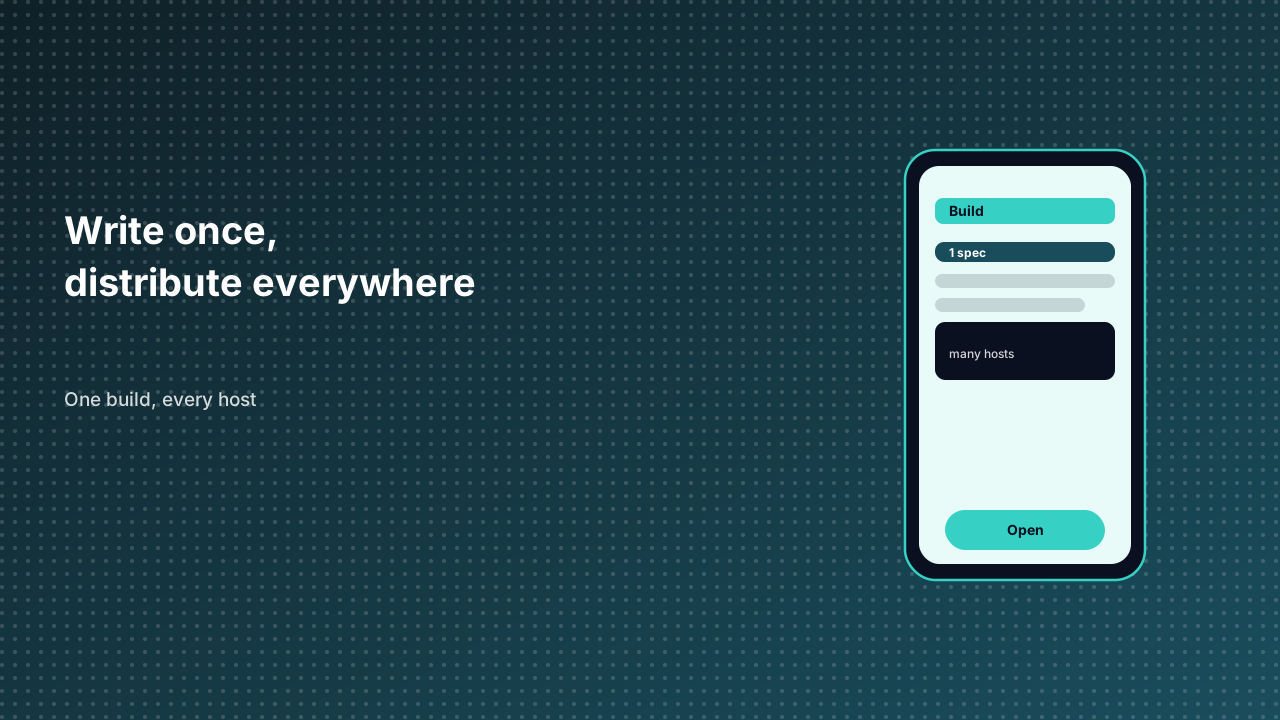
Every new platform used to mean a new codebase. iOS, Android, HarmonyOS, and a dozen mini-program dialects each demanded their own team, their own release cadence, their own bugs. The cost of reaching users across ecosystems is the cost of rebuilding the same product repeatedly. A universal runtime with an open catalog is the structural fix: build once, and the next host is a configuration, not a project.
The fragmentation tax is real
The W3C MiniApps working group's own summary from TPAC 2025 names the blocker plainly: most MiniApp runtimes are built on system WebViews, and those differ widely in API surface, performance, and stability across platforms. That fragmentation is why "write once, run anywhere" has historically meant "rewrite once per host." Cross-platform frameworks attacked the problem from the developer side — uni-app now covers 15+ platforms with 1.2 billion monthly active users and 41,000 GitHub stars, compiling a single codebase to 14+ targets; Taro compiles React syntax to WeChat, Alipay, Baidu, H5, and native formats.
What a universal runtime changes
A runtime that abstracts the host — rather than the developer abstracting each host — flips the economics. The catalog author writes to one specification. The runtime handles iOS, Android, HarmonyOS, in-car systems, and super-app containers. The marginal cost of adding a distribution channel becomes the cost of a compatibility test, not the cost of a team.
| Approach | Cost to add a host | Who owns fragmentation | Time to new market |
|---|---|---|---|
| Native per platform | Full rebuild | Each platform | Months |
| Cross-platform framework | One codebase, partial rewrites | Framework + dev | Weeks |
| Universal runtime + catalog | Configuration + test | Runtime | Days |
The catalog is the multiplier
WeChat's mini-program platform alone聚集 over 150 million developers, more than 1 million published mini-programs, over 5 million cumulative registrations, and 5,000+ third-party platforms spanning 200+ industries. That is the supply side of interoperability: a catalog built once can be offered to any host that runs the same runtime. The developer does not re-pitch the app store; the host does not re-recruit the developer. The open catalog is the shared layer both sides plug into.
The trade-off to name
Interoperability through a universal runtime means the catalog accepts the runtime's constraints — its component set, its capability ceiling, its update model. An app that needs deep OS integration or a bespoke native experience will find the runtime limiting. But for the overwhelming majority of services — commerce, content, tools, lightweight finance — the constraint buys distribution that would otherwise cost a separate engineering org per market.
Why fragmentation kept winning
The reason one-build-many-hosts failed before is that each host exposed a different WebView with different capabilities, so the runtime itself fragmented. The W3C gap-analysis work documents exactly where major super-app MiniApp runtimes diverge from the open Web platform — and that divergence is the tax. A universal runtime closes the gap by defining one capability surface and emulating it everywhere, so the catalog author never sees the host. The host becomes a deployment target, not a porting project. The catalog is no longer rewritten per ecosystem; it is configured for it, and the configuration is cheap.
Sources
- W3C MiniApps TPAC 2025 — WebView fragmentation, write-once-run-anywhere vision.
- uni-app 2025 overview — 15+ platforms, 1.2B MAU, 41k stars.
- FinClip OTA and cost — dev cost cut up to 50%, OTA updates.
- Multi-platform mini-program publishing — Taro/Uni-app one-build-many-platforms.