

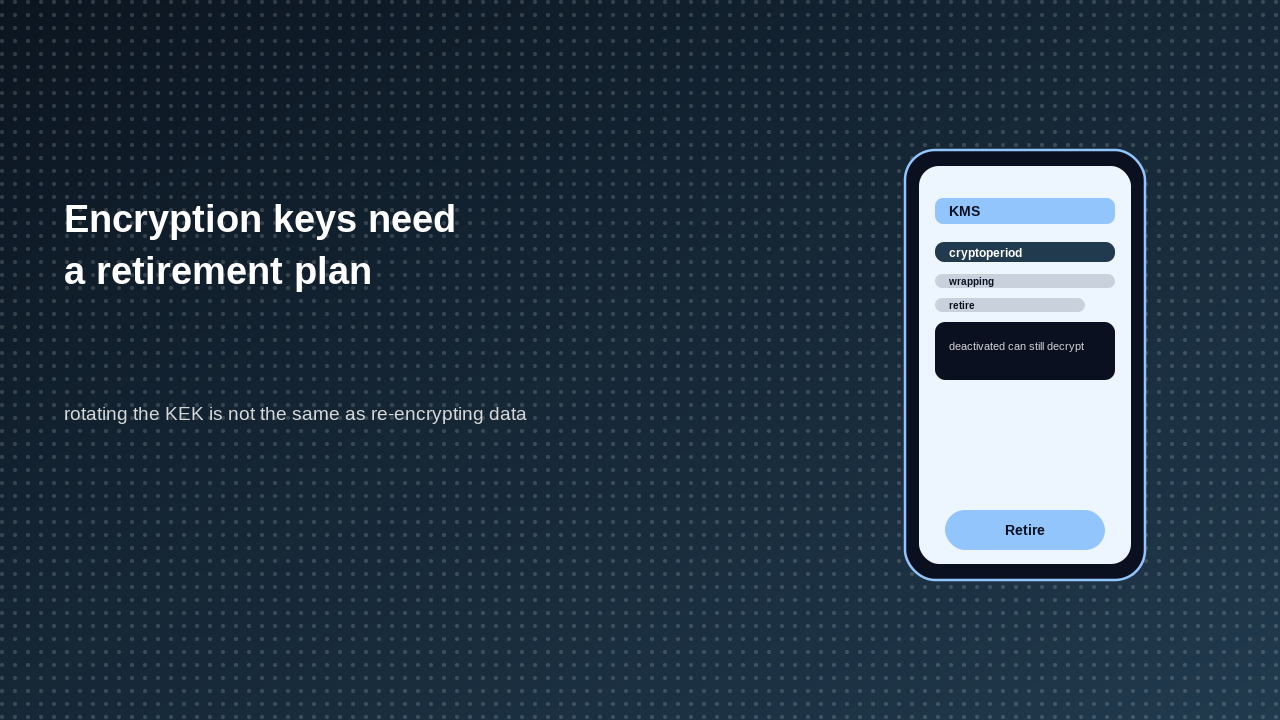
Naming AES-GCM correctly is the easy part. The difficult part begins when a key stops protecting new data and somebody still needs to read last year's records. At that moment a design decision made months earlier becomes an operational problem, and the quality of the algorithm has almost nothing to do with how it turns out.
Keys have states and purposes. They sit in a lifecycle, and the end of that lifecycle is where long-term security is actually decided.
The vocabulary the standard gives us
NIST SP 800-57 Part 1 Rev.5, published in May 2020, names six key states: pre-activation, active, suspended, deactivated, compromised, and destroyed. The deactivated state deserves close attention. A deactivated key is no longer used to apply protection, such as encryption, yet it may still be used to process information that was already protected, such as decryption. Retiring a key from new work does not erase the ciphertext it created.
The same document says a single key normally serves one purpose: encryption, integrity authentication, key wrapping, random bit generation, or digital signature. It defines a key-wrapping key as a symmetric key that provides confidentiality and integrity protection to other keys. Purpose separation is a design constraint with practical consequences. A key that signs tokens and also wraps data keys makes every decision about lifetime harder, because moving one use forward drags the other along.
Then there is the cryptoperiod, the interval in which a particular key is authorized for use by legitimate entities. Two effects motivate it: limiting the amount of material available for cryptanalysis, and limiting exposure if a single key is broken. Once a key is compromised, its cryptoperiod is no longer valid. That sentence is easy to skim past and hard to implement, because it means the schedule stops being authoritative the moment the assumption behind it fails.
Table 1 of the same revision offers suggested cryptoperiods: one to three years for private signature keys, symmetric data encryption keys reaching two years when the encrypted volume is small, and windows as short as a day or a week when large amounts of short-lived data are encrypted. The document states that longer or shorter periods may be reasonable. These are suggestions tied to algorithm and data assumptions, not mandatory rotation intervals, and quoting a number without those assumptions produces false precision.
Choosing strength is a separate job
NIST SP 800-175B Rev.1, issued in March 2020, addresses cryptographic mechanisms for the United States federal government protecting sensitive but unclassified information. It asks that algorithm and key length be chosen against how long the data needs protection, and that both sit inside the security strength time window NIST estimates. Key management appears there as a prerequisite for using cryptographic mechanisms at all, with material on key establishment, storage, protection, and cryptoperiods. That framing is the useful part for any team: a correct algorithm name says little about how the key was established, stored, or retired. The document is federal guidance, not a universal mandate.
| Key state | What the key may still do | The mistake this state invites |
|---|---|---|
| Active | Protect new information | Assuming the period never needs revisiting |
| Suspended | Hold value while use is paused | Treating the pause as a permanent end |
| Deactivated | Decrypt or verify older material | Believing old ciphertext has become unreadable |
| Compromised | Nothing useful | Continuing to trust a schedule that no longer applies |
| Destroyed | Nothing | Overlooking copies held by backups and partners |
Rotating a key is not re-encrypting the data
This distinction causes more confusion than any other part of key management. Rotating a top-level key wrapping key can place new protection around existing data keys while the encrypted payload underneath stays untouched. The key that protects the wrapping path has changed. The data has not been re-encrypted. Suspension or revocation likewise does not make old ciphertext unreadable, because a copy of the old key can still exist in a backup, a hardware module, or a retired service.
AWS KMS illustrates one vendor implementation. Its developer guide describes a hierarchy with a KMS key at the top and HSM backing key versions beneath it. Older backing keys are retained for decrypting or verifying previously protected data, and only the current active key protects new information. The hierarchy is stored as exported key tokens. In envelope encryption, a data key is generated inside the HSM and returned in plaintext and ciphertext forms; the ciphertext form is encrypted under the KMS key, the data itself is not stored in KMS, and results travel back over TLS.
The rotation guide from the same vendor sets a default automatic rotation period of 365 days, notes that AWS managed keys rotate yearly, and records a 2022 change from roughly 1095 days to roughly 365 days. Old key versions are kept so decryption can select the right one automatically. Asymmetric keys, HMAC keys, and custom key store keys are not eligible for automatic rotation and require manual handling. All of this describes one service, not a general rule, and partition behavior may differ.
What a retirement plan contains
A real plan starts with an inventory: which datasets sit under which key version, and which of them still need to be readable. It then re-encrypts that data under a current key, verifies the result, and only after that marks the old key as retired for new use. A decrypt-only path has to remain for as long as any ciphertext under the old key exists. Destruction comes last, when no such ciphertext remains anywhere, including backups. Skipping the re-encryption step leaves a retired key quietly carrying production traffic forever.
Teams working on Cross Mini App treat that inventory as part of normal engineering rather than a cryptography exercise, because a key is only as retired as the last ciphertext that still depends on it.


