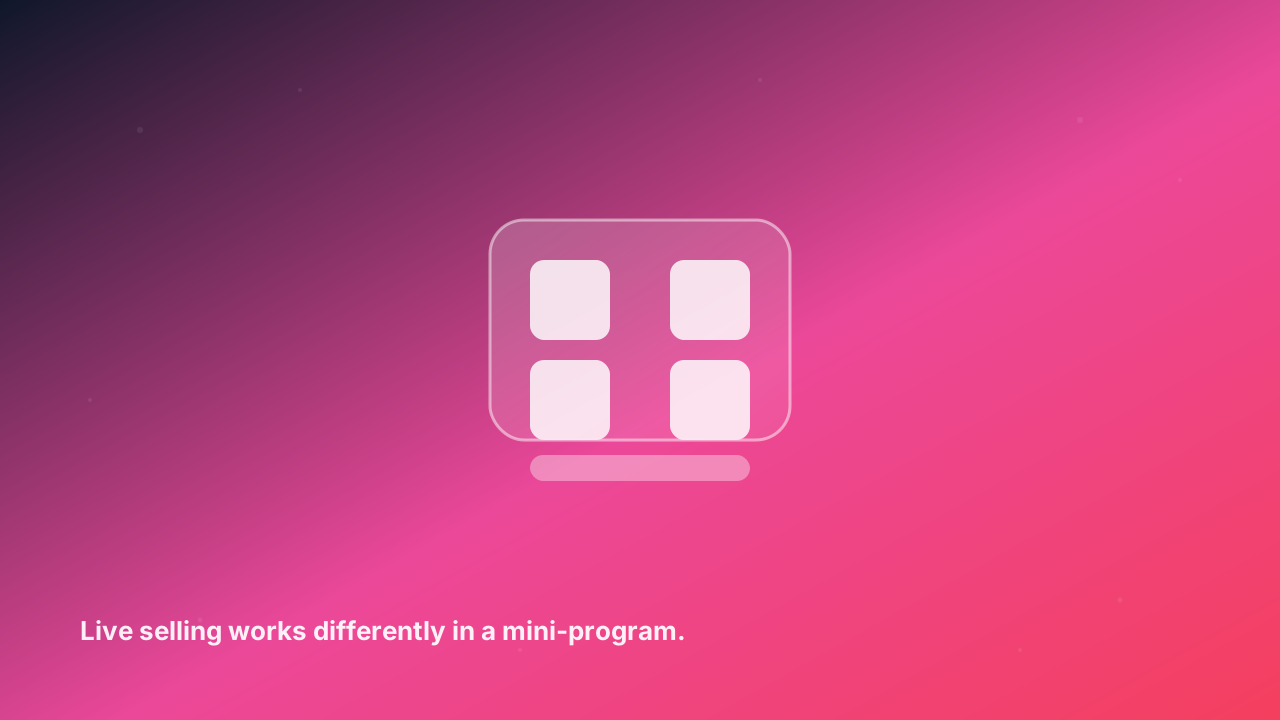
Live commerce — a host showing products on a stream while viewers buy in real time — isn't a prediction anymore. It's already a massive category in parts of Asia, and the format is spreading because it works: a person you trust holds up a thing, you tap, you own it, the friction is near zero. The interesting shift is what happens when that loop lives inside a mini-program instead of a standalone live platform. The buying doesn't leave the stream, and that changes the math.
Most teams importing live commerce bolt a stream onto a website and wonder why completion lags. The mini-program version closes the gap by keeping the entire loop in one runtime.
Why the loop stays intact
On a standalone live platform, the path from "I want that" to "it's mine" crosses several seams: the stream, a separate product page, a login, a payment form. Every seam is a place to drop. Inside a mini-program the viewer is already authenticated with the host, the wallet is already on file, and the product grid is one tap from the video. Watch, tap, pay — the same screen, no context switch.
That matters more than it sounds. Live commerce runs on impulse, and impulse has a half-life measured in seconds. Any step that takes the viewer out of the moment — a new tab, a login wall, a card entry — is where the sale evaporates. A mini-program removes those steps by construction.
The host's wallet is the checkout. No re-entry, no "create an account to buy." The same identity that opened the stream is the one that pays.
Inventory and the stream share state. Because it's one runtime, the "only 3 left" the host shouts is the same counter the tap hits. Oversell and phantom stock — the quiet killers of live trust — become much harder when the number is real and shared.
| Step | Standalone live platform | Mini-program live loop |
|---|---|---|
| Identity | New login per session | Already signed in with the host |
| Payment | Re-enter card or wallet | Host wallet already on file |
| Product access | Jump to a separate page | Grid one tap from the video |
| Stock state | Often a separate counter | Shared, real-time counter |
The tradeoff
You're live inside someone else's app, so the audience, the wallet, and the rules are the host's. A brand building its own live empire on a standalone platform owns more — but it also pays to acquire every viewer from zero. The mini-program trade is reach and a frictionless loop now, in exchange for a cut and less control. For most merchants testing live commerce, that trade is the only one that pencils.
Sources
- WeChat Mini Program live and payment docs — the in-app loop.
- DataReportal — Social commerce trends — where live selling already dominates.
- Think with Google — Video and shopping — why the path from watch to buy matters.
- StatCounter — Mobile commerce share — context on where purchases happen.