We ordered a replacement part from a shop we'd never bought from. The confirmation email pointed to a tracking page that updated twice in ten days, each time a day behind. When the box finally showed up, no one could say exactly when it had been left, or where. That silence is the part people remember, not the late delivery itself.
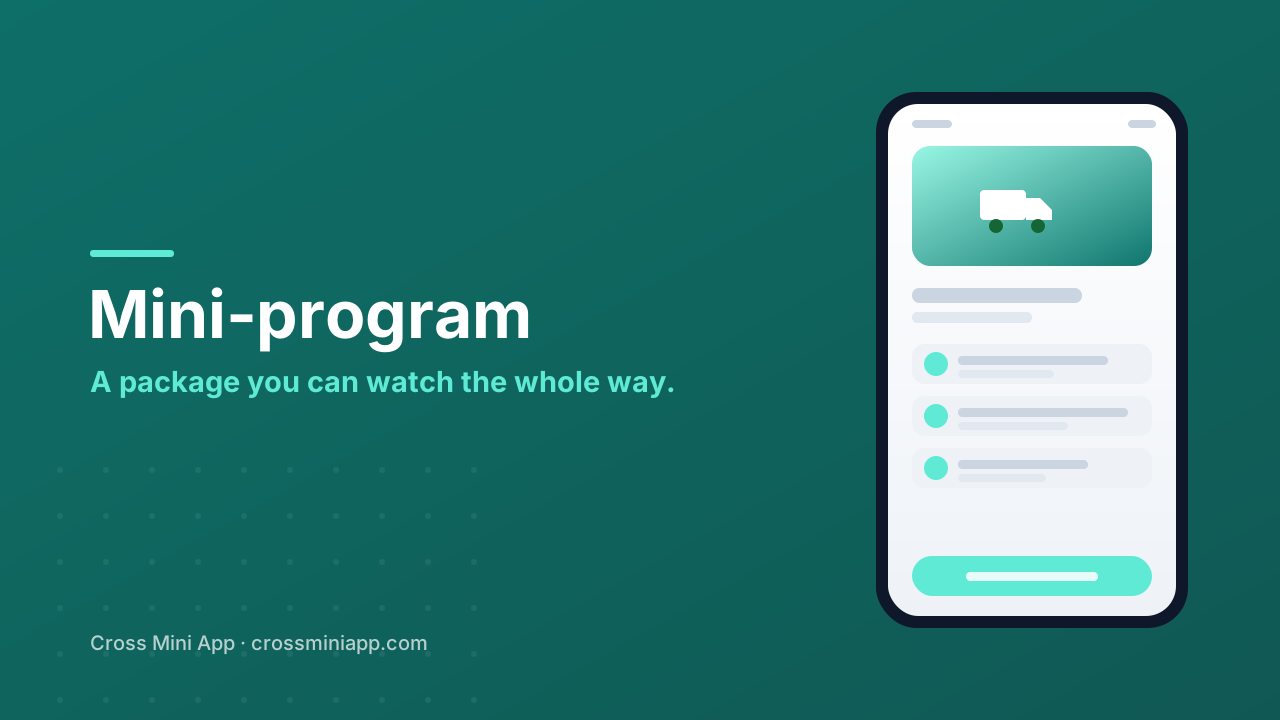
A logistics mini-program fixes the silence rather than the speed. The buyer doesn't leave the app they already open ten times a day — a messaging app, a wallet, a shopping feed — and watches the parcel move from a warehouse shelf to a photo of it sitting on their porch. The calm comes from seeing, not from being promised.
Why visibility is the real product
Couriers have always had internal tracking. What's new is pushing that signal to the person who paid, live, in the place they already are. The reassurance isn't a faster truck; it's the feeling that nothing is happening out of sight. A parent waiting on medicine, a small business owner waiting on stock, someone who's been burned by a stolen porch parcel before — they don't need a marketing email, they need to know at 9pm that the driver is three stops away.
There's a quieter business case underneath. Every where-is-my-order call is a support cost and a trust cost. When the status is self-serve and obvious, those calls drop, and the remaining ones are easier because both sides are looking at the same screen.
| What the buyer sees | What it replaces | Why it eases the wait |
|---|---|---|
| Picked — a timestamp and a bin photo | A bare processing label | Proof the order is real, not stuck |
| Out for delivery — driver's last stop count | A vague arriving today | A countdown they can plan around |
| Delivered — geotagged photo plus signature | A silent update or nothing | A receipt nobody can argue with |
| Exception — held at depot, reason given | A failed delivery with no note | A chance to act before it's lost |
The entry point nobody has to install
The clever bit isn't the dashboard, it's the front door. In China the standard move is a waybill: the buyer scans a code on the receipt, the box, or the chat message, and the tracking mini-program opens already wired to that parcel — no account, no download, no typed tracking number that's wrong half the time. The friction is one camera tap.
That matters more than it sounds. A download wall loses people. A tracking number field loses people. A single scan keeps them, and it keeps them in the host app, so the logistics brand rides along instead of asking for a new home screen icon. We've seen teams over-invest in a standalone app and wonder why open rates stayed flat; the scan-and-follow loop is what actually gets used.
The part that transfers
Here's the thesis we keep coming back to. The logistics mini-programs Chinese buyers use every day — live tracking, proof-of-delivery, redelivery booking — weren't invented for export. They were proven at scale on hundreds of millions of parcels, in markets where the phone is the only computer. The hard problems, the ones about unreliable networks and cheap devices and drivers who need a two-tap flow, got solved there first.
What's been missing overseas is the runtime. A mini-program is written once and runs inside whichever host already owns the user's attention. A universal runtime plus an open catalog of logistics components — tracking view, waybill scanner, proof-of-delivery capture — means a courier in, say, Brazil or Spain doesn't rebuild the wheel. They take the proven pattern, point it at their own fleet data, and ship inside the apps their customers already open.
We'd be honest about the risks. A universal runtime is a promise of consistency that's hard to keep across very different hosts, each with its own rules about camera access, notifications, and background refresh. Proof-of-delivery photos raise a privacy question that regulators in some markets will ask about. And a mini-program living inside someone else's app is only as reliable as that host's willingness to keep you there. None of that is fatal, but pretending it's free is how projects stall.
Where it's worth starting
Don't begin with the whole supply-chain dashboard. Begin with the last mile, because that's the stretch the buyer actually feels and the one where visibility changes behavior. Wire up scan-to-track, a live out-for-delivery state, and a delivery photo. Get that loop honest and fast, then expand inward to warehouse and dispatch.
Cross Mini App is one attempt at the runtime-and-catalog half of this: a single execution layer so a logistics mini-program travels across hosts instead of being rewritten for each. The logistics know-how, though, is the part that already exists and just needs to move.
Sources
- McKinsey — Supply Chain & Logistics insights — how last-mile visibility and exception handling shape delivery economics.
- World Bank — Logistics Performance — what reliable tracking means for trade in emerging markets.
- Think with Google — Consumer expectations — why shoppers now expect live order status, not periodic updates.
- web.dev — Progressive Web Apps — patterns for fast, install-free tracking experiences on cheap devices.
- StatCounter — Global mobile usage — why the phone inside a super app is the default screen for most buyers.