A host building a mini-program catalog faces a supply decision: curate a small set of partners, or open the door to anyone who can ship. The second option looks risky until the numbers are in. The long tail of small developers produces the bulk of catalog depth, and each one adds at near zero marginal cost to the platform.
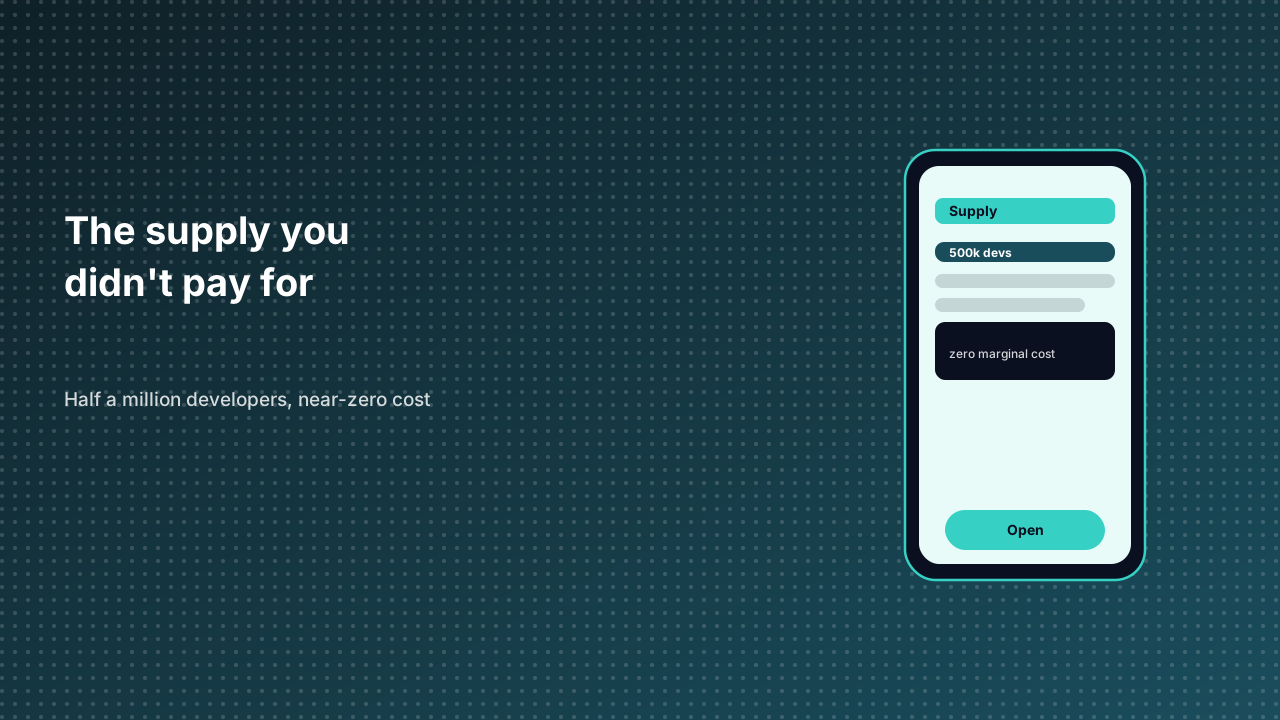
China's mini-program ecosystem is the proof. The market scale surpassed 3.2 trillion yuan in 2025, up 68% from 2023. Within the game sub-segment, WeChat reported 500,000 developers and 500 million monthly active users, with 80% of those developers coming from teams of fewer than 30 people. Another count puts cumulative mini-program developers above 400,000. Guangdong alone — the game-export hub — recorded 37 billion yuan in mini-game revenue in 2025, up about 40% year on year, with 52 local firms in the national top-100 list.
Why the tail is cheap
Small teams build because the entry cost is low and the distribution is already there. A young developer with an idea can reach users through the host's existing social and search channels without buying installs. That removes the two expenses that kill indie software: customer acquisition and infrastructure. The host provides both as a side effect of its own audience.
AI has pushed the marginal cost further down. Across game studios, development time fell about 37% and development cost about 28% where AI tooling was adopted, and more than 60% of studios now use AI in their workflow. A single developer can assemble a game in hours using code assistants, asset generators, and animation tools. The barrier to a first publish has never been lower, which means the catalog's tail keeps lengthening without the platform paying for it.
| Supply metric | Figure | Implication for the host |
|---|---|---|
| Ecosystem market size (2025) | 3.2T yuan, +68% vs 2023 | Catalog is infrastructure, not experiment |
| Mini-game developers | 500,000 | Depth comes from the long tail |
| Teams under 30 people | 80% | Marginal supply cost is near zero |
| AI dev time / cost reduction | 37% / 28% | Tail lengthens without platform spend |
The trade the host makes
Permissionless supply trades curation for volume. Not every long-tail developer ships something good, and quality control becomes a ranking problem rather than an admission problem. The host's job shifts from selecting who gets in to surfacing what works — using the same engagement and payment data that the catalog generates. The 80% of small teams that never become headline acts still collectively fill the niches a curated catalog would never bother with, and each niche is a reason a user stays.
This is the structural difference from a native app store model. There, every publisher is a negotiation. Here, the supply side is a permission granted once, and the cost of each additional developer approaches zero. The catalog's value grows with the square of its long tail, because more supply attracts more users, which attracts more developers.
What the data warns against
The trap is treating the tail as disposable. When a platform over-taxes or over-regulates small developers, the marginal supplier leaves first — exactly the margin-sensitive seller the catalog depends on for depth. Guangdong's 40% revenue growth came from a dense supporting industry that made small teams viable; remove that support and the tail thins. A host that wants durable catalog depth protects the zero-marginal-cost supplier instead of maximizing tolls on it.
Sources
- Tencent News — WeChat mini-games go overseas — 500k developers, 80% small teams, 5亿 MAU, Guangdong 37B yuan.
- Zhengguan News — 500 million players choose mini-games — 400k+ cumulative developers, 95% month-2 retention.
- Nestia — AI and mini-game creators — AI dev time −37% / cost −28%, 60% studio adoption.
- Chinanovo — Mini programs rewriting business rules — 3.2T yuan ecosystem size 2025, +68% vs 2023.