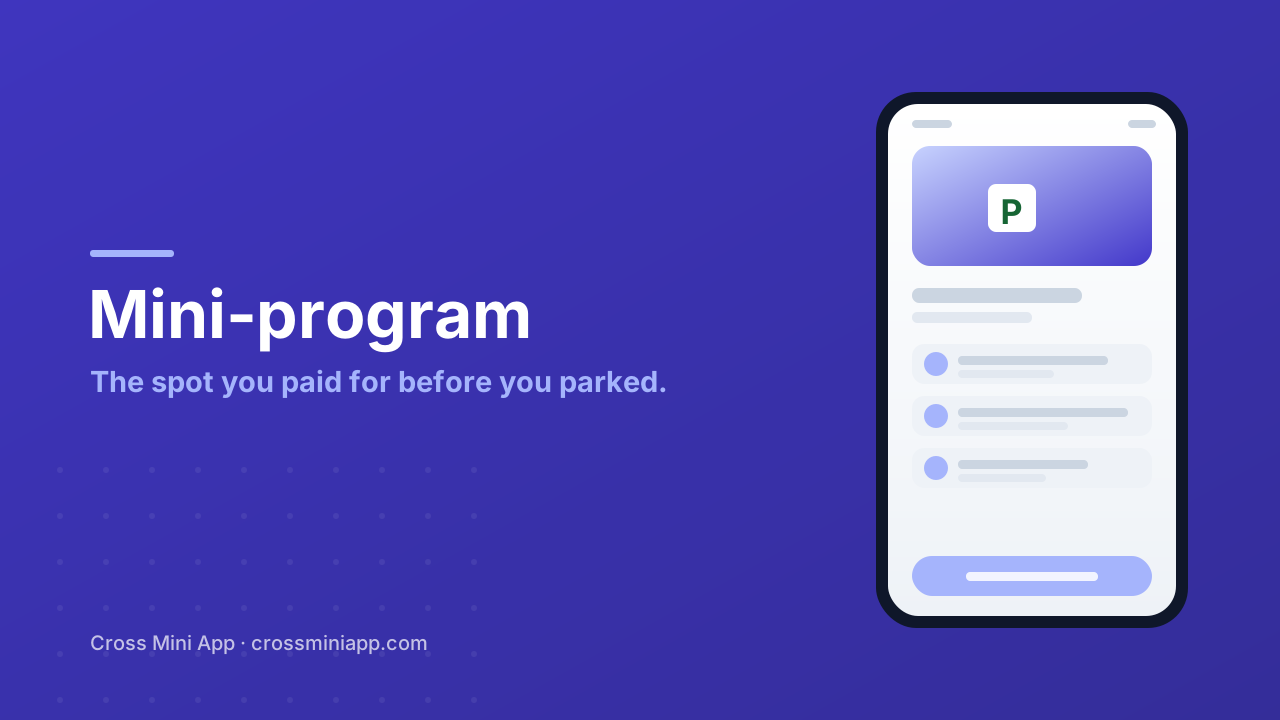
You pull into the lot, the barrier's down, and a sticker on the pole shows a square code. You point your camera, tap once, and the arm lifts before you've found reverse. No ticket to lose, no machine that eats your card, no window to roll down in the rain. The spot was paid for the moment you decided to take it.
That sounds like a small convenience. It isn't. It's the difference between a parking system that assumes you're standing at a kiosk and one that assumes you're holding a phone.
The old meter was a failure mode
We keep calling coin-and-card machines the old way as if they were merely inconvenient. They were unreliable by design. The reader jams. The network blips and the session hangs. The printer runs out of paper at 7pm. The rates change and nobody updates the sign, so you're fined for a price you couldn't have known. Every one of those is a place where the transaction fails and a human has to show up.
And when it does fail, the cost lands on the worst person to absorb it: the driver who just wanted to leave.
| Old meter failure | What it actually cost | What the in-app flow does |
|---|---|---|
| Card reader jams or goes offline | Stuck at the exit, horns behind you | Payment rides on the phone's own network, retried silently |
| Paper ticket lost or faded | Flat overcharge, no appeal trail | Session is tied to your scan, not a slip of paper |
| Rates out of date on the sign | Fines for a price nobody posted | Price is fetched live, shown before you confirm |
| Coins only after hours | Cash you don't carry, or a walk to a machine | Wallet you already have open, one tap |
| No receipt without a kiosk | Expense reports and disputes drag for weeks | Digital receipt, instant, tied to the plate |
The pattern is that the machine is a single point of failure that's also the single point of contact. The mini-program moves both the failure surface and the contact into the device you're already holding.
The local-services hook
Here's where it gets interesting for cities. A parking mini-program isn't a parking app — it's a node in a local-services graph. Once the runtime knows you're parked at this lot, at this hour, it can offer the things that are actually next to the car: the restaurant that's open, the charger two rows over, the transit option home if you'd rather not drive back.
That's the part Chinese super apps already proved. Parking wasn't shipped as a standalone product; it was one tile among hundreds, and its value came from being adjacent to everything else. Port that overseas and you don't get a parking app — you get a reason for the local-services layer to exist at all.
We'd push back on the cliché that this is just a QR code. A code is the thin end. The real asset is the catalog of services behind it and a runtime that already knows how to render them.
The portability thesis
The thing worth saying out loud: the Chinese parking mini-programs are not exotic. They're mature, battle-tested flows for finding a spot, paying, and lifting a barrier — built for cheap phones, weak networks, and millions of concurrent sessions. The hard problems are solved. What's been missing overseas is a runtime that can run those flows inside whatever app a city already uses, and an open catalog so a lot operator in Lisbon can list their barrier without a custom build.
A universal runtime plus an open catalog is the boring, correct answer. It's not a new protocol or a new wallet. It's taking code that works and giving it a neutral place to live.
There's a real risk we should name: if every operator builds their own locked-in app, we've just recreated the meter, now with a download step. The win only shows up when the entry is universal — scan anyone's code, land in a flow that runs anywhere.
Sources
- World Bank — Urban mobility and transport — why cities are moving payments off roadside hardware.
- McKinsey — Smart mobility and cities — the local-services graph around parking and transit.
- Think with Google — Local consumer behavior — what drivers expect from their phone at the curb.
- web.dev — Web performance and capability — keeping payment flows fast on weak connections.