The last mile of financial distribution is a trust problem, not a technology problem. In rural Southeast Asia, the user who will not open a bank account will hand cash to a person they see every week at the market. That person is the distribution network, and building it from scratch is the single largest reason expansion plans stall.
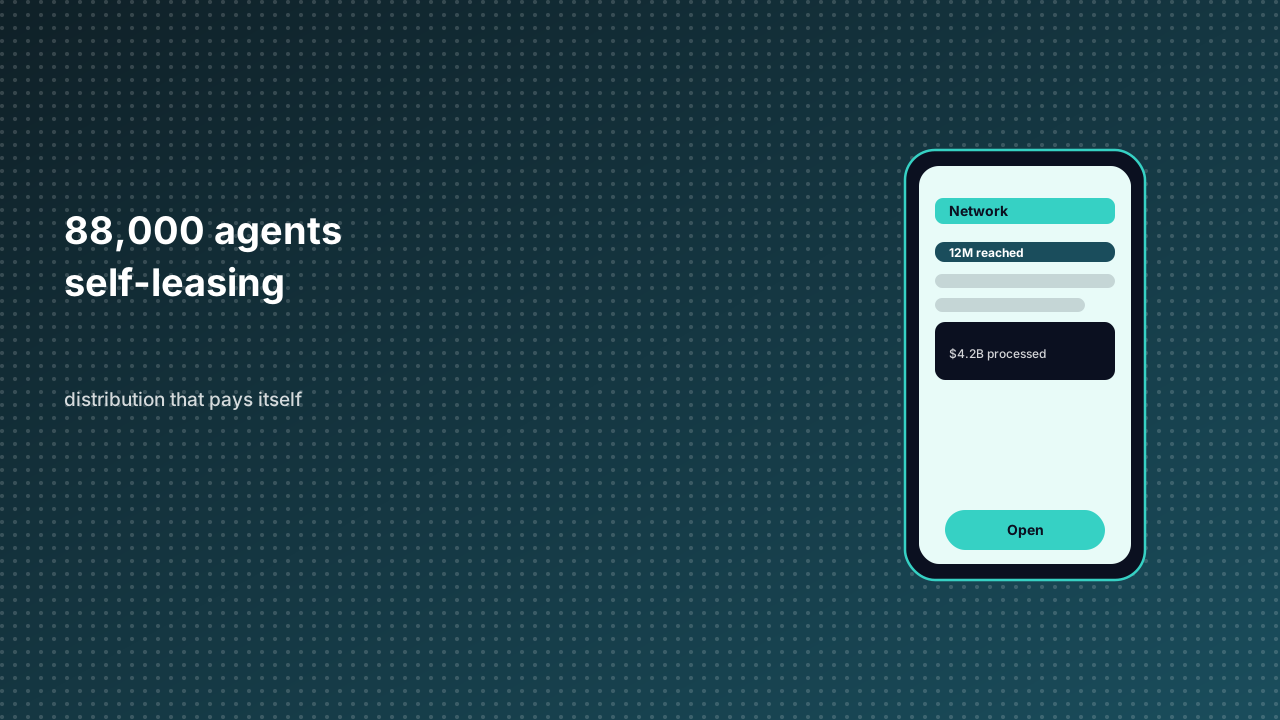
Ascend Money's numbers show what a leased network looks like at scale. Its 88,000 independent local agents reached an estimated 12 million unbanked users in 2025, processing over $4.2 billion in bill payments and cash-in transactions. The agents do not appear on the balance sheet as fixed cost. They earn on results — commission margins estimated at 20 to 35 percent on the micro-insurance and investment products they place. In Indonesia, BNI runs a similar Agen46 network that the bank describes as a pillar of inclusive access, offering agents transaction-based income with no registration fee and 24-hour service.
A mini-program catalog is the digital half of the same logic. Instead of hiring a sales force to push each new service, the host opens the runtime and lets third-party developers and local partners place their services in front of the existing user base. The host pays in revenue share, not in fixed headcount. In Southeast Asia, co-branding and revenue-share deals with telecom operators, banks, and super-apps typically run 30 to 50 percent of transaction or interest income for the first two years, renegotiated at scale.
| Model | Fixed cost | Variable cost | Time to scale |
|---|---|---|---|
| Owned sales force | High (salary, training) | Low | Slow (hiring-limited) |
| Agent / partner network | Low | 20–50% of revenue | Fast (results-driven) |
| Catalog + revenue share | Near zero | Per-transaction share | Immediate (existing base) |
The asymmetry is the point. A partner who earns only when the service sells has incentives aligned with the host in a way a salaried team rarely is. The host does not carry the cost of a market that does not convert. When a region underperforms, the variable expense simply does not materialize, instead of becoming a line item the finance team has to explain.
The risk is quality control. An agent who mis-sells damages the host's brand, not just their own commission. The catalog version of this risk is a mini-program that overpromises. The mitigation is the same in both cases: clear perimeter, disclosed participant, and the ability to cut the relationship the moment the trust cost exceeds the distribution gain. A bad agent terminated this quarter is a footnote. A bad agent carried for two years is a compliance event.
The strategic implication is that distribution stops being a reason to move slowly. The capital-intensive part of expansion — the physical and human trust layer — can be leased, not bought. What the host must own is the runtime, the settlement, and the brand promise. Everything in between can be a partner whose incentive is the host's incentive.
The deeper value is that a leased network lets the host enter markets it would otherwise avoid. Rural areas, low digital-literacy populations, and cash-dominated economies carry direct-sales costs high enough to deter a standalone app, yet they are exactly where the agent-network-plus-catalog combination is cheapest. When trust is supplied locally and technology is supplied by the host, coverage stops being a budgeting problem and becomes a question of whether partner incentives are set right.
Sources
- Ascend Money business model research — agent network metrics and commission margins.
- Rise of agency banking in Africa and Southeast Asia — agent banking platform scale and commission engines.
- ASEAN digital economy 2025 — revenue-share ranges with local partners.
- BNI Agen46 partner program — agent network as inclusive distribution.