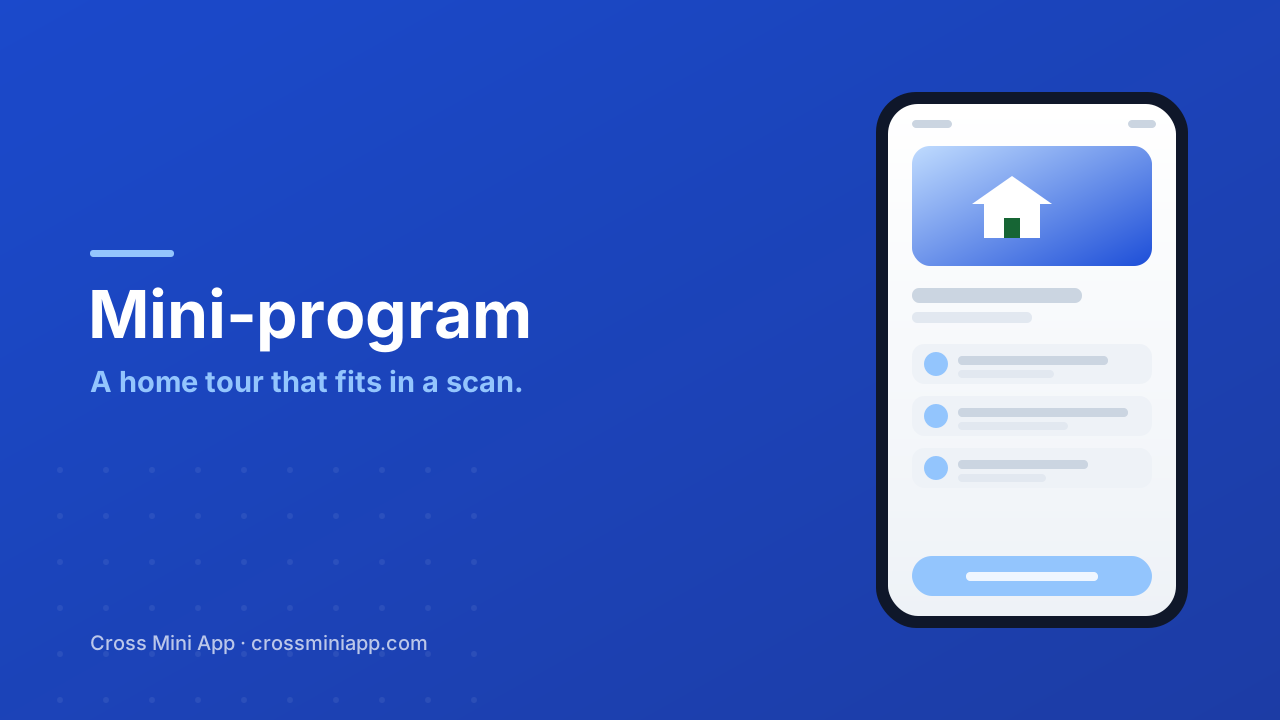
You're flat-hunting in a city you've never lived in. You walk past a hoarding, scan one code, and your phone opens a property space: fifty listings sorted by your commute, a 3D walk-through of a flat two streets away, a button to book a viewing at six tomorrow, and a calculator that tells you the rent would take a third of your take-home. None of it required a download. The app that hosted it was the one you already use to message your cousin.
That's the part the industry keeps missing. Real estate is still treated as a download problem. Portals spend fortunes convincing you to install yet another app you'll open maybe twice a year, then forget. But the moment a tenant or buyer actually needs to act, they're already inside something else — a messaging app, a maps app, a payments app. A mini-program just meets them there.
Why a separate app was always the wrong shape
A property app has a brutal usage curve. People install it during a move, hammer it for three weeks, then never touch it again. That's the worst possible profile for a native install: high acquisition cost, near-zero retention, and a review page full of complaints from the one frantic week. The mini-program model flips it. The user doesn't install your real estate brand; they open the host they trust and tap into yours. Distribution stops being a fight and becomes a link.
And the things that matter in property map neatly onto what mini-programs already do well. Listings are just cards with images and filters. A virtual tour is a video or a lightweight 3D scene — heavy on a website, trivial inside a runtime the host pre-loads. Scheduling a viewing is a calendar widget plus a notification. A rent or mortgage calculator is twenty lines of arithmetic behind a form. None of these need a dedicated team shipping a standalone product. They need to sit inside the app the user already has open.
| What the user wants | Where it used to live | Where it lives now |
|---|---|---|
| Browse listings by neighborhood | A portal app, freshly installed | A tab inside the chat or maps app |
| Walk a flat without visiting | A separate 3D tour site, slow to load | A pre-loaded scene in the host runtime |
| Book a viewing Saturday 10am | A phone call, or a form that emails someone | A calendar picker with instant confirmation |
| Know the rent is affordable | A spreadsheet the user builds themselves | A calculator bundled with the listing |
| Compare mortgage scenarios | A bank's website, logged out and confusing | The same mini-program, before they ever call the bank |
The local-services hook is the real prize
Here's where it gets interesting for hosts. A property mini-program is a natural front door to everything around moving. The host already runs cleaning bookings, furniture rentals, utility switches, neighborhood guides, even a handyman dispatch. A tenant who just signed sees those inside the same flow, and the host takes a slice of each. Property isn't a standalone category; it's the anchor that pulls a dozen local services behind it. That's why super apps abroad should be begging for this content, not building it from scratch.
The trust problem is the only hard part
I won't romanticize it. Property is the category where trust breaks first. Listings lie about size, price, and whether the place still exists. Agents ghost. Deposits vanish. A mini-program does not magically fix any of that.
What it does is change who the trust attaches to. When a property flow runs inside a super app, the user isn't handing their ID and deposit to a stranger's website — they're doing it through the host's identity, its payment escrow, its review system, its dispute process. The mini-program inherits the trust the host already earned. That's a bigger deal than any filter UI. A standalone portal has to build trust from zero; a mini-program borrows it.
The risk runs the other way too. If a listing inside the host turns out to be a scam, the anger lands on the host, not the small developer. So the catalog has to police who publishes. Open doesn't mean anonymous.
The thesis worth betting on
Chinese teams already shipped this exact stack at scale — property mini-programs with virtual tours, scheduling, and calculators, running inside WeChat for hundreds of millions of users. The play overseas isn't to reinvent that wheel in every market. It's to take the proven code, point it at a universal runtime that speaks to whatever host a region prefers, and drop it into an open catalog where local agents can publish their own listings.
That's the part we care about at Cross Mini App. The property logic — the tours, the scheduler, the math — is portable. What changes per market is the host and the language, not the product. A runtime plus a catalog turns a Chinese proven pattern into something a Lagos agent or a Lisbon landlord can switch on by lunchtime.
None of this requires consumers to learn a new habit. They already open the app. We just have to put the home inside it.
Sources
- McKinsey — Real Estate — how platform models reshape where property services actually live.
- Think with Google — Consumer Insights — why local intent and mobile-first behavior decide discovery.
- StatCounter — Global Stats — the share of mobile and super-app-style usage outside the desktop web.
- World Bank — Housing — affordability and urban housing pressure behind the demand.
- web.dev — Performance — why a pre-loaded runtime beats a fresh install on slow networks.