A woman scans a QR sticker on a shelf, sees a member price the cardboard tag doesn't show, and taps to add the item to a cart that already holds three things from her last visit. She pays, walks out, and the relationship doesn't end at the door. Two nights later, from her sofa, she reorders the coffee that ran out. Not one of those steps needed a cashier, a second app, or the store to be open.
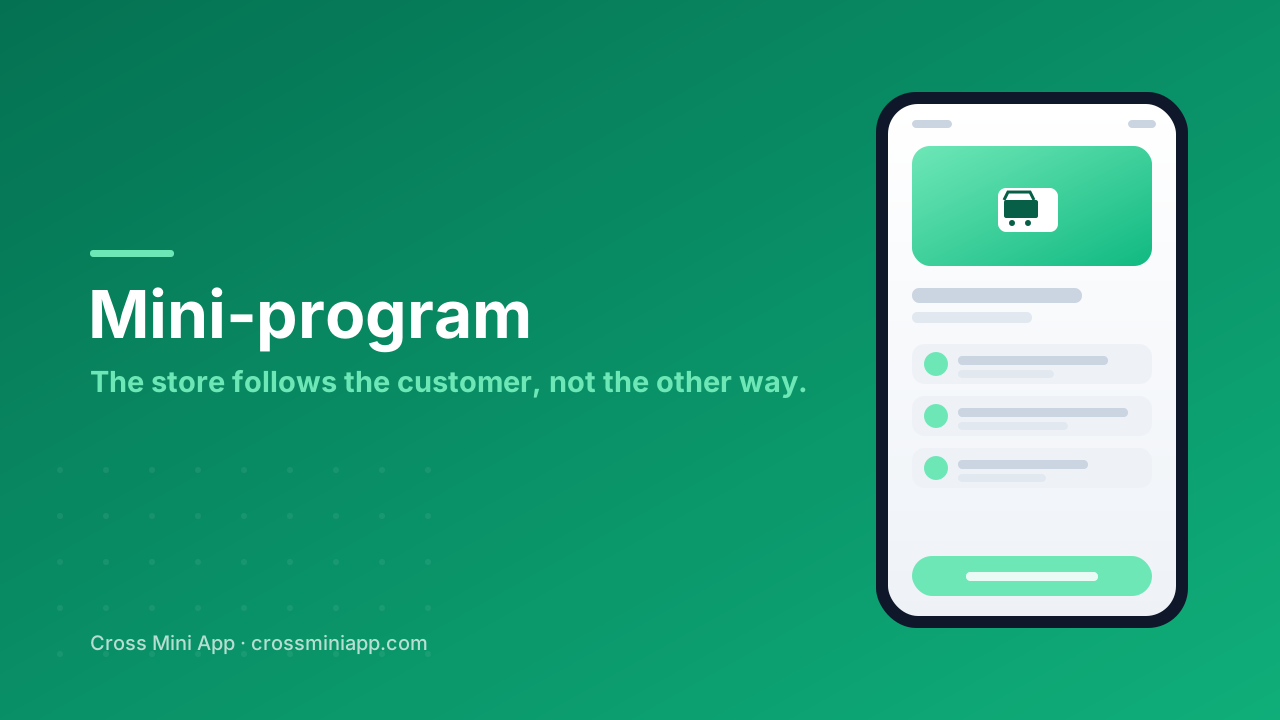
We've spent years assuming a physical store and an online store are two different businesses that happen to share a logo. They're not. The mini-program is the seam where they meet, and once that seam exists, the shop effectively walks home in the customer's pocket.
The store that follows you
The old model asked the customer to remember. Remember the name, remember to come back, remember the promo that expired. A mini-program flips it: the shelf itself becomes a link. Scan, and the product opens on your phone with its real-time stock, its member price, and a cart that remembers you. The store stops being a place you have to be and becomes something you carry.
The bridge most shops never build
Here's the thing retailers miss about foot traffic. A walk-in is the most expensive customer you'll ever acquire, between rent, staff and fixtures, and then you wave goodbye with no idea who left. The mini-program converts that anonymous visit into a known account the moment they scan. Suddenly the bridge runs both ways: the store drives people online for repurchase, and the online history tells the next in-store visit what to recommend.
This is where O2O stops being a buzzword. Pickup reminders, local inventory checks, a unified cart that works on the shelf and on the couch, these aren't features, they're the same transaction viewed from two rooms.
| In-store moment | What the phone handles | What the store gets back |
|---|---|---|
| Customer pauses at a shelf | QR opens the exact product, with live stock and member price | A browse that used to be invisible |
| Tag price feels steep | Member tier drops the price, no clerk needed | Margin kept without haggling drama |
| They don't want to carry it | In-store pickup or delivery, booked in-app | A sale that would have walked out |
| Stockout on the shelf | App shows the nearest branch with it | The sale stays in the family |
| Two days later, at home | Reorder from history, one tap | Repurchase with zero re-acquisition cost |
The part nobody talks about
We'll be blunt: most Western retail apps fail at exactly this. They're either a loyalty card that does nothing in-aisle, or a grocery app that's a second storefront with its own cart and its own prices. The seam is missing. You can't scan a shelf and get a member price, because the aisle and the app don't share a catalog.
That's the real lesson from China, where retail mini-programs are mature enough to feel boring. A convenience chain there doesn't run a website and an app and a store. It runs one catalog, exposed through a mini-program that lives inside the super app people already open forty times a day. The store, the price, the cart and the inventory are one system wearing three faces.
Why this travels
Our bet is that this pattern ports. Scan, see your price, buy now or later, pick up where you are, that isn't cultural, it's just convenient. What's kept it from spreading is the runtime and the catalog. You need a mini-program runtime that runs on whatever host dominates a market, and an open catalog spec so a store's inventory plugs in without a six-month integration.
Get those two right and the proven Chinese retail playbook, the one that turns foot traffic into a repeatable online relationship, becomes a drop-in for a shop in São Paulo or Madrid. The store still has a front door. It just also has a back door that opens on the customer's phone.
It isn't free, and it shouldn't pretend to be
Two cautions, because the cliché version of this story skips them. First, QR fatigue is real: if every surface demands a scan for a discount nobody trusts, people stop scanning. The code has to open something genuinely better, not a wall. Second, local inventory accuracy is the whole game. A mini-program that promises pickup and is wrong half the time destroys more trust than having no mini-program at all.
None of that argues against the model. It argues for doing the unglamorous work, clean catalog data, honest stock, a runtime that feels native on each host, before you print the first QR. The shop in the phone only works if the shop on the corner is telling it the truth.
Sources
- web.dev — performance and UX guidance for building fast, reliable web and app surfaces.
- MDN Web Docs — reference for the web platform primitives mini-programs rely on.
- W3C — Web Content Accessibility Guidelines 2.2 — the baseline for making in-aisle and at-home experiences usable.
- StatCounter — GlobalStats — mobile and platform usage by region, useful for picking the right host.
- Google — Think with Google — consumer behavior research on omnichannel and local commerce.