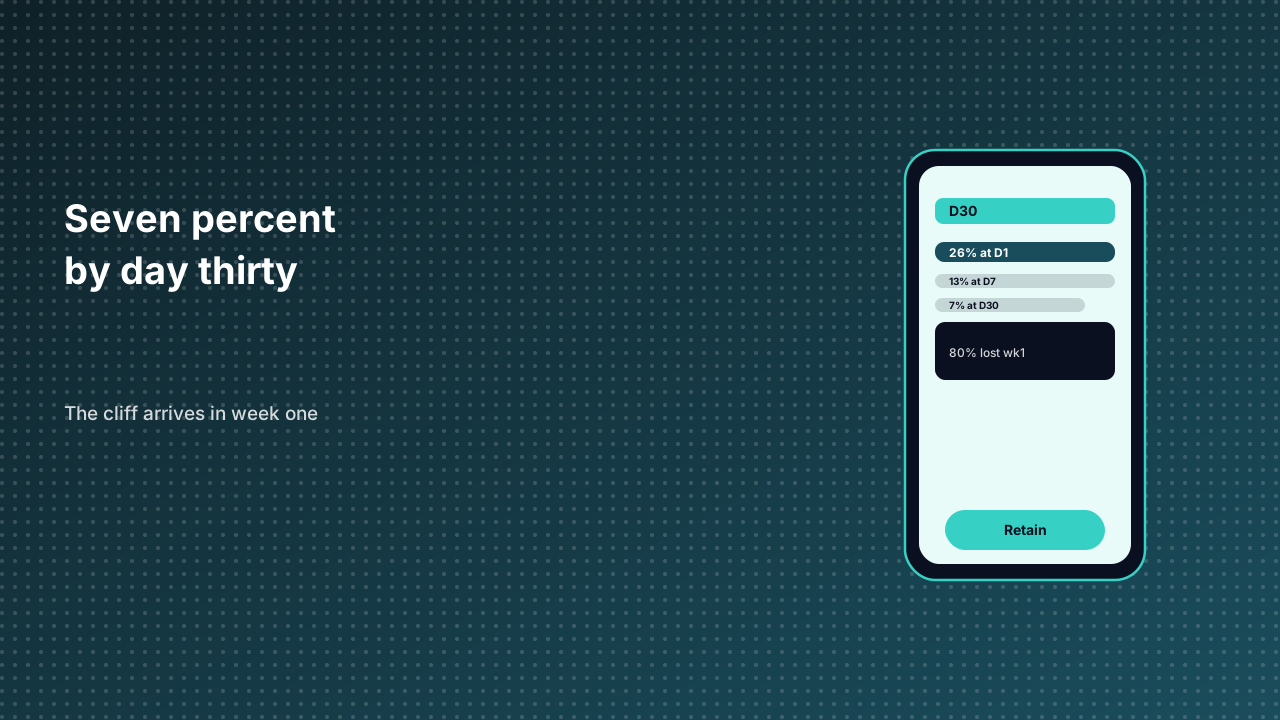
When a mini-program's 30-day retention craters, the reflex is to blame the creative and buy more re-engagement pushes. Sometimes that helps. More often the first reason a user doesn't come back is duller: they can't find you again. A native app at least earned a home-screen icon. A mini-program that opened once from a video or a friend's share has to be rediscovered, and rediscovery is a runtime problem long before it's a marketing one.
The second-open problem
The first open is your best moment — the user was handed you, warm, with no install. The second open is where most mini-programs die. If the only path back is a buried catalog search inside the host, the person who liked you has to remember your name, open the host, and dig. That's three steps of intent most users won't spend. Native apps cheat here: they live on the home screen whether you want them or not.
A runtime that gives a re-entry shortcut — a pinned card, a host shelf slot, a deep link that lands exactly where they left — turns "I liked that thing" into a tap. That single capability moves D30 more than a month of push creative.
What the runtime owns that marketing can't
- Re-entry. A persistent, one-tap way back. Without it, every return is a fresh acquisition cost.
- Delivery you can trust. Host notifications actually reach the user. A mini-program that can't ping through the host is silent, and silent is forgotten.
- Instant re-open. No reload, no cold start, state preserved. The second visit should feel like resuming, not restarting.
- Frequency hooks. The host surfaces you when the user's pattern says "now." That's an algorithm you can feed with engagement, not a channel you own.
The myth: retention means pushing harder
It doesn't. Pushing harder at a user who can't get back is spray. The real retention lever is making the second and tenth opens as frictionless as the first, then earning the host's surface by being opened often. Frequency begets surfacing begets frequency. Push is the last mile, not the foundation.
| Lever | Native app | Mini-program with weak runtime | Runtime-optimized |
|---|---|---|---|
| Re-entry | Home-screen icon | Catalog search | Pinned shortcut |
| Notification | Own channel | None / unreliable | Host delivery |
| Re-open | Resume | Cold reload | Resume, state kept |
| Surface | Store ranking | Lost | Earned by frequency |
The tradeoff you can't avoid
You don't own the re-engagement channel. The host does, and it decides when your notification is welcome and when it's noise. Trying to own that channel is how teams bolt on a web push that the host quietly blocks. The honest move is to feed the host's signals — open rate, session length, repeat visits — so the surface works for you instead of against you.
The real read
Day-30 retention is won or lost at re-entry, and re-entry is built into the runtime, not the ad budget. Fix the second open first: a shortcut, a reliable ping, a resume that doesn't restart. Then let the creative do what it's actually good at — bringing people back to something that's easy to get to. Most retention problems were solved the moment the user could find you again.
Sources
- data.ai — Mobile benchmarks — retention and engagement benchmarks across app categories.
- DataReportal — Digital 2026 — mobile behavior that explains why rediscovery fails.
- WeChat Mini Program docs — framework — the catalog and re-entry model mini-programs inherit.
- StatCounter — Mobile market share — the device base where re-entry friction bites.
- GSMA — Mobile Economy — why lightweight, returnable distribution matters in emerging markets.