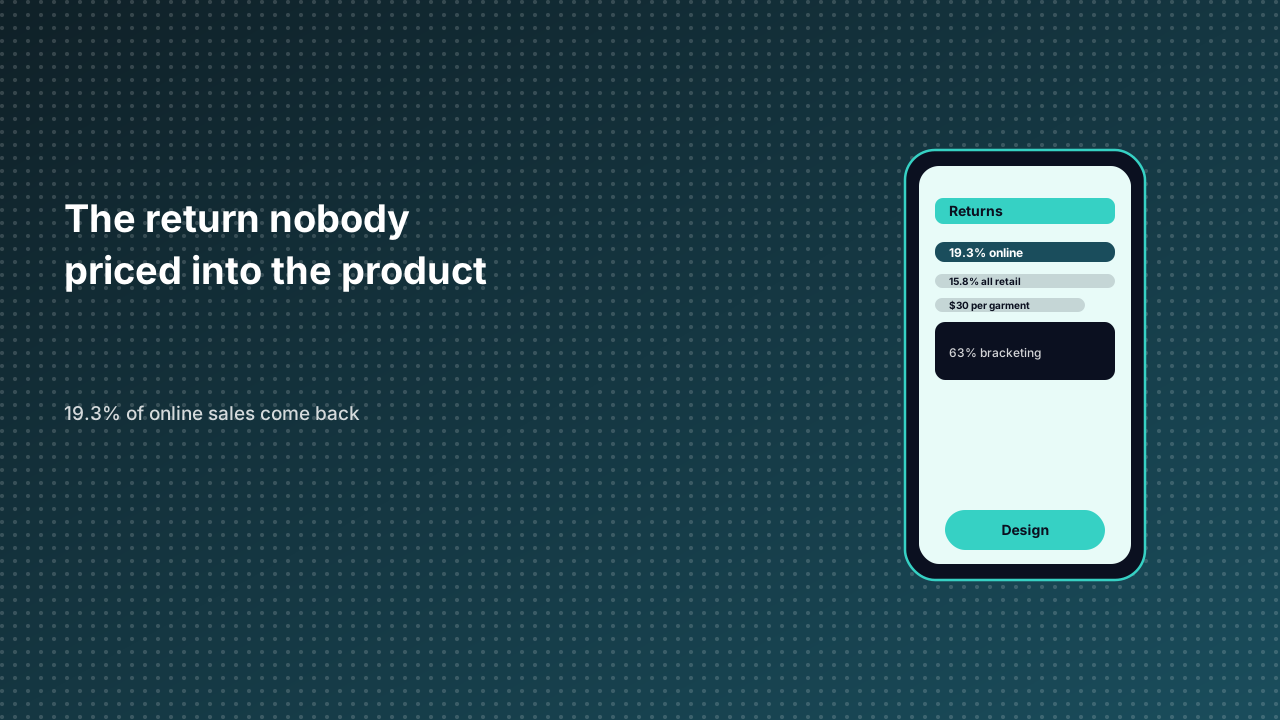
Returns reached $849.9 billion of merchandise in the United States in 2025, and the online channel carried a 19.3% return rate against 15.8% across all retail. The headline that gets quoted is the percentage. The number that actually decides whether a category is profitable is the cost of each unit coming back: roughly $20 to $30 to process, and closer to $26.50 to $33 for a $100 apparel item once return shipping, inspection, refurbishment, and markdown are stacked together. Only about 48% of returned online items get restocked and resold at full price.
The mechanism behind the apparel number is behavior that has a name. Bracketing — buying several sizes to keep one — is practised by 63% of online clothing shoppers, according to Narvar. Wardrobing, wearing an item once and sending it back, accounts for another chunk. Across 28 million orders at more than 400 apparel retailers, one in five items from women-focused stores came back versus one in eight from men-focused stores, and the gap held at every price band. Fit is the one attribute a screen cannot verify, so the buyer outsources the fitting room to the brand and ships the uncertainty back.
| Channel / category | Return rate | Source anchor |
|---|---|---|
| Online, all categories | 19.3% of sales | NRF / Happy Returns 2025 |
| All retail channels | 15.8% of sales | NRF / Happy Returns 2025 |
| Apparel online | 24–30% | industry trackers |
| Footwear online | around 27% | industry trackers |
| DTC apparel (2026) | 28.4%, up from 21.7% in 2023 | Loop Returns / Narvar |
The financial damage is systematic rather than dramatic. Loop Returns and Narvar put the 2026 DTC apparel return rate at 28.4%, up from 21.7% in 2023, and stores above 25% returns lose roughly 11 points of contribution margin. A brand doing $2 million in apparel revenue at a 27% return rate is sending back $540,000 of orders; at even $32 of cost per $100 returned, that is about $173,000 a year that never appears as a clean line on the profit and loss statement. It hides inside shipping, fulfillment, and an "other" bucket. Returns also consume cash at the worst point in the cycle: the inventory cost, outbound shipping, and acquisition spend are already gone, the refund goes out before the unit resells, and the unit may never resell at full price.
There is a real lever, and it is upstream. AI size recommendation and virtual try-on cut apparel return rates by 24–32% in reported deployments, because letting a shopper see the garment on a body like theirs reduces the number of sizes ordered in the first place. Detailed measurements, accurate size charts, and consistent product photography do the same work more cheaply. The return rate is therefore set at the moment of product presentation, long before the parcel exists — which is why treating it as a warehouse problem is a category error.
A mini-program runtime changes where that intervention can happen. The surface is interactive and stateful, so size guidance, fit checks, and "what other buyers with this profile kept" can appear inside the decision flow rather than on a static product page. A scan-to-order or in-app catalog can carry the shopper's prior purchases and returns history, which makes a fit suggestion specific rather than generic. After a sale, the same surface can offer an exchange before a refund, keep the return label and status visible, and route the item to resale or liquidation with a recorded disposition — turning a refund into a retention moment and a data point. The runtime also lets a merchant test a policy change by cohort: free returns for one group, store credit for another, and measure the effect on both return rate and repeat purchase.
Fraud belongs in the same model. NRF counts 9% of returns as fraudulent, while Appriss Retail puts the figure at 15.14%, or $103 billion in 2024. Different denominators, different stories — but both large enough to matter. A runtime that records return reasons at the point of initiation, flags repeat patterns, and applies a visible policy gets a cleaner signal than a return portal that accepts anything and asks questions later.
For a host platform, the strategic case is straightforward. Return rate is one of the few metrics that damages the merchant, the logistics partner, and the host's catalog reputation at the same time. Building fit guidance, exchange-first flows, and disposition tracking into the runtime gives every merchant on the platform a defense against a cost that otherwise arrives as a silent margin haircut. The merchant keeps more of the sale, and the catalog keeps a buyer who might otherwise have written the whole experience off as a gamble.
Sources
- NRF / Happy Returns 2025 return landscape — 19.3% online, 15.8% all retail, $849.9B returned.
- Return roulette and the cost of bracketing — 63% bracket, $26.50–$33 to process a $100 item.
- What a return actually costs a brand — margin math and returns-adjusted contribution.
- Building a returns management system — net recovery rate and disposition economics.