

A version number carrying a date
On 23 November 2026 the Stripe SDK page listed seven server libraries: Ruby 21.1.0, Python 17.1.0, Go 87.2.0, Java 34.2.0, Node 23.2.0, PHP 23.1.0 and .NET 53.2.0, alongside Web, iOS, Android and React Native offerings. Those numbers are a snapshot taken that day and will move with the next release. The numbers age quickly; the rhythm underneath them is worth a longer look. Stripe versions its API by release date and its SDKs by semantic version, then bumps the SDK major when a breaking API change lands. That two-track arrangement is Stripe's own policy. Reading it as an industry-wide rule goes past what the page says.
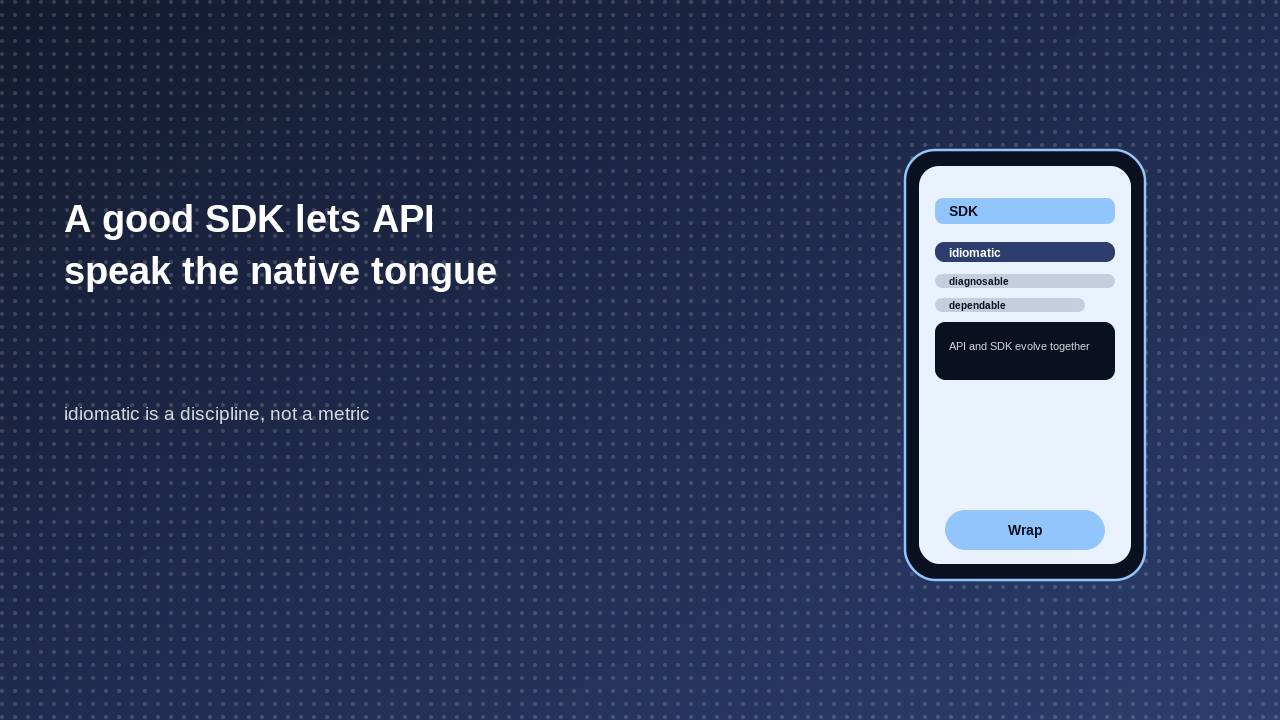
A good SDK is the layer where an API starts speaking the language of its callers. The same remote operation ought to read like ordinary local code in Ruby, in Go, in .NET. Azure's SDK guidelines put idiomatic first for exactly that reason. Google's Cloud Client Libraries describe the same goal in different words: idiomatic conventions that cut boilerplate and hide the shape of the underlying API. Both texts treat idiomatic as a direction for library authors. Neither publishes a metric that would let anyone measure it.
What the translation layer actually carries
| Design question | Who answers it | Surface the developer sees |
|---|---|---|
| Does the call look native in this language? | Language guidelines | Naming, async patterns, error types |
| What happens on a timeout or a 429? | The client library | Backoff, jitter, cancellation |
| Which fields come back, and in what shape? | Generated code | Serialization and deserialization |
| Which error can be retried? | Service error semantics | Structured codes and response headers |
| What happens when a field is removed? | Compatibility policy | SDK major version |
An SDK ships serialization, timeout handling, retry policy, error mapping, pagination and version conventions, so a caller does not reopen the reference docs for every request. Microsoft's architecture guidance asks SDK authors to expose typed methods that construct requests and parse responses, to document validation, cancellation, pagination, error responses and which operations are safe to retry, and to keep the client's compatibility policy aligned with the API's. It also notes that generating a typed client from an OpenAPI definition does not remove the need for integration tests. All of that work goes well beyond wrapping an HTTP call. It is the part that decides how an API feels at three in the afternoon when something has gone wrong.
The priority hidden inside consistency
Azure's guidelines list five principles, and the order among them matters more than the list itself. Idiomatic asks the library to follow the conventions of the target language. Consistent then ranks three kinds of alignment: agreement within one language comes first, agreement across languages second, agreement with the service third. Approachable asks for predictable defaults and concepts introduced gradually. Diagnosable asks for error messages that are short, tied to the service, actionable and readable by a person. Dependable is blunt about breaking changes: the damage they do to the experience outweighs most new features, and incompatible changes must survive strict review.
Flattening those five into a slogan about being consistent and natural throws away the part that settles real arguments. When a language convention and a cross-language convention pull in different directions, the guidelines already say which one wins. Drop Diagnosable and the error message someone reads at two in the morning disappears with it. Drop Dependable and a major-version bump becomes a routine event. A team picking a client architecture can follow all five without pretending they carry equal weight.
Machine precision, human hand feel
Here is a tradeoff worth laying out. Two signed articles, from different years, propose a split that neither Azure nor Google prescribes. Lorna Mitchell, writing for Nordic APIs in November 2020, described machine-generated code as clinically accurate but joyless, and suggested keeping it isolated behind a hand-written user layer with a little glue code. Oleksii Nikiforov, in a February 2022 InfoQ article, mapped three ways to build a client: fully manual, declarative, and generated from an OpenAPI definition. The automated route wants a clean specification and makes custom data contracts awkward. Both are practitioner opinions with names and dates attached. Calling them official OAI, Azure or Google requirements lends them an authority the texts never claim. The split is also not universal. A thin client around a small, stable API works perfectly well without a second layer, and adding one on reflex buys ceremony without much return.
The Google page reachable here is the Cloud Client Libraries entry on a regional mirror. It describes how the libraries behave and belongs in a conversation about client behaviour; citing it as a verified chapter of a design guide would be a different claim altogether.
SDK and API evolve together, and three sources give that statement three concrete shapes. The Nordic APIs piece notes that an API change can be folded in by regenerating the code. Stripe maps a breaking API change to an increment in the SDK major. Azure's Dependable principle resists incompatibility and demands review and good reasons before allowing it. Different years, different standpoints, one shared conclusion: generated precision needs an architecture to hold it, and the compatibility policy belongs in the contract beside the endpoint list.
The multiplication facing an open catalog
For a team working across host surfaces, the practical consequence is a multiplication problem. A capability published once and consumed on several hosts turns each hand-written integration into another place where naming, error mapping and retry policy can drift apart. A shared runtime and an open catalog change the cost structure of that multiplication: one typed client, one set of error conventions, one compatibility policy, carried wherever the host permits. No adoption figure, retention figure or integration-time figure hangs off this mechanism, because none of them was measured. Cross Mini App treats the translation layer as part of the contract a capability brings with it, which is why the SDK gets designed alongside the API.


