

The review nobody can repeat
A configuration flag left on in a starter template travels into every project copied from it. Each review catches some of those flags, and each reviewer remembers a different subset. Over time the team spends more effort inspecting the same decisions than it would spend making the safe choice the starting point. The Secure Product Design cheat sheet from OWASP starts from a different premise: all products should meet or exceed the security requirements the organisation sets during development, and security decisions should be explicit choices that produce the correct level.
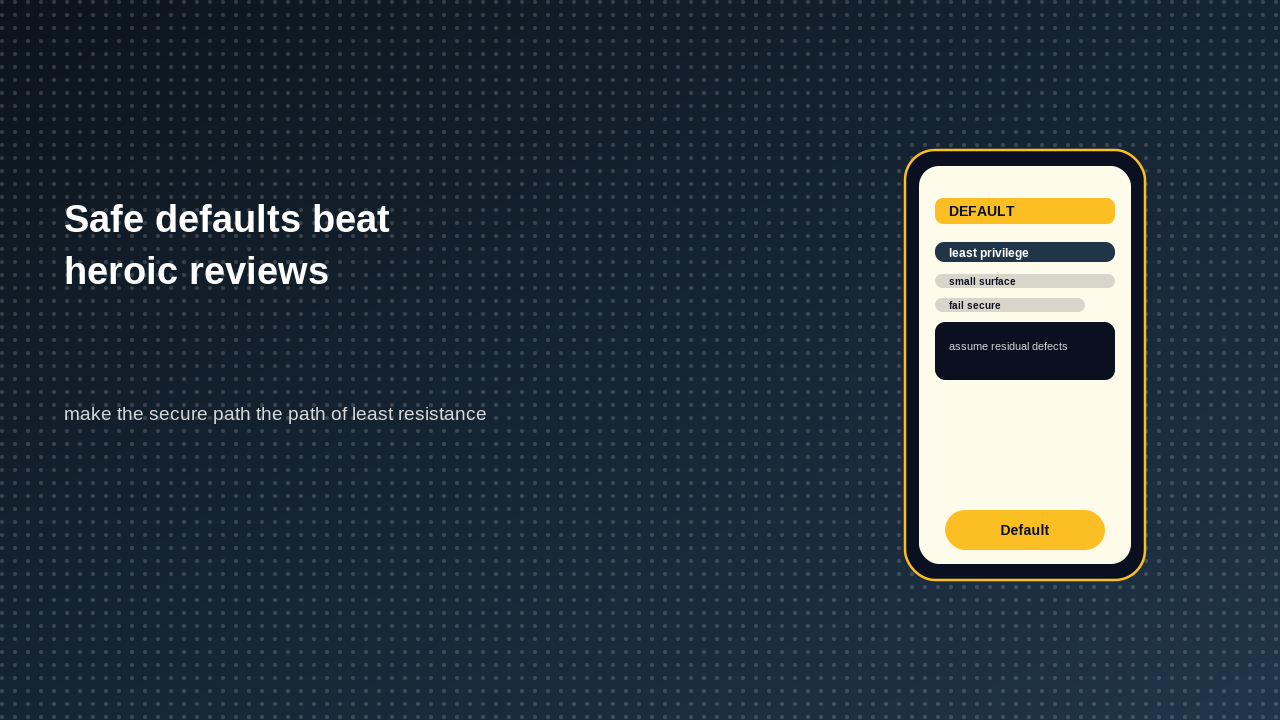
The baseline is short. Establish secure defaults, minimise the attack surface, and fail securely to defaults that are well defined and understood. Least privilege follows from the same direction: a component receives the least access needed for the work. Separation of duties is the counterweight that stops one person from controlling every part of a transaction, reducing the room for fraud and error. None of this promises that defects disappear. It decides where risk sits before a release.
Configuration guidance in the same cheat sheet puts Secure by Default in plain terms: systems and software should be secure with the least amount of manual setup. Fail Securely sits beside it, describing a system that enters a safe state when something goes wrong instead of exposing a weakness. The pairing matters. A default that is safe only on the happy path is a default that fails open under pressure.
| Practice | Where the wording comes from | Shape in a project |
|---|---|---|
| Secure defaults | OWASP configuration guidance and a Microsoft whitepaper from 2005 | The starting state needs no extra setup to be safe |
| Reduced attack surface | OWASP design guidance and the Microsoft SDL whitepaper | Services not broadly needed stay disabled or reach a small set |
| Fail securely | OWASP design and configuration guidance | Failure lands in a defined safe state instead of an exposed one |
| Least privilege and separation of duties | OWASP Secure Product Design | Access is the minimum for the task; no single person owns a whole transaction |
Attribution deserves care. The OWASP material is engineering guidance. The Microsoft SDL whitepaper from 2005 is a vendor document, and its SD3+C shorthand — Secure by Design, Secure by Default, Secure in Deployment, Communications — belongs to Microsoft's terminology rather than to NIST or ISO. That whitepaper describes Secure by Default as assuming real software will never be perfectly secure, keeping the default state favourable to security, running with the least necessary privilege, and leaving services that are not widely needed disabled or available to only a small set. It also argues that the first two elements, design and default, deliver the largest benefit: one prevents flaws from entering, the other shrinks the exposed surface.
An archived Microsoft Learn post on security principles makes the same point from a maintenance angle. Use secure defaults, and test the impact before lowering them for a feature. Fail into a secure mode. Adopt least privilege. Reduce the attack surface. Its bluntest line says that anything unused should be disabled, because a flaw discovered later in that module no longer threatens the application. That is a vendor engineering position from a particular period, not a current compliance obligation.
What the CISA page actually says
CISA's Secure by Design hub argues that cybersecurity should be built into the design and manufacture of technology products. It says the burden currently falls disproportionately on consumers and small organisations rather than on producers, and asks technology providers to carry product security responsibility at the executive level. Products should be secure out of the box, with additions such as multi-factor authentication, logging and single sign-on available at no extra charge. Applying the approach during design reduces the number of exploitable defects before a product reaches the market.
The same page records a pledge: more than 200 software manufacturers have committed to concrete, measurable actions toward seven goals. That count changes over time and reflects the reading of the page for this article; treating it as a live precise figure would be a mistake. One more boundary matters. The hub checked here does not set out a three-principle list verbatim, and the exact phrase secure by default does not appear in its text; those formulations come from related CISA guidance outside the four sources below.
Open by default accumulates debt
A default-open setting looks generous during a demo and expensive years later. Every new surface has to be defended, documented and remembered by whoever inherits it. That analysis follows from the Microsoft advice about disabling unused modules and from OWASP's call to minimise attack surface; it is an inference from those sources rather than a quoted sentence. Secure defaults move the decision out of individual memory and into the system, the only place where a repeated decision can live consistently.
The honest limitation is that defaults narrow exposure without zeroing it. OWASP and Microsoft both leave room for residual defects, so a review still has a job: checking that the defaults survived the custom work. Heroics fail when they are the only control. Defaults fail when nobody notices they were overridden. A workable arrangement uses both, with the system carrying routine decisions and reviews aimed at the exceptions.
Cross Mini App publishes shared runtime capabilities into an open catalog, a shape in which one default reaches many consumers. A safe starting state at that layer travels further than a checklist repeated in each project.


