

A definition published in August 2017
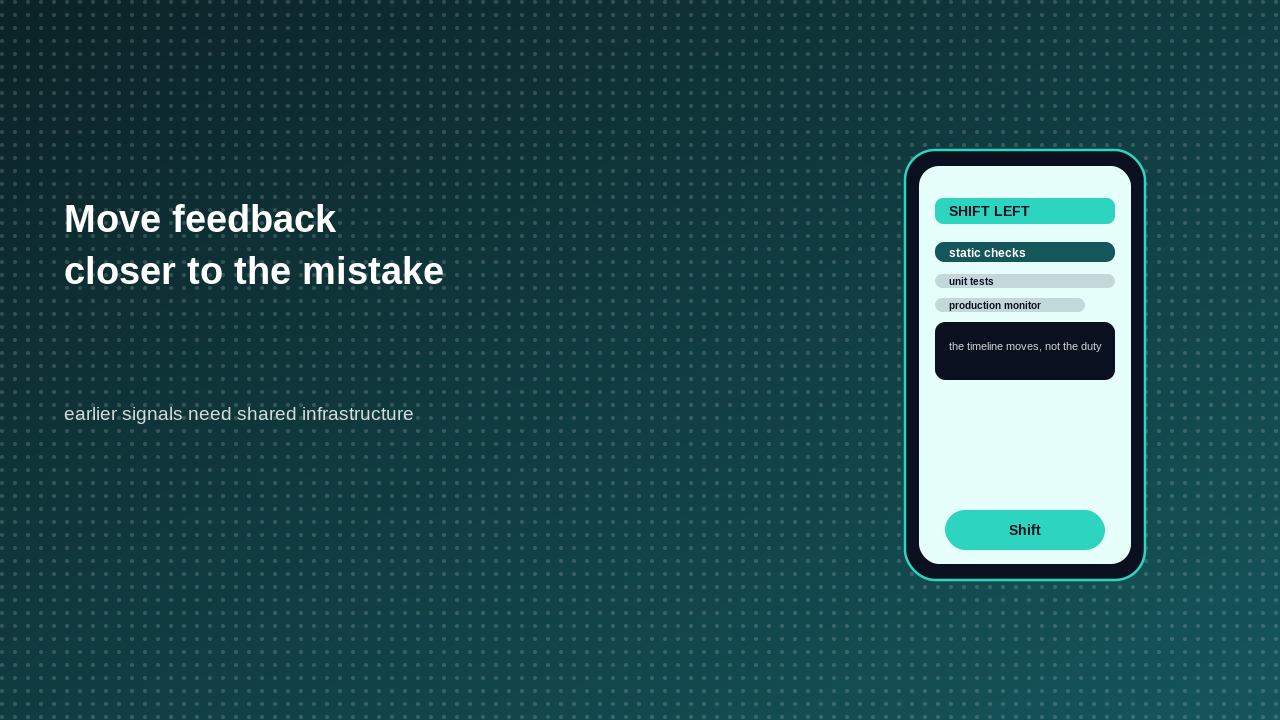
On 22 August 2017 Martin Fowler described shift-left as moving a step of the value stream earlier on the timeline. His examples are deliberately unglamorous: replace a manual test with an automated one, and notice a badly specified product idea before a product owner writes it into the backlog. In the same article, pushing unit tests into a nightly build earns the label shift-right. The direction of the arrow is decided by when feedback arrives. Which department supplies that feedback is beside the point.
That framing settles an argument that keeps resurfacing. Under it, the testing backlog stays where it is and QA stays in the room. What changes is the distance in time between a mistake and the signal about it. A short distance makes the signal cheap to act on; a long one turns it into an archaeological exercise.
The organizational conditions Microsoft lists
Microsoft's guidance on fast, reliable unit tests spells out three conditions that are easy to skip in retellings. Test infrastructure is a shared service for the whole team. Test code is held to the same standard as production code. Component authors own the component-level tests. Each condition lowers the cost of getting feedback early; none of them deletes a role. Handing developers a pile of tests without the infrastructure to run them quickly is the opposite of what the guidance describes.
The other half of the story is production. Fowler's Self Testing Code bliki observes that teams testing their own code increasingly emphasize monitoring in production, and that a production bug is handled by shipping a fixed version or rolling back to the last known good one. Microsoft places testing in production alongside shift-left as a companion activity. Early signals reduce surprises; they do not make the live-traffic signal redundant.
Four signals at different altitudes
| Practice | Where the feedback lands | What it can actually catch |
|---|---|---|
| Static checks and linting | On save, in pre-commit hooks, in CI | Syntax, style, a subset of interface mistakes; nothing about behavior under real traffic |
| Unit tests at L0 and L1 | Commit and CI | Logic inside one component, before a full build is needed |
| Contract tests | CI, against a shared agreement | Whether messages crossing a boundary still match the recorded understanding, in isolation |
| Production monitoring | Live traffic | Real user paths and conditions no test suite can enumerate |
Static checks and unit tests compress the loop to minutes. Pact defines a contract test as checking, in isolation, that the messages an application sends or receives match an understanding recorded in a contract; for HTTP those messages are the request and response. A Pact contract is generated from executable request and response examples, which the documentation calls contract by example, and is contrasted with a static schema that describes every possible state. The stated alternative without contract tests is a reliance on expensive and brittle integration tests. The fourth row is not optional: monitoring catches the failures that the first three rows never modeled.
The cost curve and the paragraph that comes with it
The cost argument belongs to Barry Boehm and Victor R. Basili, writing in IEEE Computer 34(1) in January 2001. Item ONE of their Software Defect Reduction Top 10 List says that finding and fixing a software problem after delivery is often 100 times more expensive than finding and fixing it during requirements and design. Two details travel with that sentence and are routinely dropped. The authors say they added the word often deliberately. In the same paragraph they report that small, noncritical software systems show a cost-escalation factor more like 5:1 than 100:1, and that good architecture lowers the factor further by confining fixes to small, well-encapsulated modules.
Item TWO of the same paper reports that software projects of that period spent about 40 to 50 percent of their effort on avoidable rework, and immediately notes that some rework is unavoidable because requirements emerge from prototypes and joint learning. That figure describes projects around 2001, before continuous integration was routine; it is not a current measurement of any team, let alone a mini-program team. A widely circulated 1:10:100 table has no traceable primary publication in the material reviewed here, so it is not used as evidence.
The paper itself was checked by downloading the PDF and extracting its text locally. The web fetcher returned a notice that the resource was not text, so no claim is made here about having read rendered pages through it.
The defensible conclusion is directional: earlier feedback tends to cost less, and the size of the difference depends on system size and architecture.
One team's migration is not a benchmark
Microsoft's documentation recounts a single team running more than 60,000 unit tests in under six minutes, with a goal of getting under one minute. It gives L0 tests an average execution time under 60 milliseconds, L1 under 400 milliseconds, and a two-second ceiling for any test at that layer; these are internal thresholds, not industry baselines. The same team took 42 sprints, from sprint 78 to sprint 120, or 126 weeks, to bring legacy tests from 27K down to zero. Its pull-request-to-merge time was about 30 minutes including those 60,000 unit tests, merge-to-CI build about 22 minutes, first CI quality signal about an hour, and full product tests within two hours of merge. The document calls the effort a massive investment and says the cost of the shift is difficult to measure. These are the coordinates of one migration, not a target for another team.
Where a shared runtime changes the reuse equation
A shared runtime and an open catalog alter what gets repaid when a validation is expressed once. A contract check or a component-level rule can travel with a capability to each host surface instead of being re-derived for every integration, so the early signal is written once and reused wherever the runtime is available. That is a mechanism, not a measured outcome. The research behind this article contains no first-hand mini-program shift-left figures, so none are asserted here. The practical question is which checks can be stated at a shared boundary and which must remain specific to a single host.


