

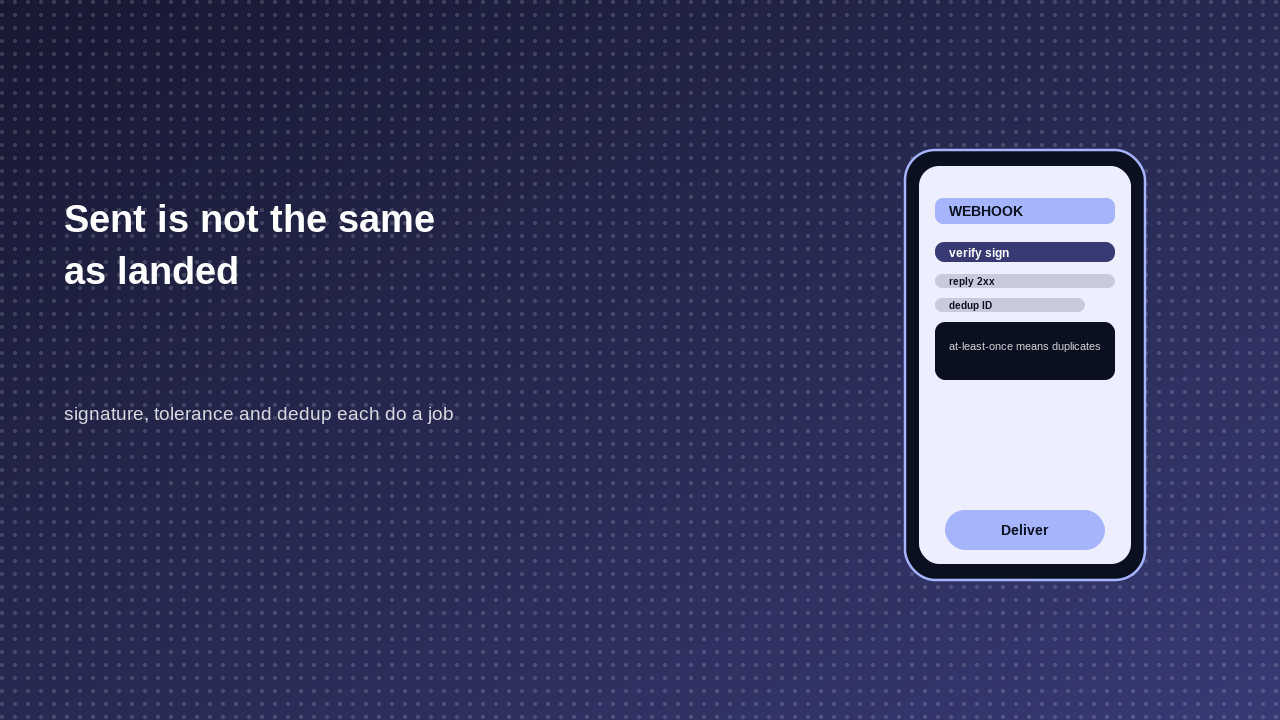
At ten seconds, GitHub calls a webhook delivery failed. A response that lands at second eleven does not repair that record. The threshold comes from GitHub's current English documentation, checked on 2026-11-23; the Chinese page for GHES 3.17 puts the same boundary at thirty seconds. Two numbers, two version labels, and a useful reminder that the timeout on a webhook is never a single portable constant.
A failed delivery keeps a status other than OK on GitHub. The documentation says it plainly: GitHub does not automatically redeliver failed deliveries. Recovery runs through the REST API or a script that asks for a replay. That detail tends to disappear from summaries of webhook reliability, because the better-documented senders behave differently. Stripe generates a fresh signature and timestamp on every retry. Svix describes exponential backoff at five minutes, then thirty, then hours, with attempts spread across twenty-four to seventy-two hours before a delivery moves to a dead letter queue. Those intervals are one vendor's engineering account of a typical implementation; whether other platforms adopt them is each platform's own decision.
The first design question therefore points at the sender: does this particular source retry at all, and under what conditions? A receiver that assumes retries exist everywhere will build the wrong safety net.
| Signal | What it actually proves | What the receiver still owes |
|---|---|---|
| HTTP 200 inside the timeout | The endpoint accepted the request | Nothing about business state; queue the real work |
| Valid signature and fresh timestamp | The payload came from a key holder, outside the replay window | Deduplicate the event ID for replays inside the window |
| Repeated webhook-id | The same event arrived again | Acknowledge quickly, skip the second side effect |
| 5xx or timeout | This source may retry, if its policy allows | Keep the handler idempotent and short |
| 4xx for bad signature or format | Most senders stop, per Svix's account | Repair verification or payload; expect no automatic replay |
The second column is where confusion concentrates. A 200 says the request was accepted. Stripe's guidance is explicit: return 2xx before any complex logic that might time out, then mark the invoice paid in the accounting system. The response and the business effect are separated on purpose. Folding them into one step is how a slow database query turns into a redelivered event.
Verification deserves the same precision. Stripe checks the raw JSON body together with the Stripe-Signature header and the whsec_ signing secret. A framework that rewrites the request body before verification breaks the check even when the payload is genuine. Default timestamp tolerance is five minutes; setting it to zero disables the recency check entirely, which only holds if clocks are kept honest through NTP. Signature, timestamp, and deduplication cover different threats. The signature blocks forgery and tampering. The timestamp tolerance blocks old replays from outside the window. Neither catches a replay arriving inside the window with a valid signature. For that, the stable event ID has to do the work.
A trap is worth naming here. Standard Webhooks, version 1.0.0, defines webhook-id as stable across retries, alongside webhook-timestamp and webhook-signature, and recommends using webhook-id as an idempotency key, with an example of storing it in Redis for five minutes. That five minutes is a deduplication window. Stripe's five minutes is a signature timestamp tolerance. The two share a number and very little else. Reading them as one setting produces a system that either rejects legitimate late events or accepts fresh replays.
Order is the other assumption that fails in production. Svix notes that retries and parallel delivery can let event B reach an endpoint before event A, and suggests deriving order from a timestamp or sequence number in the payload. At-least-once delivery puts duplicates on the normal path, to be handled as routine; after an outage, retries tend to arrive in a batch. An endpoint that does heavy work before acknowledging only makes that batch harder to absorb.
Putting the promises in writing helps more than pretending they are simpler. Best-effort, at-least-once, out-of-order are starting conditions, and the receiver's duties follow from them. The Svix retry schedule is a documented vendor choice. Standard Webhooks is a community specification whose technical steering committee draws eight people from Zapier, Twilio, Lob, Mux, ngrok, Supabase, Svix and Kong; its three stated goals are security, interoperability and reliability, with explicit attention to SSRF, spoofing and replay. Useful guidance, certainly, but written by engineers from vendor teams, with no statistical programme behind it. Claims of a universal exactly once guarantee, or assumptions that events arrive in order by default, go past what any of these sources support. No measured mini-program delivery rate is hiding in them either; every number above describes general webhook systems.
For a team shipping on multiple host surfaces, the gain is structural. Cross Mini App's shared runtime and open catalog let one receiver implementation travel across surfaces, so signature verification, event-ID deduplication and asynchronous handling get written once and carried with the capability. That is a design suggestion; no measured result in this research backs it, and the ceiling of the guarantee still sits with the sender's policy: nothing downstream can strengthen a promise the sender never made.


