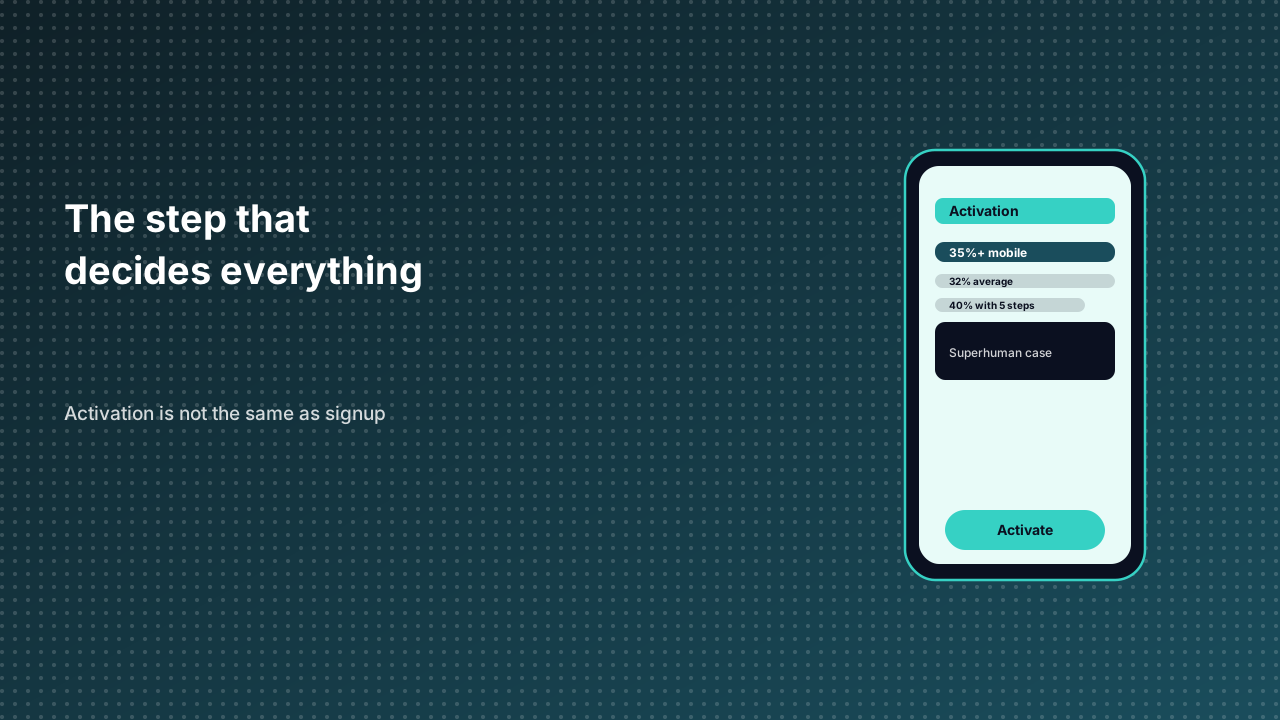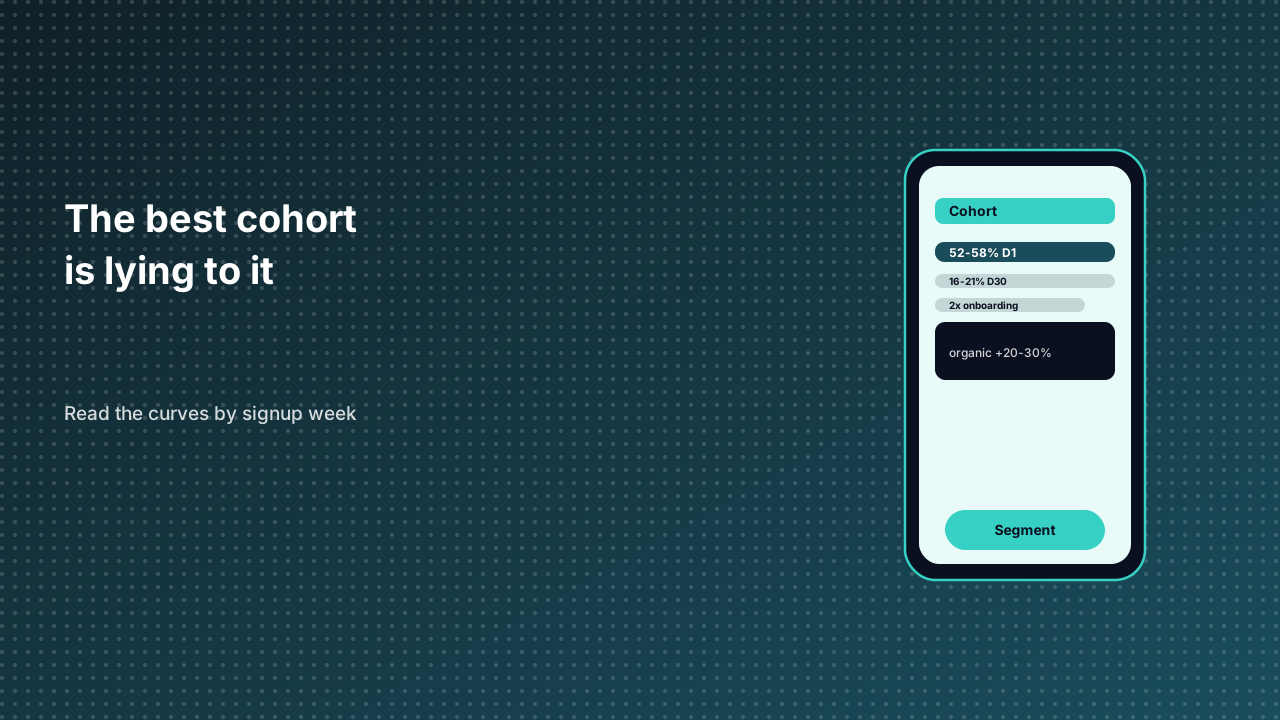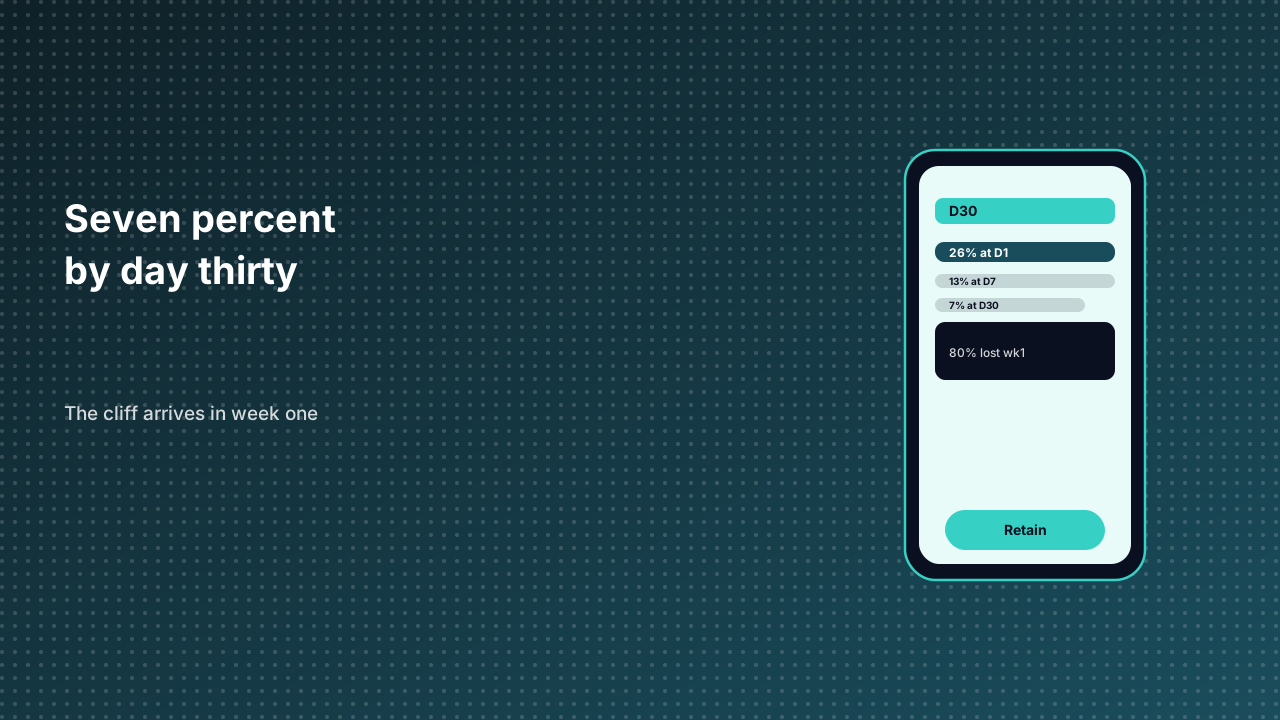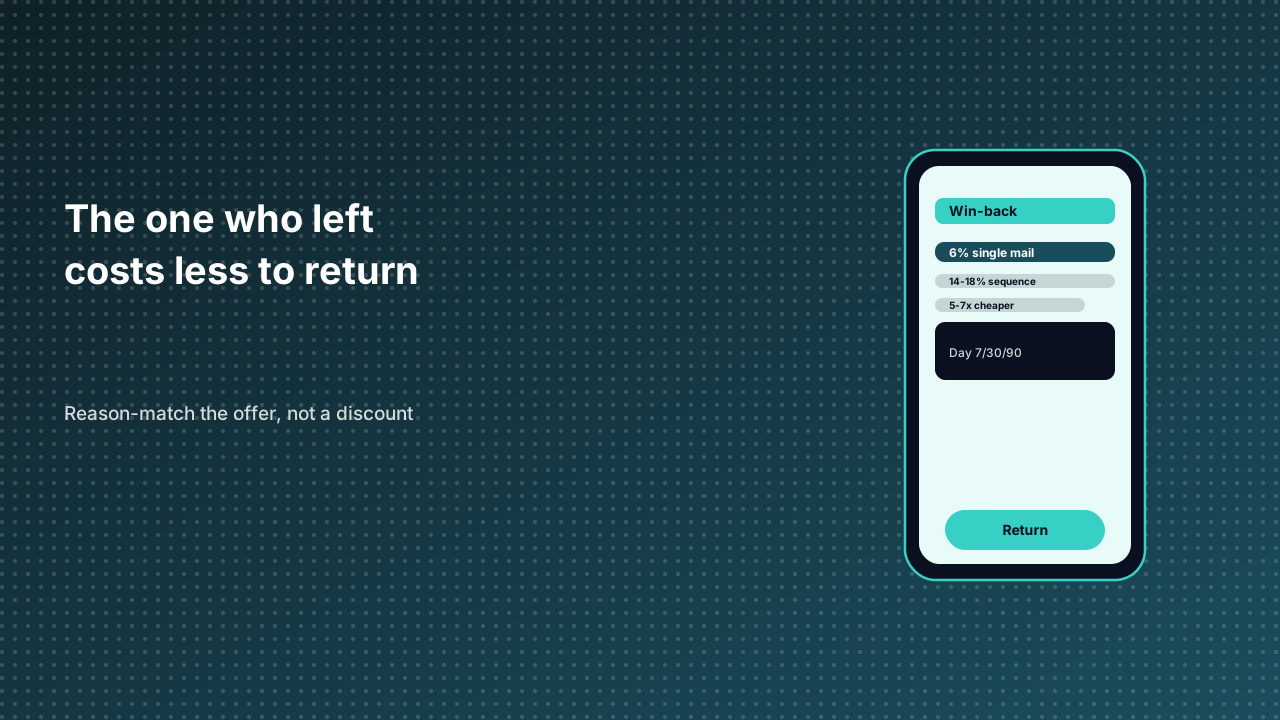
A buyer who purchased four times last year has not opened a message in ninety days. Somewhere else, a paid campaign is working hard to find a stranger with similar demographics. The dormant buyer is cheaper to reach by a factor of five to seven, according to Invesp, with Recurly putting the range as high as five to twenty-five times. Most teams still spend the larger budget on the stranger.
The gap is not a mystery; it is an execution problem. Klaviyo's 2025 data shows a single win-back email reactivating about six percent of a dormant list, while a four-email sequence reaches fourteen to eighteen percent. Solid business-to-consumer programs land in the ten to fifteen percent band; business-to-business with human assistance reaches fifteen to twenty-five; single-email programs typically sit at five to eight.
What a real sequence looks like
An e-commerce win-back flow opened in about thirty-two percent of cases and clicked at 1.2 percent, producing roughly 3.5 percent reactivation, with top performers above eight percent. Cadence matters as much as copy: a touch around day seven, another around day thirty, and a last one around day ninety gives each message a distinct job. Past three or four touches, deliverability starts to suffer — mailbox providers treat repeated ignored mail from a dormant relationship as a signal, and the domain pays for it.
| Touch | Timing | Job | Expected role |
|---|---|---|---|
| First | Day seven | Acknowledge absence, restate value | Highest open |
| Second | Day thirty | Reason-matched offer from exit data | Main reactivation driver |
| Third | Day ninety | Final useful reason to return | Last clean chance |
| Fourth | Beyond ninety | Suppress or hand to human | Deliverability risk |
| Single email | One-off | Cheap test | Five to eight percent band |
| Full sequence | Four touches | Primary program | Fourteen to eighteen percent |
The discount trap
Here is the part that separates a good program from an expensive one. A generic discount is the easiest lever, and it selects for precisely the wrong people: price-sensitive buyers who reactivate at a permanently lower average revenue per user. They come back, the reactivation chart improves, and the margin never recovers. The win looks clean in the growth report and quietly fails in the finance report.
The better move is to match the offer to the reason for leaving. An exit survey, a support ticket, a failed delivery, or a stale payment method each points to a different message. A customer who left because a size was out of stock needs a restock alert, not ten percent off. High-value segments identified by recency, frequency, and monetary scoring reactivate at thirty to forty percent against ten to twenty percent for low-value groups, which makes the argument for spending the best offers on the best dormant buyers rather than spreading them evenly.
Why the channel shape matters in a mini-program
A win-back message in an app has to drag somebody through an install flow. A mini-program has a shorter path: a deep link can drop a returning customer straight onto the host surface where the relationship originally formed, with identity and history already resolved. That reduces the friction between intent and action, but only when the link survives the handoff between the messaging channel and the host.
A shared runtime that runs across several hosts can carry the same segmentation, the same cadence, and the same reason-matched offer logic whichever host the buyer originally used. Suppression lists stay consistent, so a person who ignored three touches in one host does not receive a fourth from another. Buy the cheaper customer back first, but make the message worth returning to — a discount is a bribe, and bribes get remembered.
Sources
- Win-back campaign guide — subscriptionindex.com — how reactivation sequences and cadence are structured.
- Email marketing benchmarks 2025 — excelohunt.com — open, click, and reactivation benchmarks for win-back flows.
- E-commerce win-back campaigns — reworkcontent.azurewebsites.net — e-commerce flow benchmarks and top-performer ranges.
- Reactivation versus acquisition cost — subscriptionindex.com — the cost case for spending on dormant buyers first.