

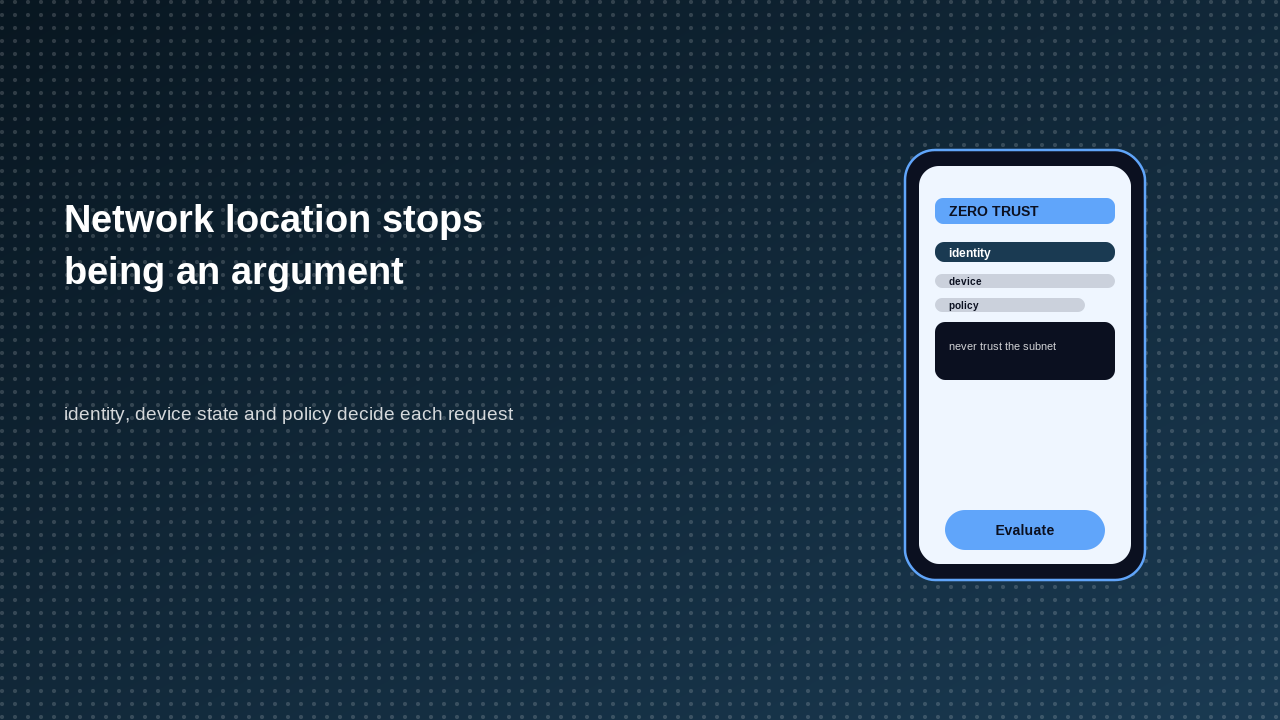
The packet from the office network
A request arrives from a device sitting on the office network. In an older access model that single fact carries most of the decision: the packet came from inside, so the resource treats it as friendly. NIST SP 800-207, finalized in August 2020, removes that shortcut. The document describes zero trust as a set of evolving cybersecurity paradigms that move defenses from static, network-based boundaries toward users, assets, and resources. The change is in where the decision is made and on what evidence. Which brand of firewall sits at the edge has little to do with it.
What the seven tenets actually promise
The standard calls its seven tenets ideal goals and says plainly that not every tenet must appear in its purest form within a given policy. That qualifier matters more than it looks. It keeps zero trust in the realm of architectural direction and stops it from becoming a procurement checkbox. A single appliance cannot deliver a set of principles, and a purchase order does not change how a decision point reasons about a request.
The second tenet is the sharpest one for everyday engineering. All communication is secured regardless of network location, and network location alone does not imply trust. A request originating in enterprise infrastructure inside the traditional boundary must satisfy the same security requirements as a request arriving from any other network. The wording is uncompromising. It does not offer internal traffic a gentler review as a nice-to-have; it removes origin as a trust signal altogether.
Tenet four moves the decision itself. Resource access is determined by dynamic policy, drawing on client identity, the application and service making the request, the observable state of the requesting asset, and behavioral and environmental attributes. Network location survives as one environmental attribute among several, which is a very different role from being the main component of a resource's security posture.
The machinery behind the decision
NIST SP 800-207 splits the policy decision point into two logical pieces. The policy engine makes and records the allow or deny decision. The policy administrator carries that decision out, establishing or cutting the communication path through a policy enforcement point, which enables, monitors, and eventually terminates the connection between a subject and an enterprise resource. Section 3.3 goes further and calls the policy engine the brain, with the trust algorithm as its primary thought process. The listed inputs are the access request, a subject database, an asset database with observable state, resource requirements, and threat intelligence.
A useful way to read that list is as debt. Policy quality is bounded by the quality of the signals feeding it. A team that deploys an enforcement point without reliable asset state has automated a guess. The seventh tenet asks for state information about assets, network infrastructure, and communications to be collected and used to improve policy, which turns telemetry into a precondition for any credible policy.
What changes in practice
| Signal | Boundary-era reading | Policy-driven reading |
|---|---|---|
| Network origin | Inside means friendly | One environmental attribute |
| Device state | Rarely consulted | Observable posture at request time |
| Identity | Checked once at entry | Rechecked against the current request |
| Resource scope | Broad reach after entry | Scoped to the specific resource |
| Decision record | Implicit in the tunnel | Logged allow or deny with context |
How CISA frames the journey
The CISA maturity model hub page describes zero trust as a collection of concepts and ideas aimed at accurate, least-privilege access decisions in a network assumed to be compromised. It frames the shift as a move from a location-centric model to a data-centric approach. The page carries an Archived Content notice, and the companion Zero Trust Maturity Model V2.0 PDF is dated April 2023. The document presents itself as one roadmap among many; it creates no compliance obligation on its own.
Its structure is worth getting right. Five pillars cover identity, devices, networks, applications and workloads, and data. Three cross-pillar capabilities cover visibility and analytics, automation and orchestration, and governance. Each pillar offers traditional, initial, advanced, and optimal architecture examples. The PDF states that the model reflects the seven tenets of NIST SP 800-207 and that later stages lean increasingly on automation and cross-pillar integration to make policy decisions more dynamic. Mixing up five pillars and three capabilities is an easy error, and they are different axes: one names the areas of work, the other names how that work is operated and connected.
The old implementation story
The most cited implementation story is also the oldest. Ward and Beyer described Google's BeyondCorp migration in the December 2014 issue of ;login:, hosted by USENIX. The paper recounts removing the privileged internal network, putting enterprise applications on the public internet, and authorizing every request from device and user credentials whether the request came from a corporate office, a home network, or a hotel. An access control engine inside the access proxy served service-level authorization by combining user and group membership, the device certificate, traces in a device inventory database, and inferred trust levels for both. The inventory database is described as one of the foundations of the model.
That paper should be read for what it is. It is a historical account from an industry magazine, a company's description of its own migration, and it sets no standard. It says nothing reliable about the author's present architecture. Its lasting value is in showing that the control plane had to be built before the network could stop carrying trust. The accessible primary record is the USENIX-hosted article.
Where a mini-program fits
A mini-program running inside a shared runtime and an open catalog makes the question narrower without making it easier. Which signals reach the policy decision, and who records the answer? A request from a program of this kind typically arrives with host-issued identity, a runtime-mediated capability call, and an environment that changes by the minute. If the policy engine sees only an address range, the design has rebuilt the old boundary behind a newer interface. If it can see the subject, the asset state, the resource being requested, and behavioral context, the decision has something to stand on. The shared runtime is useful architecture background; it is not evidence that any of this already happens.
The work is unglamorous. Signals have to be chosen, made observable, and paired with a record of every allow and deny so the policy can be argued with later. Network location still has a use, just not the final word. Cross Mini App lives at the runtime layer where those signals meet, and an open catalog is where a consistent decision policy becomes reachable across hosts.


