

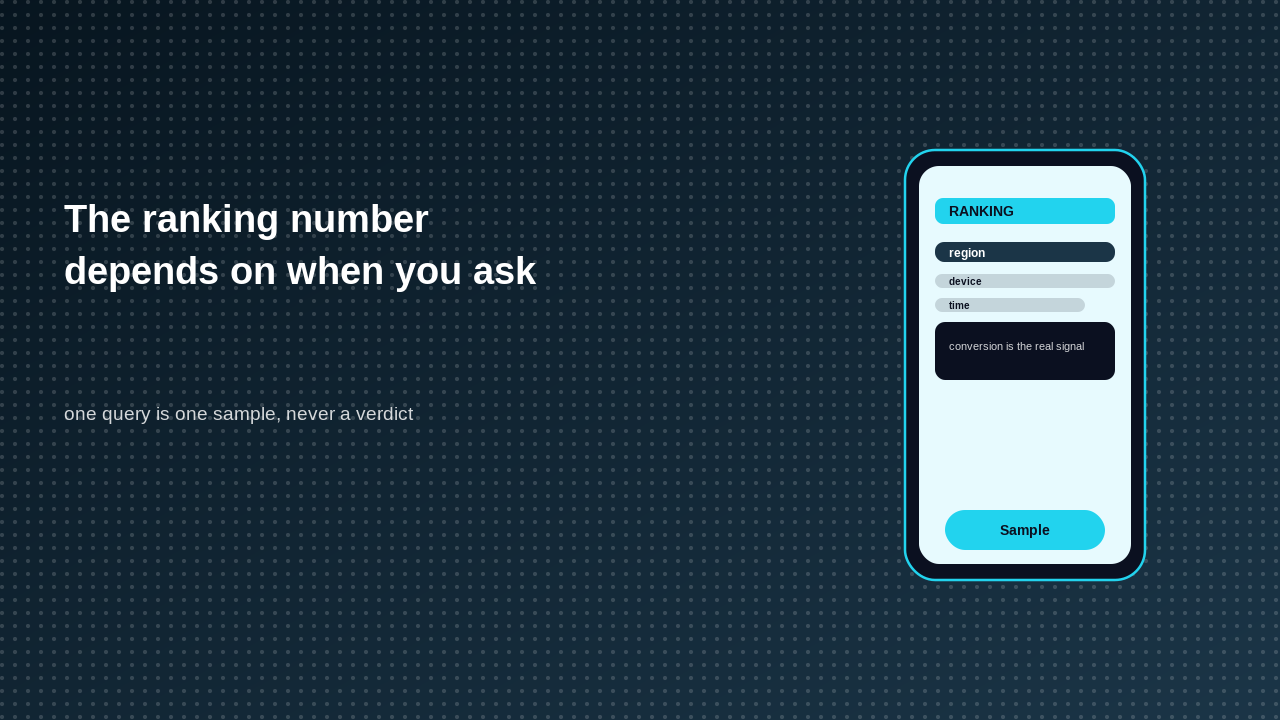
Three searches, one keyword, one app, one country, thirteen minutes: positions seven, ten and seven. That log comes from the author of a ranking tool, dated 2026-10-25, and it describes the App Store rather than any mini-program catalog. It is still the cleanest demonstration of the problem. A rank is a reading taken under a specific set of conditions. Treat it as a fixed property of a listing and the next reading will disagree.
The conditions travel with the number
The honest answer to what a position means starts with a list of labels. Which host app served the search. Which storefront or region the account sat in. Which device type and language setting were active. What hour the query ran. Whether the account was signed in. Which tool performed the query and how that tool simulates a search. Strip those labels away and the number stops being reproducible.
Google Search Central's in-depth guide, checked through the official Chinese mirror with no last-updated date on the page, places result delivery after crawling and indexing. It says relevance is decided by hundreds of factors and may include location, language and device, illustrating the point with bicycle repair shops returning different results in Paris and Hong Kong. The same guide describes clustering similar pages and offering a different version in a mobile context, and states that paid placement does not lift a page in its web results. That is web search. A host app running mini programs is a different surface with no published equivalent. What carries over is the discipline: write down the context before comparing two readings.
| Label to record | Why the reading shifts | What belongs in the log |
|---|---|---|
| Host app | Each host runs its own catalog and discovery logic | Host name and version |
| Storefront | Region and language change the result set | Region, language setting |
| Device type | Mobile and desktop contexts can differ | Device class, operating system |
| Clock time | The same query at two moments can disagree | Timestamp and time zone |
| Login state | Signed-in and anonymous sessions are not identical | Account state |
| Tool | Each vendor simulates searches differently | Tool name and sampling rule |
What Apple's page establishes
Apple's App Store search page, an official page with no update date shown, ties results to textual relevance across name, subtitle, keywords and primary category, alongside user behavior such as downloads, ratings and reviews. The keyword field totals at most one hundred characters, is comma-separated without spaces, and must not repeat words already present in the name, subtitle or category; promotional text does not affect search ranking. Custom product pages follow a one-combination-per-page rule, and localization is recommended for different regions. Every one of those statements describes the App Store, not a mini-program host. Teams still borrow the vocabulary, which is exactly why the boundary needs saying out loud.
That page also asks for impressions, conversion rates and download counts in App Store Connect, with source-type filtering to isolate downloads coming from App Store search. The measurement separates visibility from outcome. A position is an input to a discovery path; impressions and conversions are what the path produces.
Sampling is a defined process
AppTweak's help-center page, published 2025-07-02 and written from an ASO data vendor's standpoint, sets out its own delivery schedule: tracked keywords refreshed daily, newly tracked keywords fetched in real time, iOS Volume 5 terms weekly, All Ranked Keywords every seven days on continuously tracked apps, all times in UTC, and up to two days of delay in Apple's console data. Its advertising metrics come from simulated searches, a single daily run for General Search Ads Data and fifty daily searches per selected keyword for SOV History. Those are vendor-defined procedures attached to a product, not a cadence published by any store.
ASO Gauge's author, in a post published 2026-10-25 and updated 2026-11-19, recorded seven, ten and seven for one keyword and one app across three iPhone searches in one country between 20:39 and 20:52 Paris time, and notes that the same keyword gives different positions in different countries. The stated response is three searches a day with the median kept. The author's rule for metadata work is that a single search is one sample, and a change counts as visible only once the before and after ranges stop overlapping. Apple does not publish field weights. This is a tool author's small sample on the App Store, not a mini-program benchmark, and no host has published comparable figures here.
Position and outcome are different instruments
A position that moves while impressions and conversions stay flat may be sampling noise. A stable position with falling conversion points at the listing, the creative or the onboarding path rather than at the ranking model. Neither pattern tells much without several days of readings collected under the same labels. What deserves attention is whether the term brings more visits that turn into activity inside the host. A climb of a few places, on its own, is thin evidence.
For keyword work in a shared catalog, the commitment is modest and specific. Record the host, storefront, device type, clock time, login state and tool beside every reading. Sample across days and keep a median or a range. Read positions next to impressions and conversions instead of handing the rank the final word. Cross Mini App carries that record alongside each catalog entry, so a number can be read as a sample rather than a verdict.


