The fork every host app hits
A messaging, social, lifestyle, or fintech app reaches a point where embedding third-party services looks cheaper than building them. The natural next step is the super-app model: one identity, one wallet, many services, plus a mini-program layer so external developers can extend the platform. The question is not whether the model works — WeChat proved it with 4.3M+ mini-programs, 945M MAU, and 5M+ developers — but whether you should build the runtime yourself or embed one.
What "build it yourself" actually costs
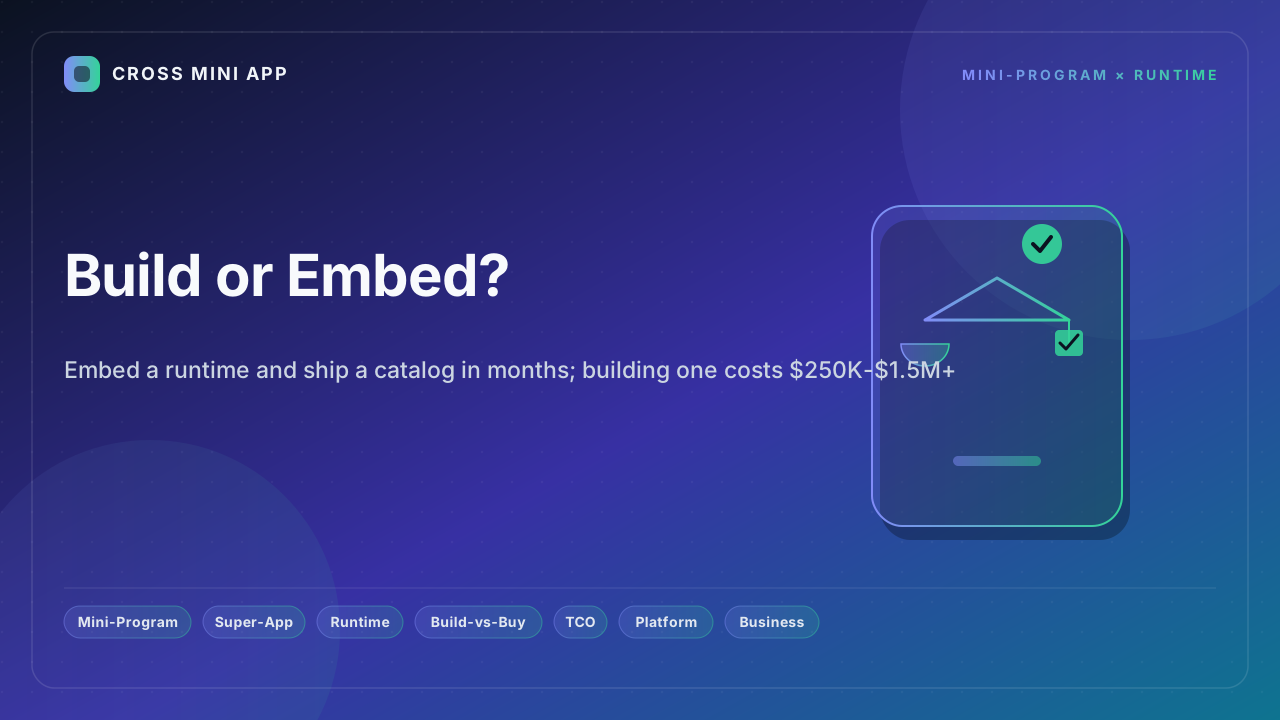
The numbers are not small. Industry build estimates put a white-label clone at $15K–$60K (2–3 months, validation only), a multi-service custom app at $60K–$300K (6–18 months), and a true super-app platform carrying a mini-program runtime at $250K–$1.5M+, with open ecosystems that include regulated financial services comfortably exceeding $1.5M. A Gojek-scale custom build starts at $150K–$300K+ and needs 8–12 months before you have a working product, plus $200K–$400K/year in salary overhead for a dedicated engineering team just to maintain it.
Broken into phases, a WeChat-like foundation alone — discovery, core messaging/identity, payments/wallet, social/content, the mini-program platform itself, then hardening and rollout — runs 9–12 months to a stable base and 18–30 months to a mature platform. The mini-program runtime phase is 12–18 weeks of dedicated work on top of everything before it, and it is the hardest part: secure sandboxing, developer SDKs and tooling, platform governance, backward compatibility, plus the compliance surface of payments (KYC/AML) and data residency.
Build vs embed, side by side
| Dimension | Build the runtime in-house | Embed a runtime (Cross Mini App) |
|---|---|---|
| Upfront cost | $250K–$1.5M+ | A fraction of that |
| Time to first catalog | 9–12 months (stable base) | Months |
| Team required | Elite multidisciplinary (architects, distributed systems, mobile, security, compliance) | Your product team |
| Hardest module | Sandboxing, SDK, governance, compliance | Integrate one SDK |
| Data sovereignty | Fully yours | Defined per contract |
| Ecosystem | Recruit developers from zero | Catalog of ported, proven mini-programs |
| Ongoing burden | $200K–$400K/yr + security/compliance | Maintained by the runtime provider |
Where the ROI actually is
The win from embedding is not just the lower bill — it is the avoided time and risk. Every month of building infrastructure is market share a competitor captures; the mini-program runtime is the single largest, riskiest, most compliance-heavy block in the whole stack, and it is exactly the block a host app should not be rebuilding. Embedding lets the host keep its focus on the one or two anchor services that earn the daily habit, ship a third-party catalog in months instead of years, and offload sandboxing, governance, and the payment/compliance surface to a runtime that already does them. The data-sovereignty trade is real and must be contracted explicitly, but for most host apps the math favors embedding.
When to build, when to embed
Build in-house if the runtime is your core product, you require total data sovereignty, and you already run a platform-engineering organization. Embed if your goal is to extend an existing audience with third-party services fast, you want a catalog without recruiting developers, and you would rather spend engineering on your anchor service than on sandboxing. The model is proven; the question is whether the runtime is a differentiator you must own or infrastructure you should consume.
Where Cross Mini App fits
Cross Mini App is the runtime and open catalog for host apps that choose to consume rather than rebuild. You embed one SDK, inherit a governed execution environment, a swappable payment module, and a catalog of mini-programs already adapted for overseas markets — and you ship a super-app surface in months, not years. The super-app outcome is the same; the cost and risk are not.
Sources
- TekRevol — Super App Development Cost (build tiers)
- Abbacus — Cost to Build an App Like WeChat (phases, team, timeline)
- Appscrip — Build a Super App Like Gojek (cost, timeline, overhead)
- Primocys — Build a Super App Like Grab or Gojek (mini-app ecosystem stage)
- Review42 — WeChat Statistics 2026 (ecosystem scale proof)