A proven product is already built
The Chinese mini-program ecosystem is the largest proof that the model works. WeChat alone hosted more than 4.3 million mini-programs serving about 945 million monthly active users and 764 million daily active users in 2025, with transaction volume that compounded from RMB 210 billion (2017) to roughly RMB 8 trillion (2024) — about 68% a year. Over 90% of WeChat's users open at least one mini-program. Building one costs roughly 10x less than a native app (RMB 20K–200K vs RMB 200K–2M), and user acquisition rides WeChat sharing and search instead of an app-store plus ad funnel. That is a validated playbook: a service that already works at scale in one market.
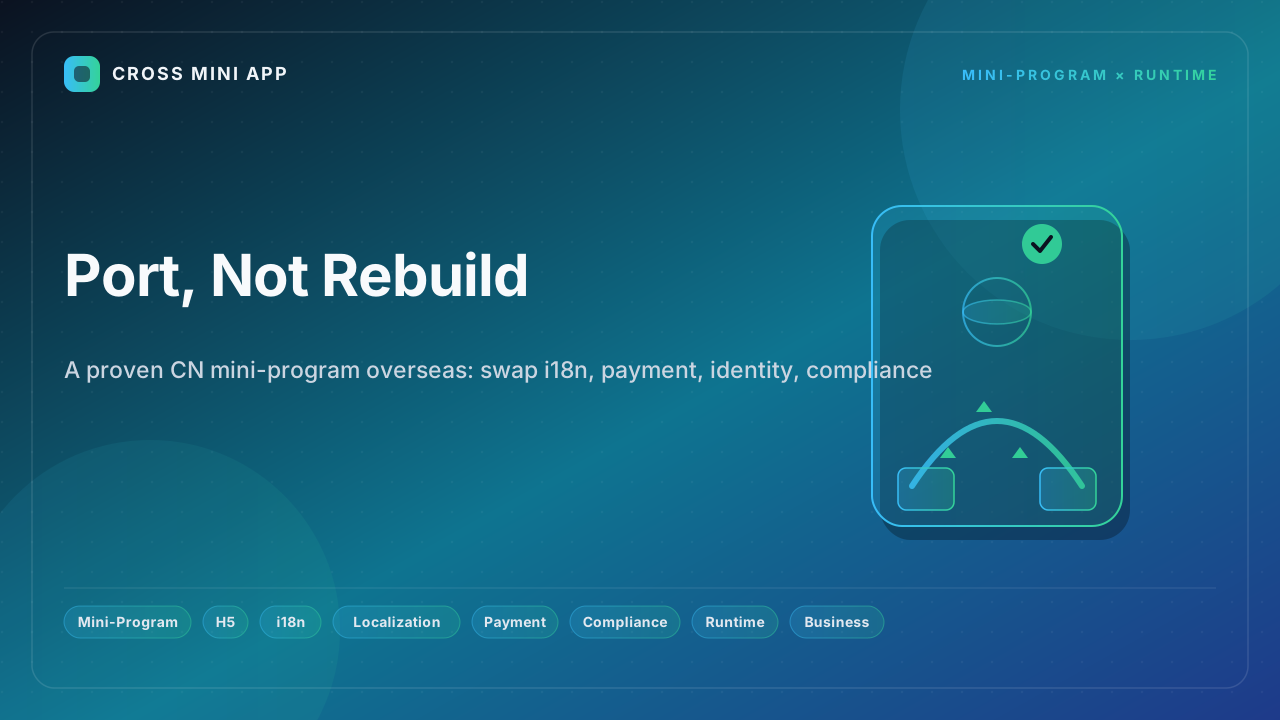
But "works in China" is not "works overseas." The domestic defaults — WeChat Pay, WeChat login, Mandarin UI, China-hosted data — are exactly the things that do not travel. Porting is not a recompile; it is a module-by-module rebuild of four things.
The four modules you must rebuild
| Module | Domestic default (CN) | What overseas requires |
|---|---|---|
| Language & UI | Mandarin, platform translation | 18-language i18n, RTL where needed, local-icon UI subtraction |
| Payment | WeChat Pay integrated | Local rail: Pix, Mercado Pago, GrabPay/GoPay, wallets |
| Identity | WeChat openid / unionid | Local phone, OAuth, or national eID — no WeChat |
| Compliance | PIPL / China hosting | GDPR, LGPD, PDPA (SG/MY/TH), data residency |
Each is a hard dependency for launch. Skip one and the app is either unusable or illegal in the target market.
Module 1 — i18n and localization
WeChat's own tooling shows the target shape. The platform provides a built-in translation capability covering 18 languages (simplified/traditional Chinese, English, Indonesian, Malay, Spanish, Korean, Japanese, Portuguese, Russian, Thai, Vietnamese, Arabic, Turkish, German, French, Italian, and more), and developers self-adapt through wx.getAppBaseInfo() (which returns a language field) and wx.onUserTriggerTranslation(). The recommended project structure is an i18n folder with a base.json baseline plus BCP 47-named files — en.json, es.json, pt.json, ar.json — noting that iOS requires zh-Hans.json/zh-Hant.json rather than a bare zh. WeChat's overseas-experience guide adds a blunt product rule: for non-Chinese language environments, strip the complex domestic marketing popups, social-fission entry points, and loyalty task mazes, and lean on universal icons and diagrams to lower the cross-cultural comprehension cost. Localization is a UI discipline, not just string translation.
Module 2 — payment rail replacement
WeChat Pay has no meaning outside China. The overseas replacement is a local instant-payment or wallet rail, and the difference is structural, not cosmetic. Brazil's Pix — designed and operated by the Banco Central do Brasil — processed 79.8 billion transactions worth R$35.3 trillion in 2025, used by 148 million individuals (about 86% of adults) and 12.8 million companies. Settlement is under 10 seconds, 24/7, free for individuals, with mandatory participation for institutions holding more than 500,000 accounts. For e-commerce, dynamic QR (Pix Cobrança) embeds amount and order data so each payment self-identifies its order — the reconciliation pattern a ported storefront must adopt. Elsewhere the rail is Mercado Pago across Latin America or GrabPay/GoPay in Southeast Asia. The ported mini-program must swap the payment module for the local rail and re-map the checkout, refund, and reconciliation flows.
Module 3 — identity, without WeChat
Overseas users do not have a WeChat openid. The identity module must move to a local anchor: phone-number verification, an OAuth provider, or a national eID where available. Session and account linking that assumed a WeChat login must be re-built on a provider that exists in the market. This is usually the smallest code change but the highest-risk assumption to catch early, because every downstream flow — auth, entitlement, anti-fraud — depends on it.
Module 4 — compliance and data residency
Cross-border data rules are the part teams underestimate. Brazil's LGPD mirrors GDPR structurally and permits transfers via ANPD adequacy, standard contractual clauses, or binding corporate rules; Singapore's PDPA (section 26) requires the overseas recipient to offer protection comparable to the PDPA and places accountability on the exporting entity; Malaysia's amended PDPA moved to an adequacy-model regime effective 1 April 2025; Thailand and Indonesia add their own layers; the EU's GDPR adds SCCs/IDTA and adequacy decisions. Several markets also impose data-residency or in-country processing expectations for financial or health data. A ported mini-program must map where personal data lives and crosses, and choose a runtime and hosting posture that satisfies each jurisdiction — not assume the China-hosted backend travels.
Launch checklist
-
i18nfolder withbase.json+ BCP 47 locale files; iOS useszh-Hans/zh-Hant - Detect
languageviawx.getAppBaseInfo(); load localized UI for non-CN environments - Strip domestic marketing/fission UI; increase icon/diagram ratio
- Swap WeChat Pay → local rail (Pix / Mercado Pago / GrabPay); re-map checkout + reconciliation
- Replace openid with local phone/OAuth/eID identity
- Map data flows against LGPD / PDPA / GDPR; pick residency posture
Where Cross Mini App fits
Cross Mini App is the runtime and open catalog built for exactly this port. You adapt a mini-program against a standard API surface — i18n, a swappable payment module, a local identity anchor — and it inherits a deployment path that already accounts for the four modules above in every host that embeds it. Porting a proven Chinese mini-program overseas stops being a from-scratch rebuild and becomes configuration against a runtime that was designed for it. The domestic playbook is proven; the cross-border part is what we standardize.
Sources
- WeChat — Internationalization-Friendly Adaptation Guide (official)
- WeChat — Multi-language Localization Handbook (i18n folder, BCP 47)
- Banco Central do Brasil — Pix instant payment system (official)
- Singapore PDPC — Personal Data Protection Act (cross-border, s.26)
- Review42 — WeChat Statistics 2026 (ecosystem scale)