A billion players with no card
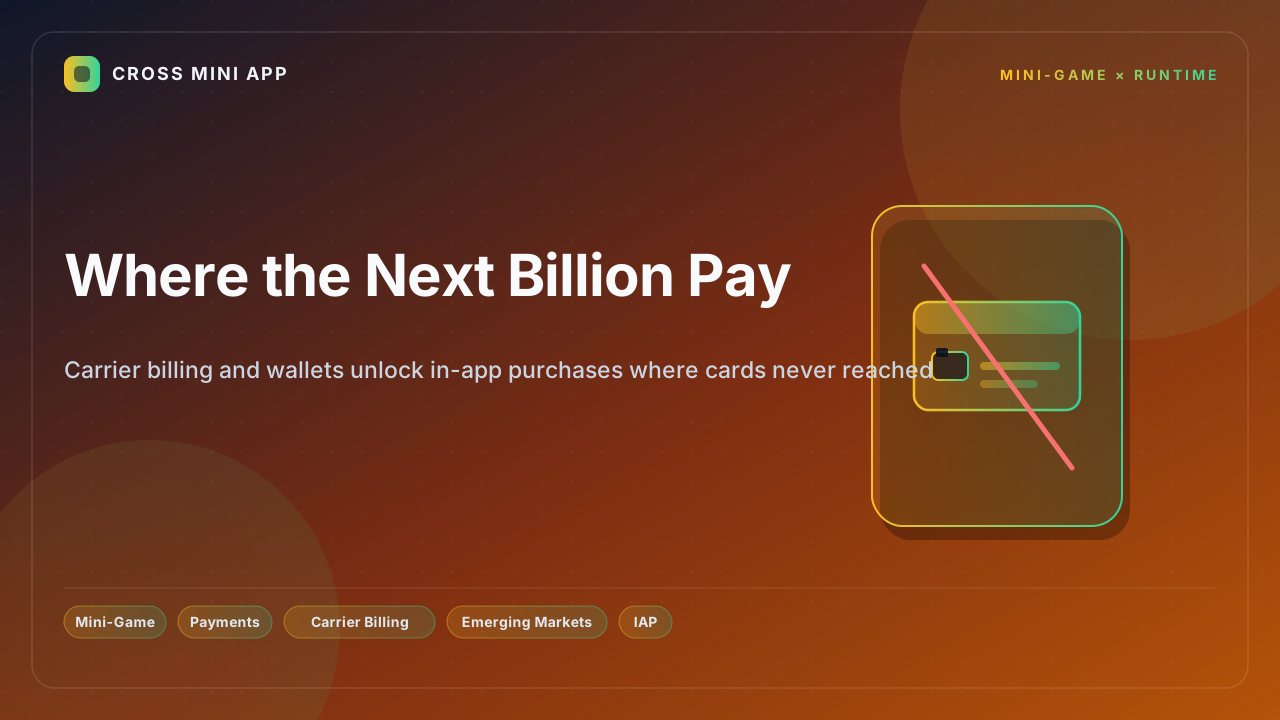
The biggest untapped paying audience in games is not in the rich world — it is in the emerging markets where smartphones are the only screen and bank cards are rare. The World Bank puts the global unbanked population at about 1.4 billion adults in 2025. For these players, the phone number is the financial identity and the prepaid balance is the wallet.
Direct carrier billing is already huge
Direct carrier billing (DCB) — charging a purchase to the mobile bill or prepaid balance — is the rail that reaches them. The market was about $47.3 billion in 2025 and is forecast at $53.4 billion for 2026, heading toward $97.8 billion by 2031. Gaming is the single largest use case: it drove about 41% of 2025 DCB revenue, and one-off in-game micro-transactions alone were roughly a 44% share.
| Rail / region | Figure | Why it matters |
|---|---|---|
| DCB market 2025 → 2026 | $47.3B → $53.4B | fastest growth in APAC, LATAM, Africa |
| Gaming share of DCB | ~41% of revenue | micro-transaction fit |
| Unbanked adults (World Bank) | 1.4B | phone = financial ID |
| Brazil prepaid subscribers | 60%+ | DCB is the default |
| Conversion lift vs card | +22% | lower-friction checkout |
The proof is in the payout
Major publishers already run DCB at scale: Tencent, NetEase, Supercell, and Scopely have carrier-billing integrations across 50+ countries, expanding toward 70+ by 2028, and the aggregator Boku connects 330+ mobile operators in 70 countries. In markets where card penetration sits below 40% — Brazil, Indonesia, Nigeria — DCB conversion runs about 22% higher than third-party payment, with first-pay conversion around 15.6% and ARPPU up roughly 37% on one documented operator channel.
Why a runtime is the unlock
The hard part of emerging-market monetization is not the game; it is the payment plumbing. A mini-game runtime that abstracts payments behind one interface — supporting carrier billing, wallets, and cards through regional aggregators — lets a title monetize in a market the day it launches there, instead of waiting for a per-country payment integration. One commerce layer, many rails.
The takeaway
The next billion paying players will not arrive with Visa. They will arrive with a phone number and a prepaid balance. A runtime that already speaks carrier billing and wallets turns the unbanked from a dead segment into a live revenue line — the same build that earns in San Francisco earns in São Paulo.
Cross Mini App's payment layer abstracts carrier billing, wallets, and cards behind one interface, so a mini-game monetizes where cards don't reach.