Pick the Wrong Engine, Pay Twice
Most teams pick a mini-game engine the way they pick a phone — by what they already know. That is how you end up rewriting the whole thing six months later because the runtime you chose does not run where your players actually are. The engine is not a detail. It decides which stores, which super-apps, and which browsers your game can ever reach.
Q: Which engine should I actually pick for a mini-game?
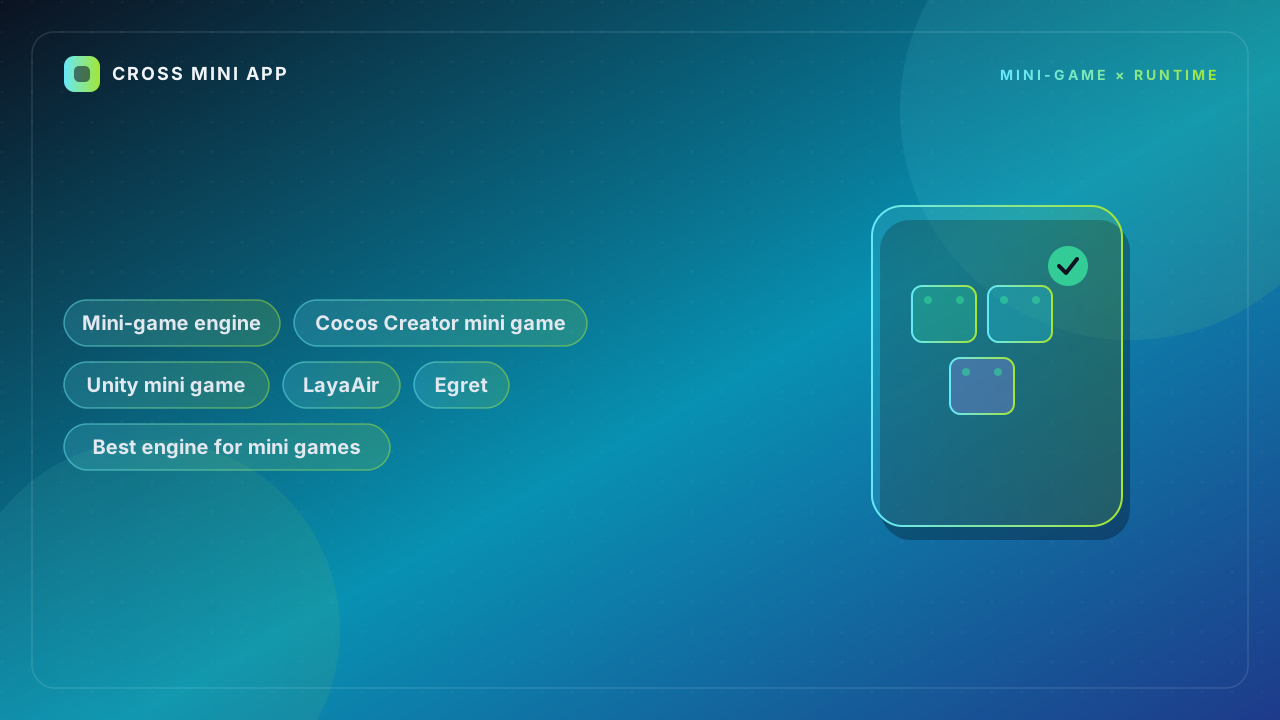
Start from where the game has to run, not from the engine's feature list. If your audience lives inside a super-app catalog or a web runtime, a lightweight H5 engine like Cocos Creator or LayaAir ships with far less friction than a Unity export, because there is no 100 MB binary to download — the game just loads. If you are building a heavier 3D or physics-driven title and you control the distribution, Unity still earns its weight. The trap is choosing Unity because it is familiar and then spending months fighting the package size and the runtime that a web-first audience will not tolerate.
Q: Is Unity worth it for mini-games, or is it overkill?
For a true instant-play mini-game, usually overkill. Unity's strength — a mature 3D pipeline and a huge asset store — costs you in bundle size and startup time, both of which matter when a player expects a game to open in under three seconds inside a host app. Cocos Creator and LayaAir were built for exactly this constraint and produce small, fast H5 builds. Reach for Unity when the game is genuinely 3D or when your team's entire pipeline already speaks Unity and the distribution is native, not instant-web.
Q: What's the H5 / runtime path and when does it beat a native build?
The H5 path wins the moment "download first" becomes a conversion killer. A web-runtime or super-app game opens immediately, survives OS updates without a re-review, and reaches users on low-end Android where a 150 MB install is a wall. The cost is performance headroom and access to some native APIs. If your loop is 2D, casual, and session-short — which describes most mini-games — H5 is not a compromise, it is the better distribution.
Q: How do I keep from being locked into one engine or platform?
Treat the engine as a renderer, not a home. Keep your game logic and economy logic in plain modules that do not depend on engine-specific APIs, so porting to a second runtime is a view-layer job, not a rewrite. The bigger lock-in is platform: a game that only lives in one store or one super-app can be re-rated or pulled without warning. A universal runtime that runs the same build across host apps and the web is the real insurance, and it is cheaper to design for on day one than to claw back later.
| Engine | Best for |
|---|---|
| Cocos Creator | 2D H5 mini-games, instant-play, small builds |
| LayaAir | H5 + lightweight 3D, China web runtime |
| Unity | Heavy 3D, native distribution, team fluency |
| Egret | Legacy H5 projects, enterprise web games |
| Web runtime | Cross-host, no download, survives OS updates |
The engine you pick is a debt you pay every day until you port. Pick for where players are, keep logic portable, and the second door is never locked.